
People powered fundraising: many hands, one month, no hero required
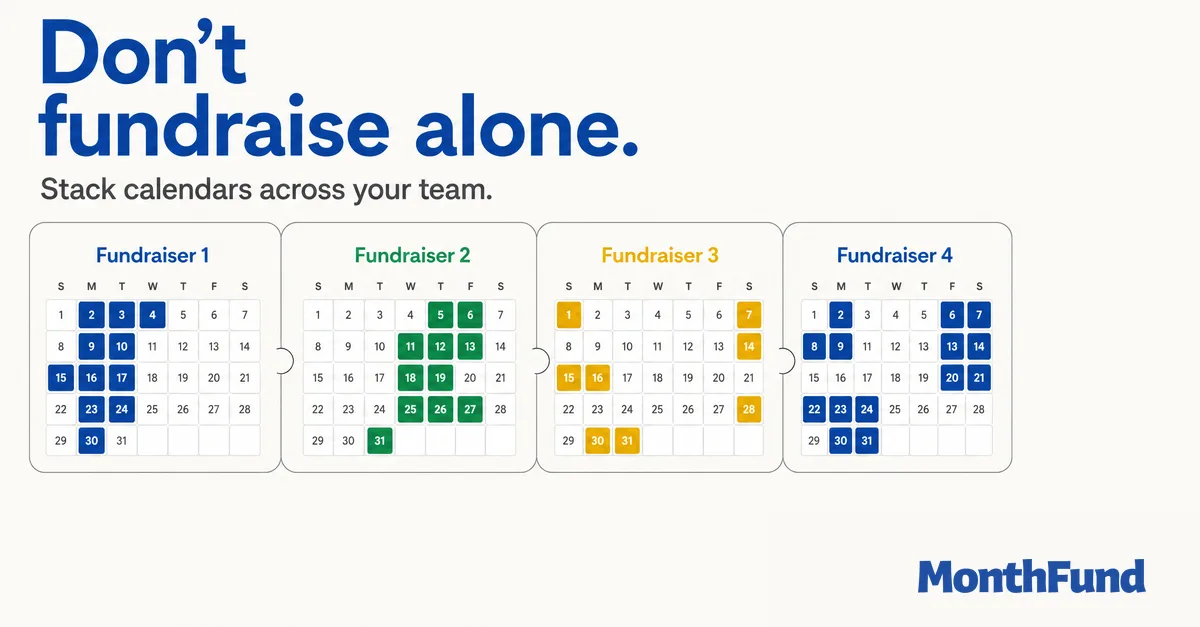
Giving is not complicated. People want to help the places they belong to: their school, their congregation, their block, their team. What is complicated is the machinery we put between them and the helping. People powered fundraising is the practice of removing that machinery, so many people can each carry a small, visible piece of the goal.
“People powered fundraising means many people each carry a small, visible piece of the goal, so no one person carries the whole month. The calendar is the simplest structure we know for it: 31 named days, visible owners, a public grid. Boards use it for annual giving. Giving circles use it to build a shared pot for local projects. Congregations, mutual aid networks, and neighbors use it to fund the work in front of them. It is not a one-off gimmick. It is core infrastructure for any group that raises money from its own people.”
When communities are trusted with the means to fund their own needs, they move faster than institutions do. The pandemic years proved this in public: neighbors built rent funds, PTAs stood up housing assistance, and volunteer-run efforts moved millions while formal processes were still scheduling meetings. Stanford Social Innovation Review documented one such moment in Minneapolis, where a website built for under a thousand dollars directed tens of millions through mutual aid networks. The lesson was not that crisis makes people generous. People were always generous. The lesson was that giving can be simple when someone removes the machinery.
Most groups do not need a crisis to learn this. They need a structure that works on an ordinary Tuesday.
What people powered means
People powered fundraising means many people each carry a small, visible piece of the goal, so no one person carries the whole month. That is the whole idea, and every word is doing work.
Many people, because a campaign carried by one treasurer is a campaign one busy month away from not happening. A small piece, because $12 and a shared link is an ask almost anyone can say yes to, and asking is the part that scales. Visible, because people follow through on commitments their community can see, and quietly drop the ones it cannot.
None of this is new. Barn raisings, susus, building funds, and passing the hat are all people powered fundraising. What is new is how much of modern fundraising abandoned it: one donate button, one overworked volunteer, one appeal shouted at everyone and owned by no one.
The structure that makes it work
Good intentions need a container. The container we build is the calendar month: 31 days, each with a dollar value, each claimable by name. A full grid is $496. The month has a beginning and an end. The grid shows what is done and what is not. The structure is the point: it converts a vague hope into 31 small, named, finishable commitments.
The calendar is not the only people powered structure, and we would not tell you otherwise. Pledge drives, giving circles, and walk-a-thons distribute ownership too. The calendar is simply the one with the least machinery: no event to stage, no products to move, no pledge sheets to chase.
Boards and member giving
Start with the group that already owes you a campaign: your own board. Most boards carry a give-or-get expectation that lives in an awkward annual email. A board month replaces it with a ritual. Once or twice a year, the board runs its own calendar. Each member claims days, or carries a full grid of their own, and everyone sees the same board fill the same month.
The change is not the money, although a ten-member board each filling a grid is real money. The change is that giving becomes something the board does together, on a schedule, with a finish line, instead of something each member privately defers. Membership organizations run the same play at larger scale: an annual member month, every member invited to carry a day, results read aloud at the annual meeting.
Giving circles and the shared pot
Giving circles are people powered fundraising in its purest form: a group pools money and decides together where it goes. What circles often lack is a collection rhythm. Contributions dribble in, someone nags, the pot is whatever it is by decision day.
A calendar month gives the circle a rhythm. Run one month per grant cycle. Members claim days, the grid fills in public, and the filled month becomes the pot. Then the circle does what circles do best: grants it to the food shelf, the youth program, the block improvement, the neighbor in a hard season. The same pattern serves a workplace giving club, a mosque's sadaqah group, a sorority alumnae chapter, or four families who decided their kids should watch them give locally and on purpose.
A shared pot with a visible floor
Neighbors funding local projects
Between formal nonprofits and individual crowdfunding sits most of real community life: the park cleanup crew, the little league, the refugee welcome committee, the mutual aid network. These groups are allergic to fundraising machinery, and they should be. Nobody joined the cleanup crew to run a gala.
This is where the month grid earns its keep. A neighborhood can fund a playground repair with one shared calendar and thirty-one small claims. A congregation can run stewardship season as many members each carrying days instead of one committee carrying everyone. A local arts organization can give its audience a way to become funders without a development office. The pattern is identical every time: name the goal, hand out the pieces, make the progress public.
Part of a serious toolkit
Here is the part we insist on, because thought leadership without honesty is just marketing. People powered fundraising is not a replacement for your gala, your grants, or your major donors, and a calendar month is not a magic trick. It is one strong layer in a serious toolkit, and it is the layer most groups are missing. Institutions bring scale and stability. Your people bring speed, reach, and the kind of ownership no institution can grant.
And it is not a one-off. That is the deepest difference between an event and a practice. A group that runs a member month every spring, a board month every fall, and a project month when something breaks has built standing infrastructure: a roster that knows the drill, templates that launch in minutes, and a base that can become monthly. The first month is a campaign. The third is a tradition. Traditions are what fund communities.
Next steps
Pick one group you already belong to, one goal it can picture, and one month on the calendar. Launch the grid free, invite people to carry a piece using the recruitment playbook, and let everyone watch the month fill. Giving can be simple. Your people have been waiting for someone to make it so.
How much can your community raise?
Use our interactive calculator to model your potential outcomes based on participant count and fill rate.
Ready to launch?
Set up your first fundraiser in under 10 minutes. No credit card required.
Common Questions
What is people powered fundraising?
People powered fundraising is fundraising carried by many members of a community rather than one organizer, one gala committee, or one grant writer. Each person takes a small, visible piece of the goal: a day on a calendar, a share of a pot, a name on a grid. The structure matters because it distributes both the work and the ownership, so campaigns do not depend on a single exhausted volunteer.
What is a giving circle and how does one work?
A giving circle is a group of people who pool contributions into a shared pot and decide together where it goes, usually to local organizations and projects. Circles range from a dozen neighbors to hundreds of members. A calendar fundraiser gives a circle a simple collection rhythm: run one month, each member claims days, and the filled grid becomes the pot the circle grants out.
How can a nonprofit board run its own giving campaign?
Many boards have a give-or-get expectation but no shared structure for it. A board calendar campaign fixes that: run one month once or twice a year, each board member claims days or carries their own grid, and participation is visible to the whole board. It turns an awkward individual obligation into a bounded, collective ritual with a clear finish line.
Is a calendar fundraiser a one-off event?
No. The month is bounded but the practice repeats. Groups run a spring and fall month, a board month and a community month, or the same month every year until it becomes a tradition. Because the format is a structure rather than an event, there is nothing to rebuild: next season starts from a template, the same roster, and last year's numbers.
What does a group need to start people powered fundraising?
Three things: a specific goal people can picture, a handful of members willing to each carry a piece, and a structure that makes the pieces visible. The structure can be as simple as a paper grid on a wall. Software adds the parts that are hard by hand: a page per person, live progress, automatic receipts, and a clean report at the end.
Keep Exploring
View all posts →Calendar fundraiser template: the grid, the pricing, and the messaging, ready to copy
Everything you need to build a calendar fundraiser today: the 31-day grid layout, three pricing ladders with their totals, the header copy, and the tracking sheet. Recreate it in any doc or spreadsheet in twenty minutes, or run the same structure digitally.
Digital vs. paper calendar fundraiser: why the grid moved online
A paper calendar fundraiser works until someone has to track who claimed Day 14. Here is what the printable template gets right, where it breaks, and what a digital grid adds: live progress, one page per participant, and totals that reconcile themselves.
Paper vs Digital Pick-a-Date: Messages That Fill Days
Templates get you a grid — digital ops fill it. Paper photos, Venmo chasing, and launch/mid/last-days messages. Definition + math on the pillar.