
How to build a recurring calendar fundraiser for monthly revenue
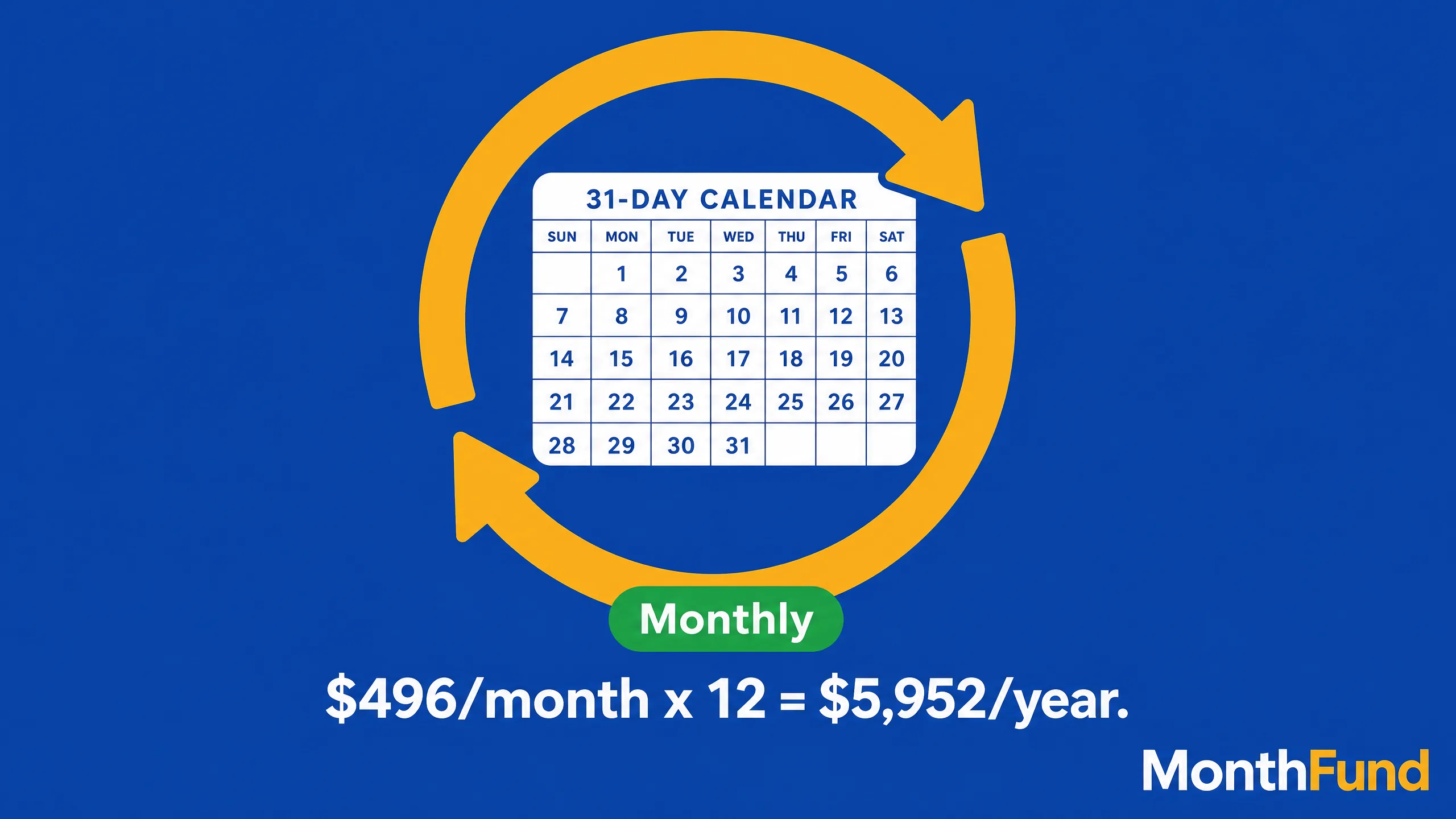
The standard calendar fundraiser is a one-time drive. But by shifting the ask from a one-time gift to a monthly commitment, organizations can build a Recurring Calendar Fundraiser, turning a $496 spike into $5,952 in annual recurring revenue.
“A Recurring Calendar Fundraiser changes the rules: donors claim a day and commit to giving that amount every month. A donor claiming the 15th gives $15 monthly. A fully claimed recurring calendar secures $496 in Monthly Recurring Revenue (MRR), yielding nearly $6,000 annually per calendar. This model provides long-term financial stability for nonprofits.”
Most organizations use the calendar fundraiser as a tactical strike: a 30-day sprint to fund a specific project, buy new uniforms, or cover a sudden shortfall. It works brilliantly for that. But for organizations focused on long-term sustainability, the model can be adapted to solve a much bigger problem: predictable operational revenue.
Organizers launch a month, fundraisers each share a calendar, donors claim days, and progress stays visible until the month fills.
From one-time spike to predictable revenue
A Recurring Calendar Fundraiser changes the core proposition. Instead of asking a donor to give $15 one time, you ask them to "own the 15th" by giving $15 every month.
Acquiring monthly donors is notoriously difficult because the ask feels abstract. The calendar makes it concrete. "We need 31 people to step up and own one day of the month" is a specific, bounded challenge that communities respond to.
The math of the recurring calendar
The impact of recurring revenue compounds rapidly. A single fully filled calendar produces $496 in Monthly Recurring Revenue (MRR). Over a year, that single calendar yields $5,952 in Annual Recurring Revenue (ARR).
If you apply Multi-Calendar Stacking and recruit just 5 board members to each fill a recurring calendar, your organization secures nearly $30,000 in predictable annual funding.
Positioning the ask
A recurring ask requires a different pitch than a one-time drive. You are not funding a trip; you are funding the mission. Target your core supporters—alumni, regular volunteers, and past donors.
The messaging should emphasize sustainability: "By owning a day on our calendar, you ensure our doors stay open all year long. Pick a day that fits your monthly budget—whether it is the 5th for $5, or the 30th for $30."
Managing churn
With any subscription model, some donors will eventually cancel or their credit cards will expire. This is called churn. To maintain your baseline, you must periodically run "fill the gaps" mini-campaigns to recruit new donors for the days that have opened back up.
Next steps
Building a recurring donor base is the holy grail of nonprofit finance. To get started, create your organization account and structure your first recurring campaign.
How much can your community raise?
Use our interactive calculator to model your potential outcomes based on participant count and fill rate.
Ready to launch?
Set up your first fundraiser in under 10 minutes. No credit card required.
Common Questions
How to get monthly donors for nonprofit?
Use a Recurring Calendar Fundraiser. Instead of asking for an abstract monthly commitment, ask donors to 'own a day' of the month. The donor claiming the 12th commits to $12 a month. The tangible structure makes the recurring ask feel manageable and specific.
Can a calendar fundraiser generate monthly recurring revenue?
Yes. By running a Recurring Calendar campaign, every claimed day becomes a monthly subscription. A single 31-day calendar generates $496 in Monthly Recurring Revenue (MRR), which equals $5,952 in Annual Recurring Revenue (ARR).
Is it harder to fill a recurring calendar?
Yes, a recurring ask has higher friction than a one-time ask. However, the long-term payoff is massive. Organizations often run one-time calendars for general audiences, and reserve the recurring calendar for their most dedicated core supporters.
How do you process recurring calendar donations?
You need a payment processor that supports subscriptions, like Stripe. When a donor claims their day, they authorize a monthly charge for that amount. MonthFund integrates with Stripe to handle the initial transaction.
What is the best use case for a recurring calendar?
It is ideal for operational costs. Mutual aid funds, faith communities, and nonprofit overhead funds benefit immensely from predictable monthly revenue rather than relying on unpredictable one-time spikes.
Keep Exploring
View all posts →The Pledge Multiplier: when donors give more than the day amount
The day amount is a floor, not a ceiling. When Day 15 suggests $15 and a donor gives $30, your calendar beats its own math. Here is how to invite bigger gifts without pressure, and what the uplift does to a $496 baseline.
Multi-Calendar Stacking: the fastest way to scale a calendar fundraiser
Instead of one central calendar, give every participant their own 31-day grid. Ten participants create a $4,960 baseline. Twenty-five create $12,400. Here is how to build and manage the stack.
How calendar fundraisers fit with galas, catalogs, and other fundraising (toolkit, not replacement)
MonthFund is one powerful layer in a larger toolkit. See how a calendar month complements product sales, ticketed events, and open donate pages, with patterns you can use around a 5K or gala.