
The Pledge Multiplier: when donors give more than the day amount
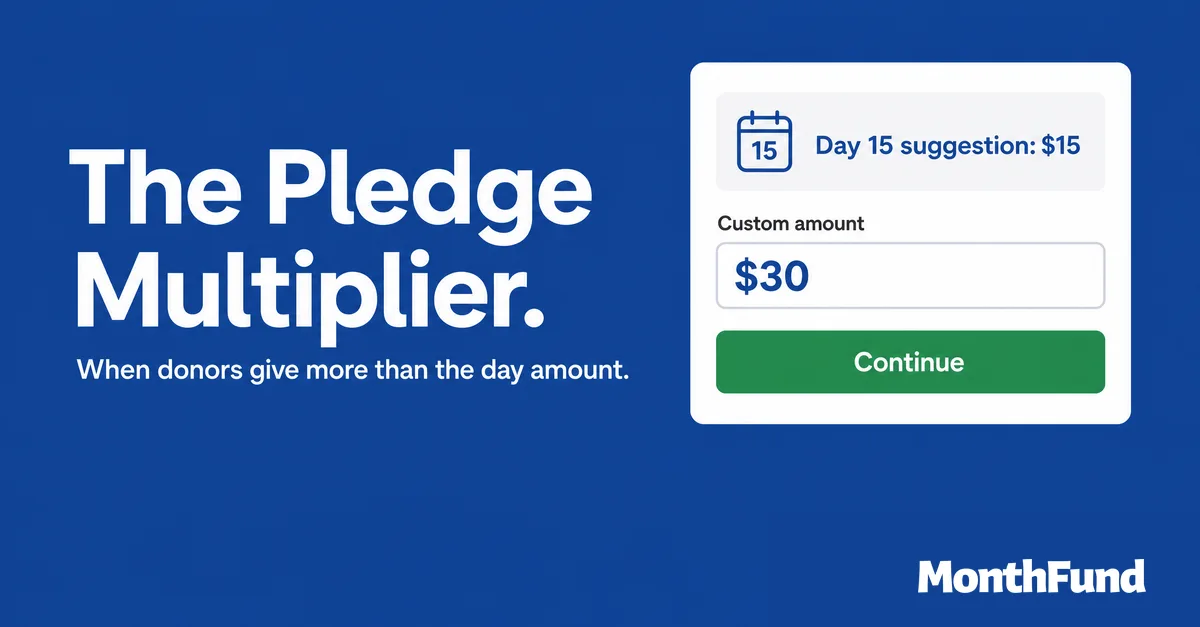
The elegant thing about a calendar fundraiser is that the calendar sets the price: claim the 15th, give $15. The underrated thing is that the price is a floor. Donors regularly claim a day and give more than its number, and campaigns that make room for that quietly beat their own math. We call it the Pledge Multiplier.
“The day amount is a suggestion, not a cap. Let donors claim Day 15 and give $30, and the calendar keeps its structure while the total climbs past $496. Invite the bigger gift with one line ("give the day amount, or more if you like"), put the high-value days in front of your most generous supporters, and pair the multiplier with a sponsor match to compound it.”
The $496 number is the model's handshake: 1 + 2 + 3 all the way to 31, a full month, a knowable total. It is the number you plan around, and planning around a floor is exactly right.
But treat it as a ceiling and you leave money on the table, because the day amount does something subtle: it anchors low and invites up. A donor who claims the 15th has been told $15 is a complete, honorable gift. From that comfortable anchor, giving $20 or $30 feels like generosity rather than obligation. Open-meter campaigns work the opposite way: with no anchor at all, donors guess, and unsure donors guess low or defer.
The day amount is a floor
Structurally, nothing changes when a donor gives above the number. The day shows as claimed, the grid keeps filling, the visible-progress engine keeps running. The only difference is the total, which now runs ahead of the grid. Donors like it because they choose the upgrade. Organizers like it because it requires no extra asks, no extra participants, and no change to the campaign.
How the multiplier works
Three donor behaviors create the uplift, and you will see all three in a normal month:
- Rounding up. The Day 7 claimer gives $10, the Day 22 claimer gives $25. Small, frequent, and nearly universal when the option is visible.
- Doubling. A donor claims a meaningful date, a birthday, an anniversary, and gives twice its value. Sentimental days are premium inventory; treat them that way.
- The flat generous gift. Someone claims the 3rd because it is open and gives $50 because they were always going to give $50. The calendar gave them a door, not a limit.
The math above the baseline
Model it as an average uplift on the day amounts. The arithmetic is simple: a filled calendar at exactly the day amounts is $496, and every dollar above a day amount is pure addition.
| Scenario | Fill rate | Average gift vs. day amount | One-calendar total |
|---|---|---|---|
| Floor | 100% | Exactly the day amount | $496 |
| Modest round-up | 100% | About 15% above | About $570 |
| Generous month | 100% | About 30% above | About $645 |
| Partial fill, round-up | 80% | About 15% above | About $455 |
The fourth row is the quiet lesson: a healthy multiplier can carry a normal partial fill most of the way back to the full-calendar floor. Fill rate and average gift are two levers, and you can pull both.
How to invite bigger gifts without pressure
The invitation is one sentence, everywhere the ask appears: "Claim a day and give that amount, or more if you like." Put it in the campaign description, the launch text, and the mid-month posts. Two quiet amplifiers help. First, point sentimental dates at the right people: a birthday text that names the person's own day converts at double-gift rates. Second, thank above-amount gifts publicly without shaming exact-amount gifts; "Sarah claimed the 9th and rounded up!" teaches the behavior to everyone watching.
Never guilt the floor
Where it compounds
The multiplier stacks with every scaling strategy because it raises the per-calendar yield that those strategies multiply. Stack ten calendars and a 15 percent uplift is worth hundreds more. Add a 1:1 sponsor match and every rounded-up dollar doubles. For the full map of levers, see scaling beyond $496.
Next steps
Set your goal with the 31-day method, write the one-line invitation into your campaign copy, and launch on MonthFund, where custom amounts above the day value work out of the box.
How much can your community raise?
Use our interactive calculator to model your potential outcomes based on participant count and fill rate.
Ready to launch?
Set up your first fundraiser in under 10 minutes. No credit card required.
Common Questions
Can donors give more than the day amount in a calendar fundraiser?
Yes. The day amount is the suggested minimum that makes the model legible: claim the 15th, give at least $15. Platforms like MonthFund let the donor enter a larger custom amount at checkout. The day still shows as claimed on the grid, and the extra simply raises the campaign total above the $496 baseline.
What is the Pledge Multiplier?
The gap between what a full calendar suggests ($496) and what it actually collects when donors round up. If the average donor gives modestly above their day amount, a single calendar lands meaningfully above $496 with zero extra recruiting. It is the cheapest upside in the model because it costs one sentence of invitation.
How do you ask donors to give more without being pushy?
Anchor on the day amount and open the ceiling in the same sentence: 'Claim a day and give that amount, or more if you are feeling generous.' The structure keeps the ask comfortable because the minimum is always honorable. Never guilt a donor about giving exactly the day amount; the floor is the deal.
How much does a calendar fundraiser actually raise?
The arithmetic floor for one full 31-day grid is $496. Real campaigns land above or below that depending on fill rate and donor generosity. A 100 percent filled calendar where donors round up beats $496; an 80 percent filled one may still reach it. Model both levers, fill and average gift, when you set the goal.
Keep Exploring
View all posts →How to build a recurring calendar fundraiser for monthly revenue
Turn a one-time $496 drive into $5,952 in annual recurring revenue. A Recurring Calendar Fundraiser converts donors from one-time givers into monthly subscribers by having them own a day of the month.
Multi-Calendar Stacking: the fastest way to scale a calendar fundraiser
Instead of one central calendar, give every participant their own 31-day grid. Ten participants create a $4,960 baseline. Twenty-five create $12,400. Here is how to build and manage the stack.
How calendar fundraisers fit with galas, catalogs, and other fundraising (toolkit, not replacement)
MonthFund is one powerful layer in a larger toolkit. See how a calendar month complements product sales, ticketed events, and open donate pages, with patterns you can use around a 5K or gala.