
How Much Can a Calendar Fundraiser Raise? $496 Math
A fully claimed 31-day calendar totals $496 at face value. The formula is the triangular number: face value = n(n+1)/2. So n = 31 → $496, n = 30 → $465, n = 29 → $435, n = 28 → $406. Those numbers are planning baselines, not promised results. (If you have seen $466 listed for a 30-day month elsewhere, the correct sum of 1 through 30 is $465.)
“Organizations scale by stacking many personal calendars (one per community fundraiser), not by putting everyone on one editable grid. Multiply face value by fundraiser count and a realistic fill rate, then optionally layer a verified sponsor match. Gifts above day amounts are upside — leave them out of the base forecast. Model your stack on the Calculator before you set a public goal.”
Model it first
When organizations first look at the calendar fundraiser, they usually ask one question: how much does it make? A 31-day calendar totals $496 only when every day is claimed and funded at its face value. A 30-day calendar totals $465 under the same assumption.
Use $496 as a planning unit, not a promised outcome. Organizations can model more calendars or a verified sponsor match without changing the core calendar mechanics, then compare the actual result with the assumptions after the campaign.
Organizers launch a month, fundraisers each share a calendar, donors claim days, and progress stays visible until the month fills.
The $496 face-value unit is the building block
A single 31-day calendar totals exactly $496 when every day is claimed and funded at face value. To model a larger goal, multiply that face-value unit by the planned number of fundraiser calendars, then apply a conservative fill-rate assumption. Keep that forecast separate from the actual campaign result.
How MonthFund stacking differs from a single shared calendar tool
Some calendar tools center one shared month grid (or treat "participant" as one claimed day). MonthFund's organization model is different: each community fundraiser shares a full personal calendar, and those calendars combine into one campaign total. Scaling is stacking people who each own a month — not fighting over the same 31 cells. That is why the planning math is face value × number of fundraiser calendars × fill rate. For a fair side-by-side with specialist calendar products, see Compare and Best platforms 2026.
Multiplier 1: Multi-Calendar Stacking
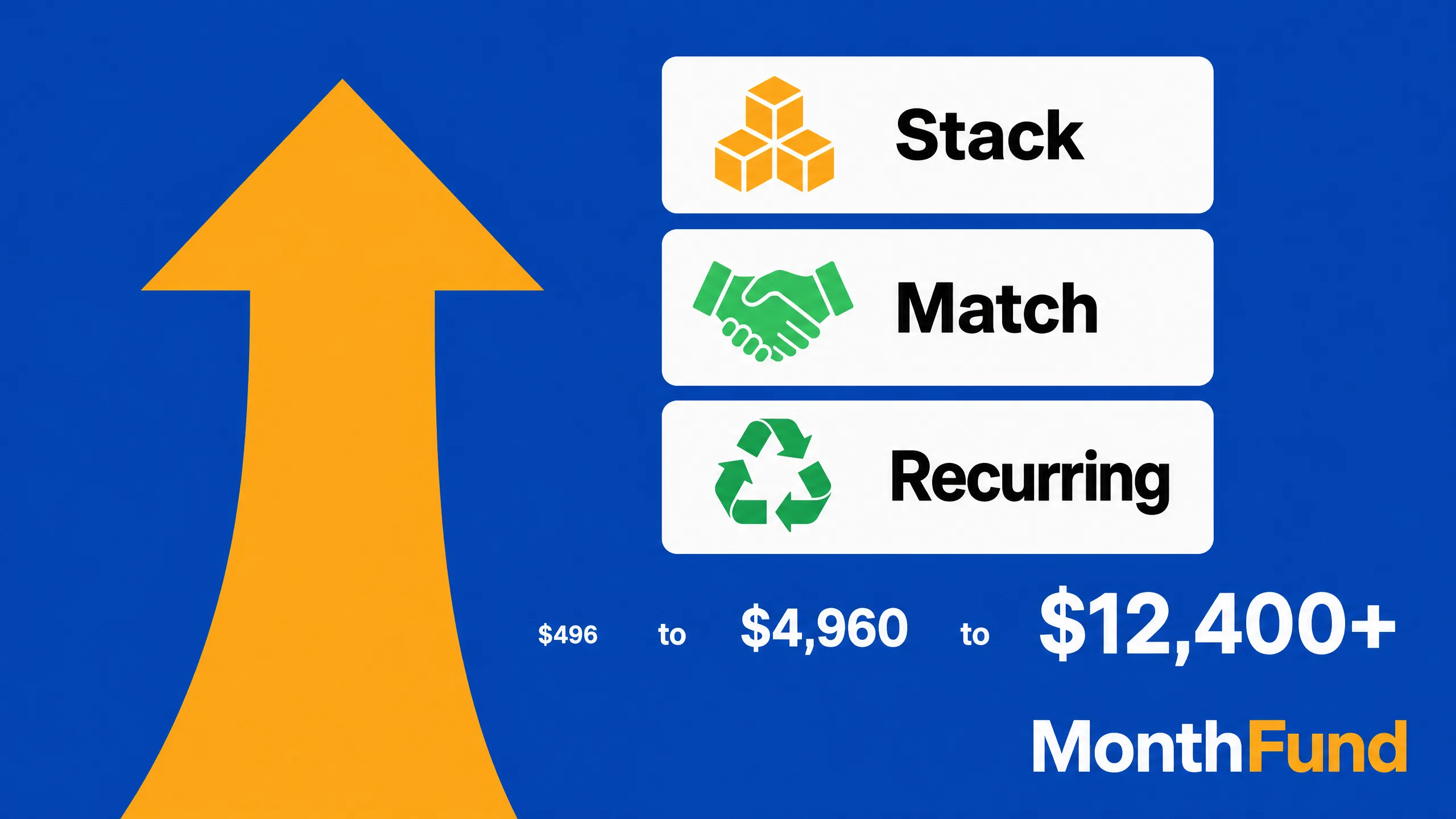
The most reliable scale lever is recruiting more community fundraisers so each shares their own personal calendar at the same time. Ten fully claimed 31-day calendars are a $4,960 face-value scenario; twenty-five are $12,400 — before fill rate, fees, refunds, or extras. MonthFund rolls personal calendars into the org total. Participation and fill rate still decide the real result.
Read the deep dive on Multi-Calendar Stacking.
Multiplier 2: Sponsor Matches
A confirmed 1:1 sponsor match can double eligible gifts without requiring more participant calendars. If the written match terms cover Day 10, a $10 donor gift can trigger another $10 from the sponsor. A fully funded $496 calendar plus a fully honored 1:1 match would total $992 before applicable fees or refunds.
Matches can be structured as flat 1:1 matches, or as Challenge Matches that only unlock if the calendar reaches 100% completion, which drives intense urgency. Learn how to secure a sponsor match.
Multiplier 3: Donor Generosity
The day value is a suggested amount, not a cap. A donor claiming the 15th can choose to give $30, $50, or $100. Treat those optional extra gifts as upside rather than building them into the forecast unless MonthFund has measured evidence for the relevant audience.
The Tiered Mega-Calendar for large orgs
For school districts, national nonprofits, or multi-chapter organizations, scaling requires a hierarchy. The Tiered Mega-Calendar structure assigns a master goal to the organization, but breaks the execution down to the chapter or classroom level. Each sub-group runs its own stack of calendars. Explore the Tiered Mega-Calendar structure.
Building a Recurring Calendar
Most calendar fundraisers are one-time drives, but recurring gifts can be modeled separately. If every face-value day were funded monthly for twelve completed billing cycles, the annual gross scenario would be $5,952 before fees, failed payments, pauses, cancellations, or refunds. See the Recurring Calendar guide.
Next steps for scaling
Scaling does not mean working harder; it means structuring the campaign so that the math works in your favor. If you are ready to scale, start a free campaign and invite your first cohort of fundraisers.
How much can your community raise?
Use our interactive calculator to model your potential outcomes based on participant count and fill rate.
Ready to launch?
Set up your first fundraiser in under 10 minutes. No credit card required.
Common Questions
How much can a calendar fundraiser raise?
A fully claimed 31-day calendar has a face value of $496; a 30-day calendar has a face value of $465. Twenty-five fully claimed 31-day calendars total $12,400 at face value before fill rate, fees, or refunds. Actual campaign results depend on which days are funded, extras, participation, and any verified sponsor match — always model on the Calculator.
How do you scale a calendar fundraiser?
Scale by recruiting more community fundraisers (each adds a full personal calendar — Multi-Calendar Stacking), adding a verified sponsor match with written terms, and treating gifts above day face amounts as optional upside. Use face value × fundraiser count × fill rate as a modeled estimate.
What is Multi-Calendar Stacking?
Multi-Calendar Stacking is when an organization recruits multiple fundraisers, each sharing their own personal month calendar. Ten personal calendars at full claim are a $4,960 face-value scenario; thirty classrooms at $465 (30-day) are $13,950 face value. It distributes effort while rolling results into one campaign total.
Can you do a sponsor match with a calendar fundraiser?
Yes. A corporate sponsor can agree to match gifts 1:1 with written terms. A $496 calendar plus a fully honored 1:1 match would model to $992 before fees or refunds. Matches should have verified terms, not soft commitments.
Does MonthFund support scaled campaigns?
Yes. Professional and Network plans support unlimited simultaneous active campaigns, making it easy to run Multi-Calendar Stacks across chapters, teams, or classrooms. Each fundraiser owns a personal calendar; totals roll up to the organizer dashboard.
Keep Exploring
View all posts →The Pledge Multiplier: when donors give more than the day amount
The day amount is a floor, not a ceiling. When Day 15 suggests $15 and a donor gives $30, your calendar beats its own math. Here is how to invite bigger gifts without pressure, and what the uplift does to a $496 baseline.
How to build a recurring calendar fundraiser for monthly revenue
Turn a one-time $496 drive into $5,952 in annual recurring revenue. A Recurring Calendar Fundraiser converts donors from one-time givers into monthly subscribers by having them own a day of the month.
Multi-Calendar Stacking: the fastest way to scale a calendar fundraiser
Instead of one central calendar, give every participant their own 31-day grid. Ten participants create a $4,960 baseline. Twenty-five create $12,400. Here is how to build and manage the stack.