
Multi-Calendar Stacking: the fastest way to scale a calendar fundraiser
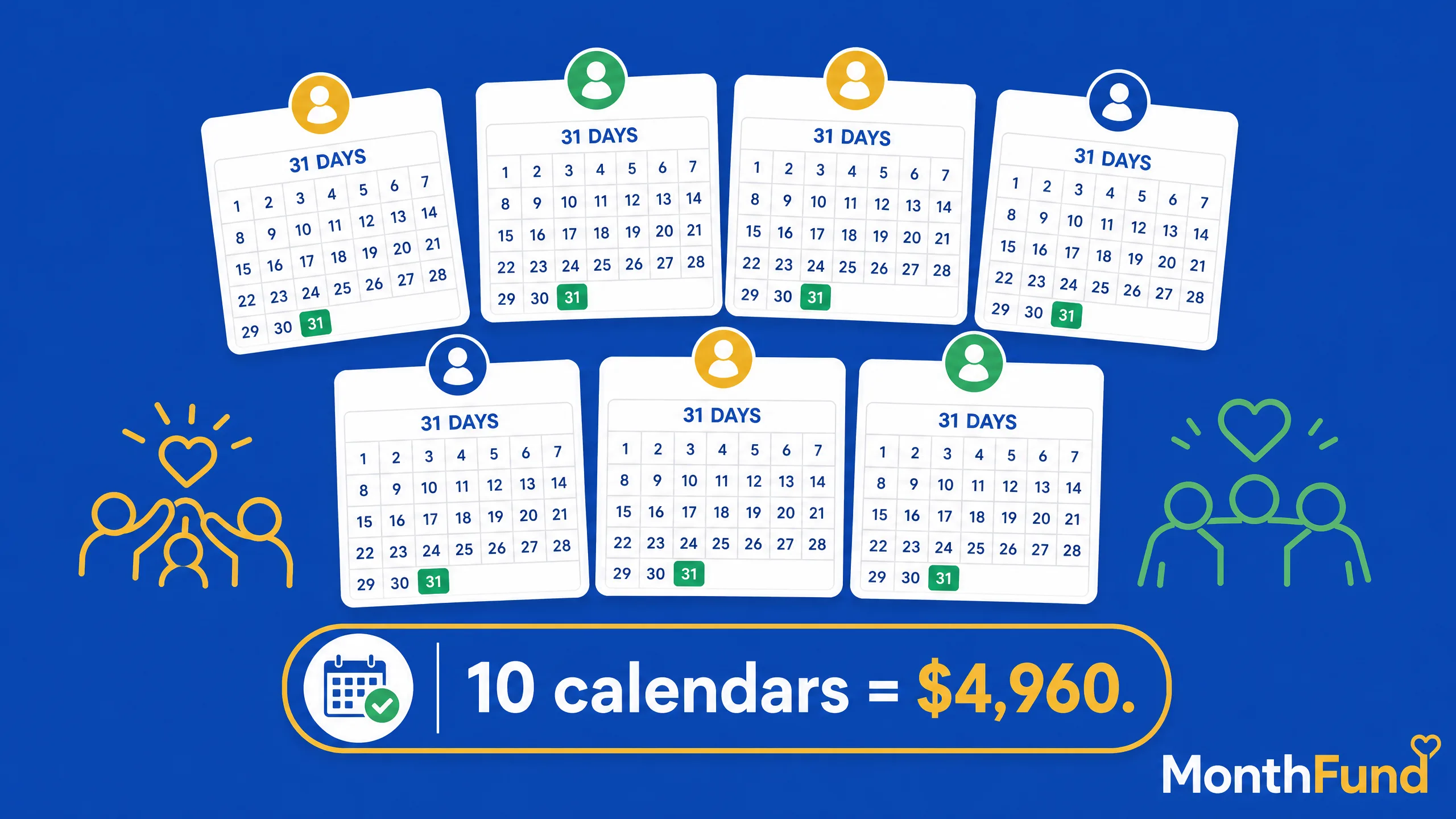
Multi-Calendar Stacking distributes a campaign across several participant calendars. In the face-value planning model, each fully claimed 31-day calendar adds $496; actual results still depend on participation, fill rate, gift amounts, fees, and refunds.
“Instead of one central calendar, Multi-Calendar Stacking gives each participant a 31-day grid. Ten fully funded face-value calendars model to $4,960; twenty-five model to $12,400. This distributes the outreach across personal networks while centralizing tracking and reporting.”
The single biggest mistake organizations make with a calendar fundraiser is trying to fill one giant calendar themselves. The model is not designed for solo execution; it is designed for scale. The mechanism for that scale is Multi-Calendar Stacking.
Organizers launch a month, fundraisers each share a calendar, donors claim days, and progress stays visible until the month fills.
What is Multi-Calendar Stacking?
Multi-Calendar Stacking is the practice of running multiple simultaneous calendar fundraisers under one unified campaign goal. Instead of the PTA president trying to find 31 donors, the PTA recruits 25 parents. Each parent gets their own 31-day calendar to share with their personal network.
This shifts the organizer's role from "fundraiser" to "campaign manager." You are no longer asking for donations; you are recruiting mobilizers.
The math behind the stack
The face-value planning math is linear. Every fully claimed and funded 31-day calendar adds $496 to the scenario.
| Active Calendars | Baseline Total ($496/ea) |
|---|---|
| 1 | $496 |
| 5 | $2,480 |
| 10 | $4,960 |
| 25 | $12,400 |
| 50 | $24,800 |
These totals assume every day is claimed and funded at face value. They are planning scenarios, not promised results. Optional gifts above the day amount increase the total only when donors choose them. See the Hub guide on scaling for more scenarios.
Why distributed networks work
Stacking can reduce repeated outreach to the same donor pool when participants share with distinct networks such as relatives, friends, and coworkers. In a fully funded face-value scenario, twenty-five calendars total $12,400 and each individual day amount ranges from $1 to $31. Actual overlap and participation vary by campaign.
How to manage a stacked campaign
Managing 25 paper calendars is an administrative nightmare. Purpose-built platforms solve this. With MonthFund, you create the campaign and invite participants via email or link. The platform automatically generates a unique, tracked calendar for each person. As donations come in, the individual calendars update instantly, and the central organizer dashboard reflects the combined total.
Next steps
Ready to stack? Create your campaign and invite your first 10 participants. If you are part of a massive organization, read about the Tiered Mega-Calendar approach.
How much can your community raise?
Use our interactive calculator to model your potential outcomes based on participant count and fill rate.
Ready to launch?
Set up your first fundraiser in under 10 minutes. No credit card required.
Common Questions
Can you run multiple calendar fundraisers at once?
Yes. Running multiple simultaneous calendars is called Multi-Calendar Stacking. Instead of one organization-wide calendar, each participant or team gets their own calendar to fill. This multiplies the total raised by the number of active participants.
How much does Multi-Calendar Stacking raise?
Multiply $496 by the number of fully funded 31-day calendars for the face-value scenario: five total $2,480, ten total $4,960, and twenty-five total $12,400. Actual results vary with participation, fill rate, gift amounts, fees, and refunds.
How do you track multiple calendar fundraisers?
Using a platform like MonthFund, the organizer creates one central campaign and invites participants. Each participant gets a unique, tracked calendar link. The organizer dashboard rolls up all individual progress into one unified total in real time.
Is it hard to find enough donors for multiple calendars?
It depends on participant activation and network overlap. Giving each participant a calendar can distribute outreach across family, friends, and coworkers, but organizers should still plan recruitment, sharing cadence, and follow-up rather than assume every calendar will fill.
What is the best way to recruit participants for stacking?
Start with your core advocates: board members, team captains, or highly engaged parents. A small group of 10 committed participants who actually fill their calendars will outperform 50 passive participants who never share their links.
Keep Exploring
View all posts →The Pledge Multiplier: when donors give more than the day amount
The day amount is a floor, not a ceiling. When Day 15 suggests $15 and a donor gives $30, your calendar beats its own math. Here is how to invite bigger gifts without pressure, and what the uplift does to a $496 baseline.
How to build a recurring calendar fundraiser for monthly revenue
Turn a one-time $496 drive into $5,952 in annual recurring revenue. A Recurring Calendar Fundraiser converts donors from one-time givers into monthly subscribers by having them own a day of the month.
How calendar fundraisers fit with galas, catalogs, and other fundraising (toolkit, not replacement)
MonthFund is one powerful layer in a larger toolkit. See how a calendar month complements product sales, ticketed events, and open donate pages, with patterns you can use around a 5K or gala.