
How to hit your fundraising goal in 31 days: the calendar fundraiser math behind a predictable month
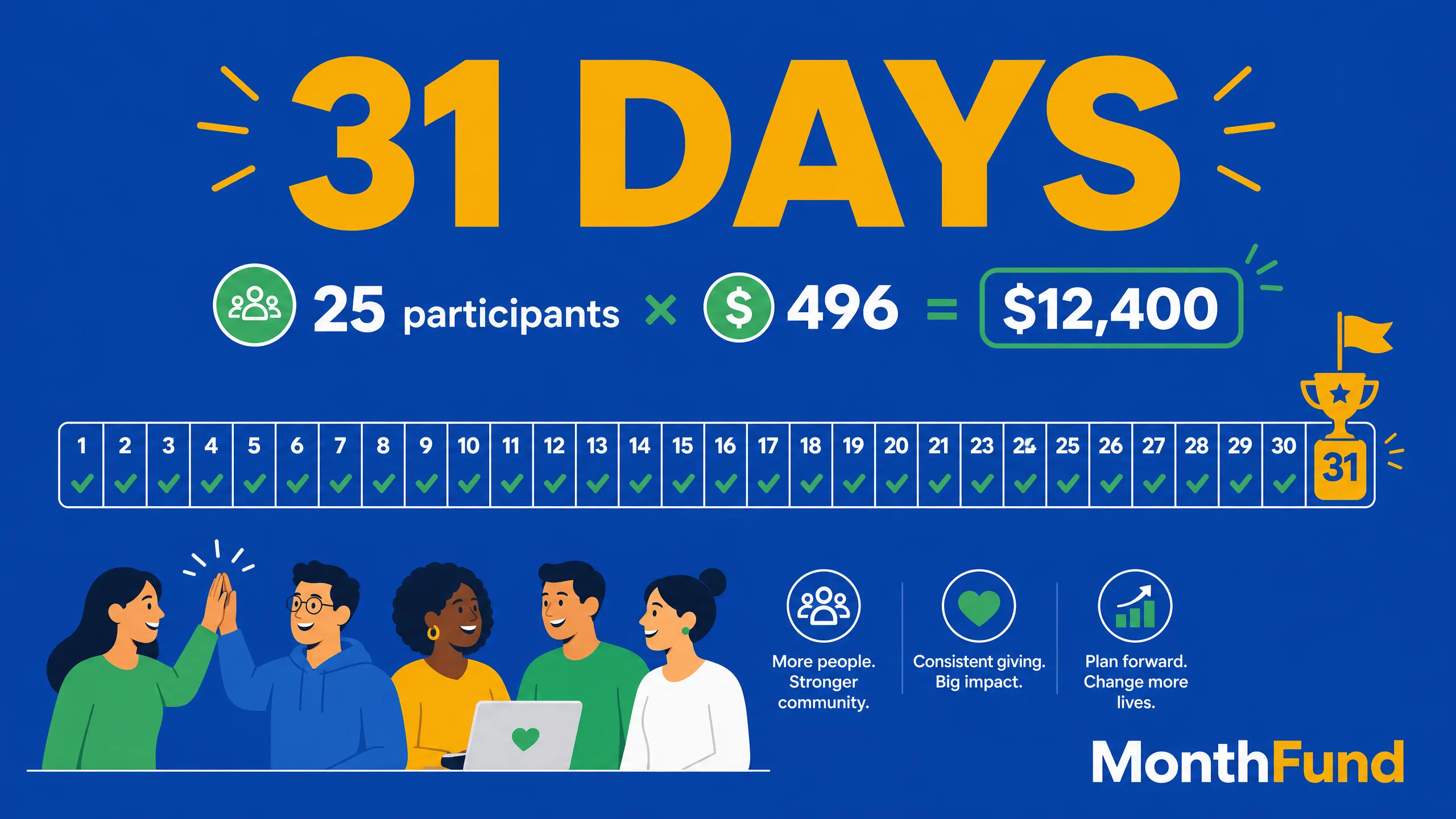
Setting a fundraising goal is easy. Hitting one in 31 days takes a model you can plan against. Here is the calendar fundraiser math, the recruit motion, and the launch cadence that turn a wish into a worked plan.
“A calendar fundraiser sums to $496 per fully filled month. Pick your goal, divide by $496 × your expected fill rate, and you have a participant count. Recruit that number on purpose, run a four-week launch cadence, and the month becomes predictable instead of hopeful.”
Most organizations set a fundraising goal the way they set a New Year's resolution: pick a number that feels ambitious, announce it, and hope the community shows up. By day 20 the thermometer is at 42% and the leadership team is rewriting reminder emails. Nobody planned for the campaign to stall. There was just no model to plan against.
A calendar fundraiser, sometimes called a pick a date fundraiser, closes that gap. Every day of the month carries a dollar amount equal to its number. Every day has an owner. The total is knowable in advance. That means a 31-day goal is no longer a wish, it is an equation you can solve before the month opens.
Walk this math with us live every Friday.
We will set a goal, back into a fundraiser count, and work the 31-day cadence in real time. Bring your numbers. Every registrant gets The 31-Day Fundraiser Recruitment & Launch Playbook.
Why most 31-day goals miss
The pattern is consistent across schools, faith communities, mutual aid groups, and grassroots campaigns. The goal gets set first, the work to support it gets sketched second, and the gap between the two only shows up around day 14 when the chart stops moving. By then the recruit window is closed and the only lever left is more email.
The structural fix is to set the goal and the model together. Organizers launch a month, fundraisers each share a calendar, donors claim days, and progress stays visible until the month fills. If you can name a goal in dollars, you can name the inputs that produce it. If you can name the inputs, you can decide before launch whether the plan is realistic, which is the only honest way to commit to a 31-day number.
A campaign that misses goal usually did not miss in the final week. It missed in the four weeks before launch, when nobody decided how many fundraisers the math required.
The $496 model in one paragraph
Days 1 through 31 sum to $496. That is the face value of one fully filled calendar. In a pick a date fundraiser, one participant who claims a day and fills it across their network contributes a slice; one participant whose calendar fills end-to-end accounts for $496 at face value. The total your campaign raises is, almost exactly:
Goal ≈ Participants × $496 × Fill rate
The $496 number is the only constant in that line. Participant count and fill rate are the two knobs you turn. That is the entire model, and it is what makes a 31-day calendar fundraiser plannable in a way most formats are not.
Back into your participant count
Pick the goal first. Then divide by $496 × the fill rate you can defend. First-time organizers should plan against a 70–80% fill rate; repeat organizers with a known cohort can plan against 85–90%. The output is the number of fundraisers you actually need to recruit before the month opens.
| Goal | Fill rate | Fundraisers you need |
|---|---|---|
| $5,000 | 75% | 14 fundraisers |
| $10,000 | 80% | 26 fundraisers |
| $15,000 | 80% | 38 fundraisers |
| $20,000 | 85% | 48 fundraisers |
| $30,000 | 85% | 72 fundraisers |
This is the moment the campaign becomes honest. A team that wants $20,000 but has the personal capacity to recruit twelve fundraisers does not have a $20,000 plan; it has a $5,000 plan plus pressure. The model tells you which one you are running before you launch, while there is still time to adjust the goal or the recruit list.
If you have never run the math against your own community, the outcome calculator models a realistic range in about a minute. The format comparison is the right read if you are still weighing this against a gala, 5K, or catalog drive. Bring those numbers to the training and we will work them on a shared screen.
The four-week launch cadence
Once the participant count is locked, the 31-day calendar fundraiser runs on a four-week cadence. Each week has one job. None of the jobs are optional, and none of them work if they happen in the wrong order.
- Week −4 (pre-launch): Build the recruit list against the number the math required. Personal asks to the strongest ten before anyone else sees a link. Lock verbal commitments. The launch checklist covers each pre-launch task by day.
- Week −2 (soft launch): Open the calendar to your pre-committed ten. The grid starts filling on day one. Now the campaign has visible momentum before it goes wide. Why visibility moves the campaign explains the mechanism.
- Week 0–2 (open + mid-month push): Wave 2 and Wave 3 invitations. Daily ownership posts on the channels your community already reads. A single mid-month push on the day fill rate historically dips, around day 14.
- Week 4 (close): Public thank-yous tied to specific days. A short close-of-campaign summary that becomes the recruit asset for next month.
The detailed week-by-week version, including the mid-month script that consistently moves fill rate by 8–12 points, lives in how to fill your calendar fundraiser. If you would rather walk it on a call, the weekly training is the working version.
Where fill rate is actually won
The most common misread of the model is to treat fill rate as something the campaign earns at the end of the month. It is not. Fill rate is determined almost entirely by what happens in the four weeks before launch, in two places.
The first is who you ask to fundraise. Participants with their own real networks fill days. Participants drafted to round out a roster do not. The participant recruitment guide walks the three-filter screen we use to build a list that holds up under a 31-day month.
The second is the 15-minute kickoff. Participants who get a brief, specific orientation, what day they claimed, who to ask, what to say, fill at a measurably higher rate than participants who are handed a link and a thumbs-up. Skip the kickoff and you cap your own ceiling.
Fill rate is not a campaign metric. It is a recruitment metric that shows up on the calendar a month later.
Walk it with us live
Every Friday at 2:00 PM Central, we run a free 60-minute working session on exactly this. The first 30 minutes are the math and the cadence on a shared screen. The second 30 minutes are open Q&A with your specific numbers, your timing, and the questions you have not been able to ask the rest of your team. Every registrant gets the The 31-Day Fundraiser Recruitment & Launch Playbook as a PDF, an editable Google Doc, and a Canva template, whether you attend live or take the recording the next morning. Next session: Friday, October 23, 2026.
If a 31-day goal is on your roadmap for this season, this is the hour that decides whether you hit it on purpose or hope into it. Reserve your seat for Fri, Oct 23, then bring your real numbers. We will work them in front of the room.
How much can your community raise?
Use our interactive calculator to model your potential outcomes based on participant count and fill rate.
Ready to launch?
Set up your first fundraiser in under 10 minutes. No credit card required.
Common Questions
Can you really hit a fundraising goal in 31 days?
Yes, if the goal is set against a model. A calendar fundraiser ties every dollar to a numbered day, every day to an owner, and every owner to a small network. That structure lets you back into the participant count you need before the month opens, instead of finding out you came up short at day 28.
How big a goal can a 31-day calendar fundraiser actually support?
First campaigns commonly land between $5,000 and $12,000. Repeat campaigns with a known participant cohort can reach $20,000–$40,000+ in a single month. The ceiling is set by how many real fundraisers you can recruit, not by the platform.
What if our month is not 31 days?
A 30-day month sums to $465. The model still works; you just adjust the per-participant base in the math. The recruit motion and the cadence do not change.
Do we need to be a 501(c)(3) to run this?
No. Schools, PTAs, mutual aid groups, faith communities, and grassroots campaigns run calendar fundraisers regularly. Stripe handles processing; you handle the recruit and the run.
What is the live training?
A free 60-minute working session every Friday at 2 PM Central: 30 minutes of training on the math and the cadence, 30 minutes of open Q&A with your numbers. Every registrant gets the 31-Day Recruitment & Launch Playbook (PDF + Google Doc + Canva template) whether they attend live or not. Next session: Friday, October 23, 2026.
Keep Exploring
View all posts →Calendar Fundraiser Budget Worksheet for Boards
Build a board-ready calendar fundraiser budget by separating funding need, confirmed people, planning assumptions, and optional over-gifts.
Booster Club Budget Template: Set a Fundraising Goal
A practical way to turn a booster club season budget into a transparent fundraising goal without hiding the math.
How calendar fundraisers fit with galas, catalogs, and other fundraising (toolkit, not replacement)
MonthFund is one powerful layer in a larger toolkit. See how a calendar month complements product sales, ticketed events, and open donate pages, with patterns you can use around a 5K or gala.