
How to fill your calendar fundraiser: week-by-week nudges and mid-campaign strategies
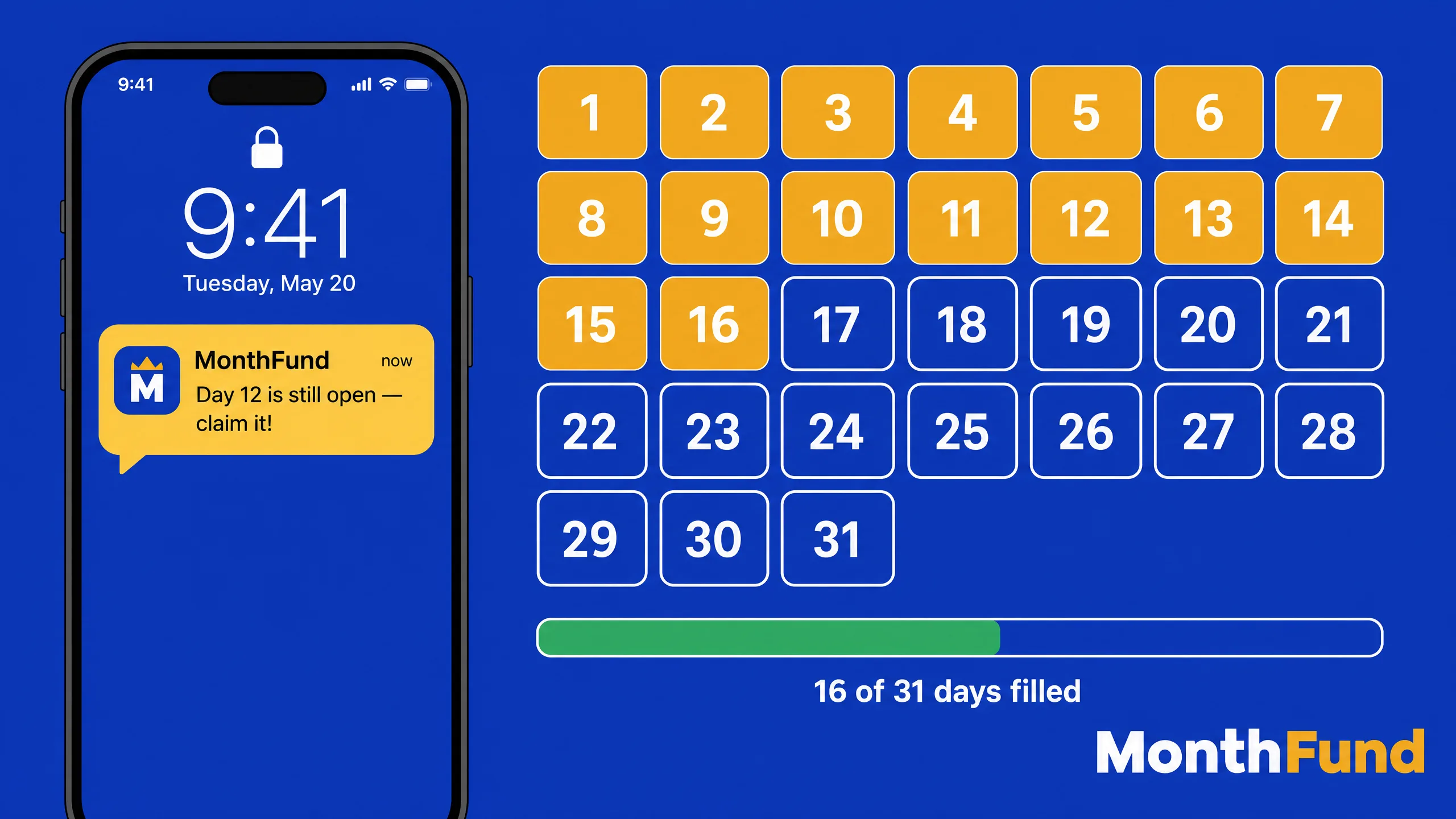
You launched. The first days were good. Then it got quiet. Here is what to do at each checkpoint, which nudges actually move fill rate mid-month, and how to close the campaign strong even if the calendar is not yet full.
“Momentum stalls predictably around day seven. The fix is not another group email; it is a personal text about one specific empty day. Check fill rate at days seven, fourteen, and twenty-one. Name open days publicly. A partial calendar still closes with real dollars.”
The first two days of a calendar fundraiser almost always feel good. Your pre-committed participants post their links. A few days fill immediately. The calendar has names on it.
Then, around day six or seven, it gets quiet. The easy yeses are in. You check the grid and see twelve days filled, nineteen open. Silence in the group chat.
This is not a failing campaign. This is a normal campaign at the moment it requires active management. The difference between a 65 percent fill rate and an 85 percent fill rate is almost always what the organizer does in days seven through twenty-one. Not what they posted on launch day.
If you are still in the format-decision phase, read how calendar fundraisers fit alongside galas, catalogs, and other formats first. This guide is for organizers who have launched and are managing the month.
What mid-campaign actually means
A 31-day calendar fundraiser has three zones of organizer attention: the launch window (days one through five), the active middle (days six through twenty-two), and the close (days twenty-three through the final day). Most organizer energy goes into the launch. Most fill-rate gains or losses happen in the middle.
The middle is where participants who said yes stop posting. It is where donors who meant to give forget. It is also where the calendar's structure does its best work, because every unfilled day is visible on the grid, and visibility is what makes a calendar more than a thermometer.
Mid-campaign management is not about sending more email. It is about using the grid's information to make targeted, personal asks at the right moments.
The week-by-week momentum curve
Most calendar fundraisers follow a predictable curve. Understanding it in advance means you can intervene before the stall becomes permanent.
| Period | What typically happens | Organizer role |
|---|---|---|
| Days 1–3 | Launch energy. Pre-committed participants post links. Early days fill quickly. | Watch who goes quiet. Note names. |
| Days 4–7 | Momentum slows. Some participants waiting to see if others post first. | Day 7 checkpoint: personal outreach to anyone not yet active. |
| Days 8–14 | The critical window. Half your final fill rate is determined here. | Name open days publicly. Text specific participants. Recruit one or two replacements if needed. |
| Days 15–21 | Final mid-campaign push. Urgency becomes real and usable. | Highlight progress. Make the close feel possible, not desperate. |
| Days 22–31 | Last stretch. Urgency is now natural and genuine. | Call-outs for named open days. Celebrate each fill publicly. |
The most common mistake is treating each week the same: one group reminder, one social post, and hope. What actually moves fill rate is escalating specificity at each checkpoint.
Day 7: your first checkpoint
On day seven, open your organizer dashboard and count: how many of your participants have at least one donor on their calendar? Not how many total days are filled, but how many of your people are actually doing the work.
A healthy campaign at day seven has sixty to seventy percent of participants active. With twenty-five participants, fifteen to seventeen of them should have at least one donor committed. If you are at ten or fewer, do not send a group reminder. Send personal texts.
The fix for a quiet mid-campaign is almost never another group email. It is a personal text about one specific empty day.
The personal text looks like this:
"Hey, Day 14 is still showing empty on the grid. I know things get busy. Do you want to keep it, or should I offer it to someone else? No pressure either way."
This message does four things at once: it names the specific day, it acknowledges that life got in the way, it creates a gentle deadline, and it opens the door to reassignment without shame. Most participants respond within a day. Many fill their day within twenty-four hours of receiving it.
If a participant wants to return their day, let them without friction. Take the day back, then offer it to someone on your backup list or post it publicly as a named open day. A reassigned day is better than an empty placeholder for three more weeks.
For a refresher on how recruitment shapes what happens here, the participant recruitment guide covers the pre-launch work that makes day-seven follow-up easier.
Day 14: the midpoint read
At the halfway point, you have enough information to project where you will land. Divide the number of filled days by fifteen (half the calendar). If you have eighteen days filled at day fourteen, you are on pace for roughly 80 percent. If you have ten filled, you are tracking toward 60 percent and the second half needs specific work.
| Days filled at day 14 | Projected fill rate | What to do now |
|---|---|---|
| 22+ days | ~90% or better | Celebrate publicly. Push for a complete calendar. Name the remaining open days explicitly. |
| 17–21 days | ~75–85% | On track. Identify the open days by number and call them out in your next post. |
| 12–16 days | ~60–75% | Send targeted, personal outreach to three to five specific participants today. |
| Under 12 days | Under 60% | Consider recruiting one or two new participants to claim open days before day 20. |
At day fourteen, public visibility is your best lever. Post the calendar with open days named explicitly: "Day 9, Day 17, Day 22, and Day 27 are still open. Here is the link." This is not desperation. It is information. Supporters who have been meaning to donate often need a specific day named before they act.
Day fourteen is also a good moment to ask your most active participants to do one specific thing: text one person they have not contacted yet. Not a group post. One personal text. A warm direct ask converts at a dramatically higher rate than a cold social share, and your best participants already have the language down.
Day 21: the final push
By day twenty-one, urgency is no longer manufactured. The calendar closes in ten days. That is real. Use it plainly.
The tactics that move fill rate at this stage are different from mid-campaign nudges:
- Name every open day publicly and specifically. Not "several days remain." Post the list: "Day 4, Day 11, Day 19, and Day 28 are still open." The specific day number gives someone something to decide about immediately.
- Celebrate every fill in the final stretch. When a day closes in the last ten days, acknowledge it publicly. "Day 19 just got claimed. Three days left." This signals momentum and makes the close feel achievable, not distant.
- Make direct calls for high-value open days. If Day 26 or Day 29 has been empty since launch, someone with a strong personal network needs to claim it. Call them. Do not post. The ask is direct: "Day 27 is worth $27 per donor. I think your network could fill it in a few texts. Would you take it?"
- Accept that partial is still a real outcome. A 75 percent fill rate on a 25-participant campaign produces approximately $9,300. That is a meaningful result. Do not let the gap between projected and actual make the final week feel like failure, because how you close affects whether people say yes to the next month.
Platform tools that move fill rate
MonthFund has four built-in donor-facing features that are especially useful mid-campaign. Most organizers underuse them because the focus is on outreach rather than what the platform itself makes possible. Here is when each one pays off.
Multi-day claiming: Lowest, Highest, and Random. Donors do not have to pick just one day. They can claim several in a single checkout using MonthFund's multi-day tool. The three selection strategies serve different moments in the month:
- Lowest picks the smallest available days first (Day 1, Day 2, Day 3...). Send this mid-campaign with a specific prompt: "Help us clear the first row of the calendar. Click Claim Multiple Days and choose Lowest, then pick how many you want." It makes the grid look visibly fuller faster, which builds social proof for everyone who looks at the calendar next.
- Highest picks the largest available days first (Day 31, Day 30, Day 29...). This is the right ask for a high-capacity donor or sponsor: "The top few days are still open. Would you take the highest three in one step?" One checkout, one transaction, and your most expensive days are off the board.
- Random picks a mix of available days and includes a re-roll option for donors who want to try again. Best for donors who want to participate but do not care which days they land on. Give them the link and tell them to choose Random, pick any number, and roll until they are happy. It lowers the decision friction for supporters who are willing but not sure what to pick.
Claim All (Rest of Month). Any donor can claim every remaining open day in a single transaction. This is the highest-impact closing tool in the platform. Save it for the right moment and the right person: a board member, a major donor, or a corporate sponsor who wants to guarantee a full calendar. The message is direct: "We have [X] days left open. Would you want to fill the rest of the month in one step? Here is the link, and it handles everything in one checkout." It is a large ask, so match it to someone with both the capacity and a genuine stake in seeing the month close complete.
Lowest builds visual density mid-month. Highest removes the expensive days fast. Claim All closes the month for a champion donor who wants to guarantee the finish line.
Live Activity Ticker. The ticker shows real-time donation activity on the public hub. When it goes quiet, the campaign feels stalled even if your fill rate is fine. Use the three-day rule: if the ticker has been silent for more than three days, have someone on your team claim a small available day to restart the activity feed. Day 2 or Day 3 works. The goal is not the dollar amount; it is the signal that the campaign is still alive and people are still giving.
Public Leaderboard. The leaderboard ranks your fundraisers by total raised. Mid-campaign is the best moment to use it. Take a screenshot on day fourteen or the Friday closest to it and share it in your group chat or on social: "Here is where everyone stands at the halfway point. Big shoutout to [Name] for leading the board." Public recognition combined with visible ranking is one of the most reliable ways to activate participants who have gone quiet. Fundraisers who are close to each other on the leaderboard often make a visible effort to move up in the final stretch.
If the calendar will not fill completely
Not every campaign reaches 100 percent. A partial fill is not a failed campaign. Here is what the math looks like at different fill rates, so you can set accurate expectations with your board or leadership before the month closes.
| Fill rate | Per calendar | 10 participants | 25 participants |
|---|---|---|---|
| 100% | $496 | $4,960 | $12,400 |
| 85% | $422 | $4,216 | $10,540 |
| 75% | $372 | $3,720 | $9,300 |
| 65% | $322 | $3,224 | $8,060 |
| 50% | $248 | $2,480 | $6,200 |
A few things worth knowing about partial fills:
- High-numbered days matter more than count. Ten unfilled days at the high end of the calendar (days 22 through 31) cost significantly more revenue than ten unfilled days at the low end. If you can only move a few days in the final stretch, prioritize filling the higher-numbered ones first.
- Close on time, always. Extending a campaign rarely recovers the final gap. It also signals that the original urgency was not real. Donors and participants notice. The discipline of a defined month is part of what makes the calendar model repeatable.
- Document the specific gap before you close. Was it a recruitment gap (not enough participants)? An activation gap (participants who claimed days but did not post)? A donor gap (participants posted but got low response)? Each has a different fix for the next month, and the data you have now is worth more than any amount of post-campaign guessing.
The most valuable thing a partial-fill campaign produces is data. You now know exactly which days were hardest to fill and which participants were most active. That knowledge compounds into the next month.
Closing the month and setting up the next one
The last day of the month is both a finish line and a recruitment moment. Thank participants publicly and specifically, not as a group, but by name where you can. Post the final calendar, filled or partial. Name the total raised. Make the collective work visible to everyone who participated.
Before the energy dissipates, ask your most active participants a simple question: "Would you do this again next month?" The people who answer yes without hesitation are your core cohort. They already understand the model. Their second month runs faster because recruitment is a confirmation, not an introduction.
Second campaigns consistently outperform first campaigns because:
- Participants already know what to say and how to share their link.
- Their donors have given before and remember the experience positively.
- The organizer knows which days to assign first and which participants to pre-load into high-value slots.
- The calendar format is no longer a concept to explain. It is a familiar shape people already said yes to.
Lock the next month before the current one closes. Announce it in the closing message: "The calendar for [next month] is now open. If you want to participate again, reply here." The transition from one campaign to the next should feel seamless, not like a fresh start from zero.
The $496 math tells you what a full calendar is worth. The participant recruitment guide covers what happens before the month opens. And the launch checklist walks the days between commitment and going live. Mid-campaign is the gap between those two guides. Now you have the whole arc.
For a full overview of the format itself, the pick a date fundraiser guide is the right starting point.
How much can your community raise?
Use our interactive calculator to model your potential outcomes based on participant count and fill rate.
Ready to launch?
Set up your first fundraiser in under 10 minutes. No credit card required.
Common Questions
What is a good fill rate for a first campaign?
70–80% is strong for a first month. Experienced organizers with tight participant recruitment often hit 85–90%. Below 60% usually signals a recruitment gap, not a messaging problem.
How do I follow up without annoying participants?
Specificity is the difference. 'Day 14 is still open' is not a nag; it is information. Generic reminder emails annoy. A named-day text helps.
Should I extend the campaign if we are behind?
Almost never. A defined month creates real urgency. Extensions signal that urgency was not genuine, and they rarely recover the final gap. Close on time and apply what you learned to the next month.
What if a participant goes quiet mid-month?
Reach out personally and offer to reassign their day. A new participant on that day is better than an empty placeholder for three more weeks.
How many participants can one organizer manage mid-campaign?
With 25–35 participants, one organizer can handle mid-campaign nudges in about 30–60 minutes per week. Above 50, consider adding a co-organizer to split the outreach load.
Keep Exploring
View all posts →Can Schools Use Stripe for Fundraising? Start With the District
MonthFund cannot currently mail fundraiser checks. Learn how a school or district may approve Stripe, who should own the account, what the business office needs, and which real schools already use Stripe for selected payments.
School fundraiser approval guide: budget, payments, and privacy
A principal or PTA board needs more than a catchy idea. This approval packet covers purpose, budget gap, payment flow, privacy, parent communications, and closeout before the campaign reaches families.
How calendar fundraisers fit with galas, catalogs, and other fundraising (toolkit, not replacement)
MonthFund is one powerful layer in a larger toolkit. See how a calendar month complements product sales, ticketed events, and open donate pages, with patterns you can use around a 5K or gala.