
How to recruit 25 participants for your first calendar fundraiser campaign
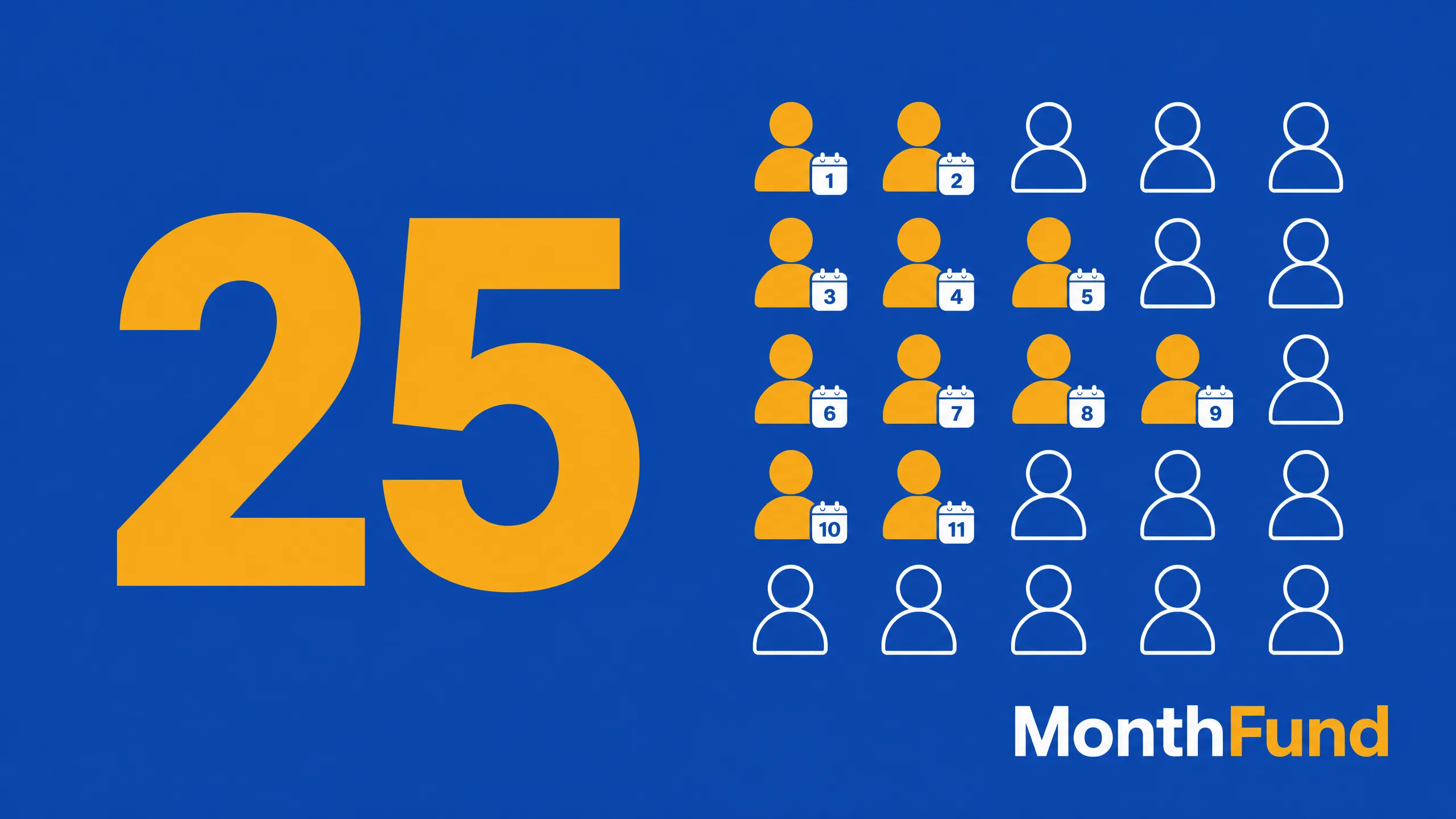
The difference between a good first month and a failed one is almost always participant recruitment. Here is exactly how to find, invite, and activate your first cohort.
“Successful campaigns are won before they launch. Build your list early, make personal asks to a core group of 10, and sequence your invitations to build social proof as the calendar begins to fill.”
Running a strong calendar fundraiser starts with format fit, see how calendar fundraisers fit with other formats , then execution. Our launch checklist walks the weeks before go-live.
Twenty-five is not a magic number. It is a useful target. At 25 participants with an 80% fill rate, a MonthFund campaign produces approximately $9,920. At 15 participants, it produces about $5,900. The math changes, but the process for finding participants is the same whether you need 15 or 50.
What most first-time organizers underestimate is how much of their campaign's outcome is determined before the campaign launches. Recruitment is not marketing. It is organizing. It requires personal contact, specific asks, and real follow-up. Done well, it makes everything else easier.
Step 1: Build the list before you open the platform
Before you create your campaign in MonthFund, open a spreadsheet. List every person in your organization's community who might realistically participate. Do not filter yet, just list. Board members, volunteers, active donors, staff, parents, members, friends. Aim for 40–60 names.
Then apply three filters:
- Network size: Does this person know people outside your existing community? Participants who fundraise in their own networks extend your reach. Participants who only know your current donors recirculate the same pool.
- Follow-through: Has this person completed commitments to your organization before? Reliability is worth more than enthusiasm.
- Availability: The month you choose matters. Avoid busy seasons. A willing participant who is traveling for three weeks cannot fill their day.
After filtering, aim for 30–35 people you feel genuinely good about. You will not get everyone, plan for 70–80% acceptance.
Step 2: Make personal asks before you send invitations
Do not send a bulk email as your first contact. Call, text, or speak in person with your strongest 10 recruits before the campaign launches. Say exactly this:
"We're running a MonthFund campaign in [month]. You'd claim one day of the month and ask people you know to donate that day's amount. Takes maybe two hours total. I want you specifically because [reason]. Would you be in?"
The specificity matters. "Would you be in?" is a yes/no question that makes the commitment concrete. Vague invitations produce vague responses. Get verbal commitments from your first 10 before you open the campaign to everyone else. Social proof, knowing that others have already committed, significantly increases acceptance rates for the remaining invitations.
Step 3: Sequence your invitations strategically
Once the campaign is live in MonthFund, send invitations in waves:
- Wave 1 (Day 0): Your pre-committed 10. They claim days immediately. The calendar starts filling on day one.
- Wave 2 (Day 2–3): Your next tier of 10–15. By now, the calendar shows real activity. New invitees see a campaign already in motion.
- Wave 3 (Day 5–7): Final 5–10 invitations. Use remaining open days as specific asks: "Day 19 is still open, would you take it?"
The psychology here is real. An empty calendar asks for abstract help. A calendar with 10 days already claimed asks for something specific: fill one of the remaining gaps. The second ask converts at a higher rate.
A calendar with 10 days claimed does not look like a project in trouble. It looks like a project in motion.
Step 4: Run a 15-minute kickoff
Before your participants go out to recruit donors, give them a brief orientation. This does not need to be formal, a Zoom call, a voice note, or even a well-written email works. Cover three things:
- Exactly what to say: "I claimed Day 15 for [organization]. That means I'm asking for a $15 donation per donor. Can you donate $15?"
- Where to send people: their personal participant link, which MonthFund generates automatically.
- What success looks like: filling their day means 10–20 donors who each give their day's amount. They should aim for 10 at minimum.
Participants who receive this briefing perform measurably better than those who are left to figure it out alone. The model is simple, but simple does not mean self-evident. Ten minutes of orientation pays for itself many times over.
What to do when someone says no
Expect 20–30% of invitees to decline or not respond. This is normal. When someone declines, ask two questions: Is there someone else you'd recommend? And would you be willing to donate to another participant's day instead? The first expands your network. The second converts a non-participant into a donor, which is still valuable.
The goal is not 100% acceptance. It is building a group of 20–30 people who are genuinely committed and who will do the work. A smaller, engaged cohort will outperform a larger, passive one every time.
For a full overview of the format before you recruit, the pick a date fundraiser guide explains the model end to end. Once you have your cohort, the fill-the-calendar guide covers mid-campaign strategy.
How much can your community raise?
Use our interactive calculator to model your potential outcomes based on participant count and fill rate.
Ready to launch?
Set up your first fundraiser in under 10 minutes. No credit card required.
Common Questions
Do I need 25 people to start?
No, but 25 is a great target for a $10k-range outcome. You can start with 10 or 15 and grow from there.
Should I send a bulk email to find participants?
No. Personal asks (text, call, or in-person) convert significantly better than bulk emails for recruitment.
What's the best time of year to recruit?
Timing depends on your community rhythm, but spring is often a high-energy window for many organizers.
How do I explain the calendar to recruits?
We provide templates and a clear 'how it works' page that you can share with your core team.
Can I manage everything from a dashboard?
Yes. As an organizer, you'll have a central admin dashboard to track all filled days and total donations.
Keep Exploring
View all posts →Printable Calendar Fundraiser With a QR Code
Use a printable calendar and QR code to move supporters from a hallway bulletin board to a live, shareable online giving path.
Digital Calendar Fundraiser Setup: Personal Links
Set up a digital calendar fundraiser with personal supporter links, open-day claims, shared progress, and clear organizer roles.
How calendar fundraisers fit with galas, catalogs, and other fundraising (toolkit, not replacement)
MonthFund is one powerful layer in a larger toolkit. See how a calendar month complements product sales, ticketed events, and open donate pages, with patterns you can use around a 5K or gala.