
The $496 number: what one full calendar fundraiser raises (and how to model it)
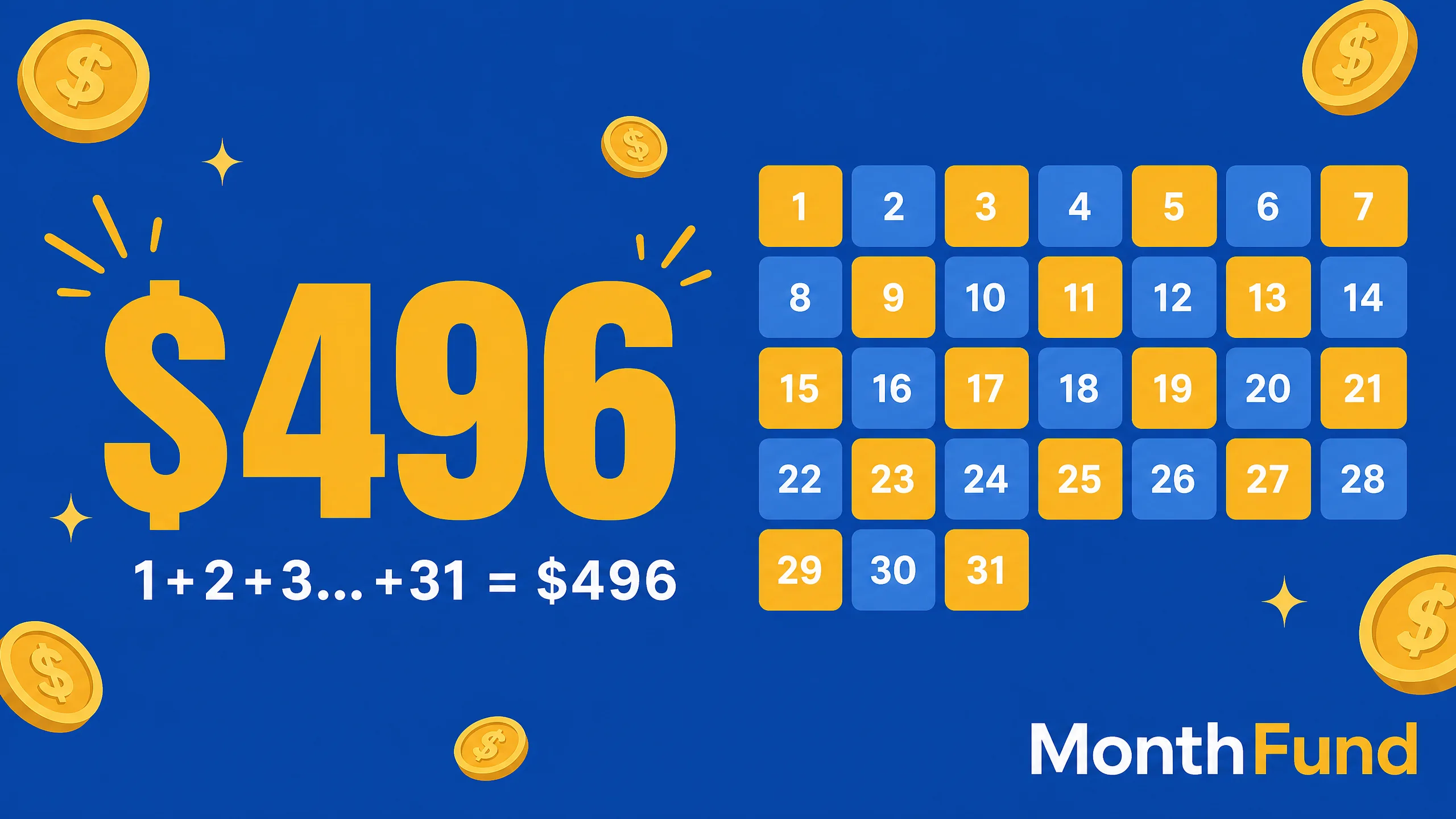
1+2+3…+31 = 496. Here is why that number matters, how to model realistic outcomes before you recruit anyone, and how to think about scale.
“The sum of all days in a 31-day month is $496. This 'base number' is the foundation of our math, allowing you to accurately model your campaign's potential revenue based on participant count and fill rate before you even launch.”
Every calendar fundraiser on MonthFund comes down to the same arithmetic: day amounts add up to a knowable floor. If you are still weighing formats, how calendar fundraisers fit with catalogs, events, and open-ended pages before you commit.
The first thing most people do when they hear the MonthFund model is the math. Day 7 is $7 per donor. Day 22 is $22 per donor. If you fill all 31 days and every donor covers every day, what does that come to?
$496. The sum of all integers from 1 to 31 is 496.
That is the base number. Everything else in MonthFund's math is built on top of it. Understanding where $496 comes from, and what realistically affects it, is the foundation of campaign planning.
Where $496 comes from
The formula is straightforward: the sum of all integers from 1 to n is n(n+1)/2. For a 31-day month: 31 × 32 ÷ 2 = 496. For shorter months:
| Month length | Base sum | 25 participants, 80% fill |
|---|---|---|
| 28 days (February) | $406 | $8,120 |
| 29 days (Feb, leap year) | $435 | $8,700 |
| 30 days | $465 | $9,300 |
| 31 days | $496 | $9,920 |
This is the per-calendar figure, what a single fully filled calendar raises from a single donor who covers every day. In practice, each calendar has multiple donors and each participant works to find as many donors as possible.
The fill rate variable
A fully filled calendar means all 31 days are claimed and each claimed day is fully funded. In practice, most campaigns do not run at 100% fill. Some days go unclaimed. Some participants do not recruit enough donors.
The realistic range for a first campaign is 65–85% fill rate. By the third or fourth campaign, experienced organizations routinely hit 85–95%. Here is what that looks like at different participant counts:
| Participants | Fill rate | Expected outcome |
|---|---|---|
| 15 participants | 70% | $5,208 |
| 15 participants | 85% | $6,324 |
| 25 participants | 70% | $8,680 |
| 25 participants | 80% | $9,920 |
| 25 participants | 90% | $11,160 |
| 40 participants | 80% | $15,872 |
The power of the model is that the face-value scenario is visible before you start. You can see what a full calendar is worth at $1 through $31 before anyone gives extra.
What actually drives fill rate
Fill rate is not random. It is determined by two things: how many days get claimed, and how thoroughly each claimed day gets funded. Both are within the organizer's control.
Days claimed is a recruitment problem. The more engaged participants you recruit before launch, the faster the calendar fills. Organizations that do pre-launch outreach, getting verbal commitments before the campaign goes live, consistently outperform those that send a link and wait.
Day funding is a coaching problem. Participants who understand their ask, and who feel supported, perform better. A brief 15-minute kickoff call explaining exactly what to say to potential donors can move fill rate by 10–15 percentage points.
Neither of these requires extra technology. They require the organizer to treat participant activation as a job, not an afterthought.
For a practical timeline before launch, use the calendar fundraiser launch checklist.
Modeling annual revenue
The real leverage in MonthFund is repetition. A campaign that runs every month, even if it only runs at 70% fill, compounds into significant annual revenue for organizations that commit to the rhythm.
| Campaign frequency | 25 participants, 80% fill | Annual total |
|---|---|---|
| Once a month (12×) | $9,920 per campaign | $119,040 |
| Quarterly (4×) | $9,920 per campaign | $39,680 |
| Once (1×) | $9,920 per campaign | $9,920 |
The monthly model is not for every organization. But for those with the capacity to run it, and communities with strong enough networks to sustain it, the compounding effect is the most powerful argument for MonthFund as infrastructure rather than a one-time campaign.
If you are new to the format, the pick a date fundraiser guide explains the model from the ground up, including how the math works for different participant counts.
If you are weighing this model against general crowdfunding, read Calendar Fundraiser vs. GoFundMe for a direct comparison of the two approaches.
How much can your community raise?
Use our interactive calculator to model your potential outcomes based on participant count and fill rate.
Ready to launch?
Set up your first fundraiser in under 10 minutes. No credit card required.
Common Questions
What is the $496 number exactly?
It's the sum of 1+2+3...+31. It represents the base amount one fully filled calendar raises at face value.
How much can we realistically expect to raise?
Multiply $496 by your number of participants and then by a conservative fill rate (e.g., 75%). For 25 participants, that's roughly $9,300.
What if the month has 30 days?
The total for a 30-day month is $465. The strategy remains the same: fill the grid to hit your goal.
How do I increase our fill rate?
High fill rates come from personal recruitment and timely follow-ups. Check out our participant recruitment guide.
Are there transaction fees?
Yes, standard Stripe fees apply to all transactions. You can view our full fee structure on the pricing page.
Keep Exploring
View all posts →Calendar Fundraiser Budget Worksheet for Boards
Build a board-ready calendar fundraiser budget by separating funding need, confirmed people, planning assumptions, and optional over-gifts.
Booster Club Budget Template: Set a Fundraising Goal
A practical way to turn a booster club season budget into a transparent fundraising goal without hiding the math.
The Pledge Multiplier: when donors give more than the day amount
The day amount is a floor, not a ceiling. When Day 15 suggests $15 and a donor gives $30, your calendar beats its own math. Here is how to invite bigger gifts without pressure, and what the uplift does to a $496 baseline.