
Why the calendar is the point: how structure drives fundraising accountability
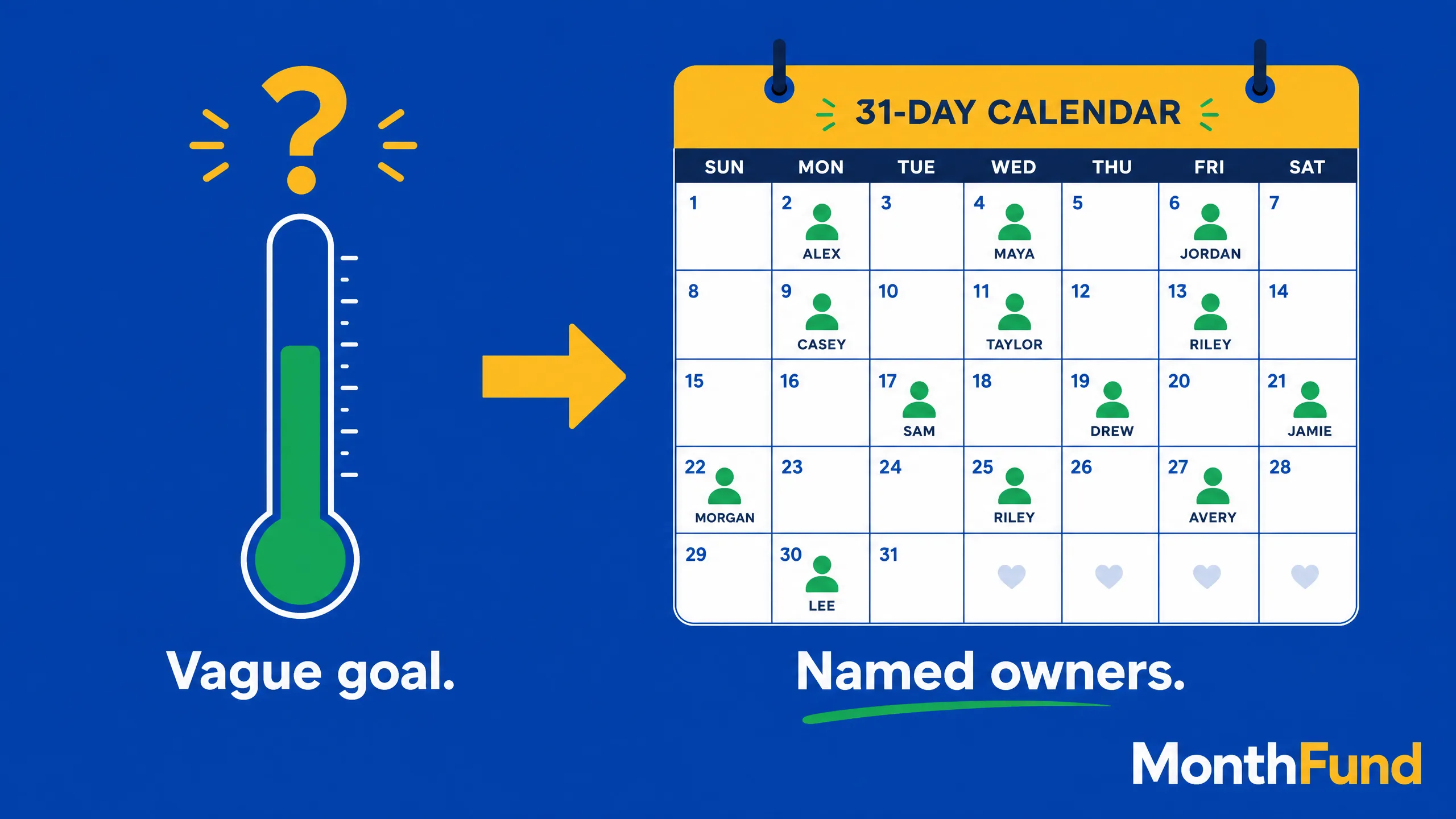
A goal meter shows one total. A month calendar shows named days and owners. That difference shapes how people follow through, and it sits comfortably next to galas, runs, or anything else that already works for you.
“Standard thermometers show goals, but calendars show names and gaps. The grid structure drives accountability because an empty day is a visible prompt, making collective action legible, repeatable, and deeply personal.”
There is a specific moment that happens in almost every community fundraiser. The first two weeks go well. Energy is high. Then it gets quiet. The thermometer stops moving. The organizer sends one reminder, then another. The response tapers. The campaign closes at 60%.
Nobody planned for it to go this way. The goal was clear. The cause was real. The people were willing. What went wrong?
The structure went wrong. Or rather, there was no structure. There was a goal, a link, and a general hope that people would figure it out. That is not a system. It is a wish.
A calendar fundraiser fixes that by making the structure visible. If you are deciding whether that format fits your group, read how calendar fundraisers fit with other formats first.
What a calendar does that a goal meter cannot
When you set a fundraising goal (say, $10,000), you have given people a destination but no map. They know where you want to end up. They do not know what role they play in getting there. They do not know what happens if they drop out. They cannot see whether their effort matters or whether someone else will pick up the slack.
A calendar works differently. Every day is a unit. Every unit has an owner. Day 7 belongs to Maria. Day 22 belongs to Tom. The calendar is a grid of 31 specific commitments made by 31 specific people. When someone looks at it, they do not see a percentage toward a goal. They see names, days, and gaps.
The empty days are not absence. They are a prompt. A visible ask that requires no email.
This is the mechanism. Visibility creates pressure, not social pressure in a manipulative sense, but the natural pressure of being able to see a gap that you could fill. People are responsive to concrete opportunities, not abstract ones. "We need to raise more money" is abstract. "Day 19 is open and nobody has claimed it" is concrete.
Accountability is a design problem
Many fundraising platforms lean on culture and reminders: nudges work when the community is already deeply engaged; when attention splits, the middle of the month goes quiet.
MonthFund treats accountability as a design problem. The calendar is built so that inaction is visible. A participant who has not filled their day is not invisible: their day is empty on a grid that everyone can see. They do not need to feel guilty. They just need to see the gap and remember their commitment.
The structure makes follow-through easier, not harder. When someone claims Day 15, they are not agreeing to "help with fundraising." They are agreeing to one specific thing: fill the 15th. That specificity is what makes accountability possible. Vague commitments drift. Specific ones hold.
Why "every day" matters as much as the total
The math of MonthFund, $1 through $31 summing to $496, is elegant. But the more important property is this: every day is different. Day 1 requires a different kind of participant than Day 28. The smaller days are more accessible, lower stakes, easier to fill. The larger days require someone with a deeper network or more personal investment.
This means the calendar naturally distributes responsibility across different levels of capacity. A new participant might claim Day 3. A longtime leader might claim Day 29. Nobody is doing the same job. And because the jobs are different, more people can find a place that fits them.
That distribution is not accidental. It is built into the model. It is also why a collective month with 25 day-owners can cover more ground than asking the same three leaders to carry every relationship.
The month as a shared narrative
There is a social dimension to the calendar that is worth naming. When 25 people each claim a day and fill it, the campaign becomes a shared story in a very literal way. Everyone can point to their day. Everyone can see how the month came together. The calendar, at the end, is a record of collective action.
This matters for organizational culture in ways that extend beyond the campaign itself. Communities that fundraise together with visible, shared accountability build a different kind of trust than communities that just donate to a common cause. The difference is the structure. The structure made the story possible.
That is why the calendar is the point. It is not decoration. It is not a progress tracker. It is the organizing mechanism that makes collective accountability legible, repeatable, and real.
When you are ready to run it, use the launch checklist and the walkthrough on how it works. For the full model explained from the donor's perspective, the pick a date fundraiser guide is the right next read.
How much can your community raise?
Use our interactive calculator to model your potential outcomes based on participant count and fill rate.
Ready to launch?
Set up your first fundraiser in under 10 minutes. No credit card required.
Common Questions
Why is a calendar better than a progress bar?
A progress bar is abstract. A calendar day is concrete. When a day has a name attached to it, or remains empty, it creates a natural sense of ownership and accountability that a simple percentage cannot.
Does this structure make people feel guilty?
It's about visibility, not guilt. It provides a clear 'map' for how to help, which most supporters actually find more comfortable than vague requests for money.
How do I recruit people to own days?
Recruitment is the engine of a successful month. We've developed a specific playbook for finding your first 25 participants.
How does the $496 math work?
The math is based on the sum of integers 1 through 31. We explain the '496 foundation' in detail here.
Can we run this for a mutual aid group?
Absolutely. The calendar format is perfect for the ongoing, rhythmic needs of mutual aid networks.
Keep Exploring
View all posts →Pick a Date to Donate: Supporter Guide
Learn how to choose an open date, give its suggested amount or more, and understand the claim-a-day experience before donating.
Calendar fundraiser template: the grid, the pricing, and the messaging, ready to copy
Everything you need to build a calendar fundraiser today: the 31-day grid layout, three pricing ladders with their totals, the header copy, and the tracking sheet. Recreate it in any doc or spreadsheet in twenty minutes, or run the same structure digitally.
Digital vs. paper calendar fundraiser: why the grid moved online
A paper calendar fundraiser works until someone has to track who claimed Day 14. Here is what the printable template gets right, where it breaks, and what a digital grid adds: live progress, one page per participant, and totals that reconcile themselves.