
Calendar fundraiser fill rate: what good enough actually looks like (and how to plan for it)
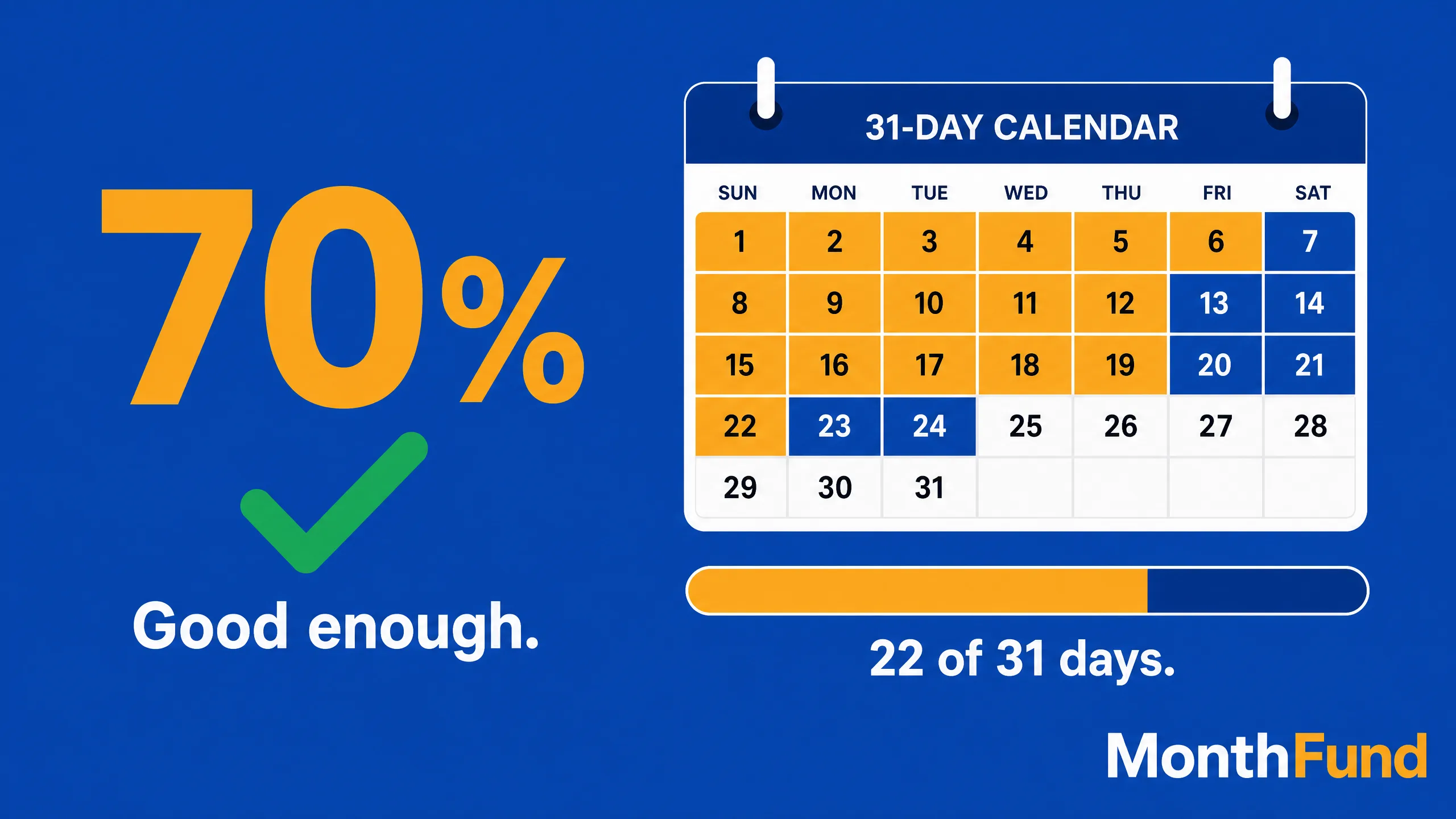
Every treasurer eventually asks the same question: if our calendar fundraiser ends at 72 percent fill, did we fail? No. Fill rate is how you plan a month before anyone shares a link, not a moral score at the finish line. Here is what good enough looks like for first campaigns, repeat months, and solo pages, and how to set expectations your board will actually believe.
“Plan first-time calendar months at 70 to 80 percent fill. Repeat organizers with tight recruitment often hit 85 to 90 percent. Below 60 percent usually signals a recruitment gap, not bad luck. Multiply participants × $496 × your planned fill rate before you announce a goal, then close the month on time and document which gap you hit.”
A calendar fundraiser (also called a pick a date fundraiser) turns thirty-one numbered days into a public grid. Participants claim days. Donors fund them. Progress stays visible. The outcome is predictable because the arithmetic is fixed: one fully filled calendar at face values sums to $496. What varies is fill rate, the percentage of day-slots that actually get claimed and funded.
If you are new to the format, start with the $496 number and how fill rate fits the model, then return here for benchmarks and board-ready planning language.
Organizers launch a month, fundraisers each share a calendar, donors claim days, and progress stays visible until the month fills.
Fill rate is a planning input, not a grade
Product catalogs and galas often report gross sales or ticket revenue as the headline number. Calendar months report fill rate because the grid makes partial progress visible. That visibility makes treasurers nervous. A calendar that closes at seventy-eight percent can feel like a public incomplete when a silent auction simply never mentions the items that did not sell.
The healthier read: fill rate tells you how thoroughly your community activated the structure you built. It is an input you choose before launch when you multiply participants × $496 × fill rate, and an output you read after close when you decide what to fix next month. It is not a pass-fail test of your mission.
Progress on a calendar fundraiser is not binary. Neither is your grid. A partial month with honest data beats a full spreadsheet fantasy every time.
Benchmarks by campaign type
These ranges come from how the model behaves in practice, not from a guarantee. Use them to set expectations with leadership before the month opens.
| Campaign profile | Typical fill rate | What it usually means |
|---|---|---|
| First month, new organizer | 65–80% | Normal learning curve; focus on recruitment quality |
| Second or third month, same core group | 80–90% | Participants know the ask; donors remember the format |
| Tight school or booster roster, strong pre-launch | 85–92% | Verbal commitments before go-live; active kickoff |
| Solo personal calendar | 50–85% | Network size matters more than participant count |
| Below 60% on any profile | Under 60% | Almost always recruitment or activation, not donor fatigue |
For how calendar months sit beside galas, catalogs, and open donate pages without replacing them, see how calendar fundraisers fit with other fundraising formats.
The formula before you announce a goal
The planning line every treasurer should write down:
Expected raise ≈ Participants × $496 × Fill rate
Example: twenty-five participants at seventy-five percent fill → 25 × 496 × 0.75 ≈ $9,300. At eighty-five percent → roughly $10,540. Announce the goal using the conservative end of your range. Surplus feels like a win; a miss after an inflated promise erodes trust for the next month.
Walk the numbers interactively on the outcome calculator and cross-check the arithmetic in how to hit your fundraising goal in 31 days.
Board slide in one sentence
What partial actually raises
Partial fill is not empty air. Here is what common fill rates produce per participant calendar and at team scale, so you can answer "is seventy percent enough?" with dollars, not vibes.
| Fill rate | Per calendar | 15 participants | 25 participants |
|---|---|---|---|
| 100% | $496 | $7,440 | $12,400 |
| 85% | $422 | $6,324 | $10,540 |
| 75% | $372 | $5,580 | $9,300 |
| 70% | $347 | $5,208 | $8,680 |
| 65% | $322 | $4,836 | $8,060 |
| 50% | $248 | $3,720 | $6,200 |
Seventy-five percent on twenty-five participants is nearly $9,300 with no inventory, no delivery day, and no paper reconciliation. That is often comparable to a product fundraiser net after vendor splits, with a fraction of volunteer hours. The comparison table in school fundraisers without selling products walks a similar scenario for PTAs.
Diagnosing the gap: recruitment, activation, or donors
When fill rate lands below plan, the fix depends on which gap you hit. Guess wrong and you will over-correct the wrong lever next month.
| Gap type | Symptoms | Fix for next month |
|---|---|---|
| Recruitment | Many calendars never claimed; empty low-number days | Three-wave invites before launch; target twenty-plus commits |
| Activation | Days claimed but not funded; quiet participant grids | Kickoff call, scripts, mid-month texts on specific days |
| Donor response | Active posters, low gifts; same empty days across roster | Sharpen day-level asks; pair participants with champions |
Recruitment gaps are solved before the month opens. Read how to recruit twenty-five participants for the three-wave sequence. Activation and donor gaps are solved during the month; how to fill your calendar fundraiser covers day-seven, day-fourteen, and day-twenty-one checkpoints.
High-number days vs. low-number days
Fill rate is not evenly distributed across the grid. Ten open days at the top of the calendar (days 22 through 31) cost more revenue than ten open days at the bottom. If you are in the final week with limited energy, prioritize filling high-number days first. One funded Day 28 beats three funded Day 3 slots for both dollars and the public story of momentum.
Organizers who pre-assign high-value days to their most connected participants during recruitment consistently outperform those who treat day choice as first-come-first-served chaos.
When to close on time anyway
Extending a calendar month to chase the last ten percent rarely recovers the gap. It signals that the original deadline was flexible, which makes the next month harder to sell. Close on the date you announced. Report the actual fill rate and dollars. Thank participants by name. Partial transparency builds more repeat participation than a quiet extension ever did.
If you need tactical language for the final week, including Claim All for a champion donor, that playbook lives in the closing sections of fill the calendar, not here. This article is for the treasurer who needs to know seventy-eight percent was always an acceptable plan.
How repeat months compound fill rate
Second and third campaigns outperform first campaigns for predictable reasons: participants already know what to post, donors remember claiming a day, and organizers know which families to pre-load on high-number slots. Teams that treat month one as a data-gathering run, not a verdict on the format, are the ones posting eighty-five percent fills by month three.
Before you schedule the next month, capture three numbers from the close: final fill rate, count of participants who funded at least one day, and which ten day-slots stayed open longest. That triplet tells you whether next month is a recruitment problem, a coaching problem, or a donor-messaging problem.
Walk this math with us live every Friday.
We will set a goal, back into a fundraiser count, and work the 31-day cadence in real time. Bring your numbers. Every registrant gets The 31-Day Fundraiser Recruitment & Launch Playbook.
Next steps
Model conservatively on the outcome calculator, align your board using the formula in the $496 number, and walk the launch checklist before you send the first invite. When the month is live, switch to mid-campaign nudges. Ready to run your first structured month? Start free.
How much can your community raise?
Use our interactive calculator to model your potential outcomes based on participant count and fill rate.
Ready to launch?
Set up your first fundraiser in under 10 minutes. No credit card required.
Common Questions
What is a good fill rate for a first calendar fundraiser?
Seventy to eighty percent is strong for a first month. That range on twenty-five participants produces roughly $8,680 to $9,920 before fees. Below sixty percent usually means too few active participants were recruited before launch, not that the format failed.
How do you calculate calendar fundraiser fill rate?
Fill rate is the percentage of day-slots that were both claimed and fully funded across all participant calendars. On MonthFund, your campaign dashboard shows this in real time. For planning, multiply participant count × $496 × expected fill rate.
Is a partial calendar fundraiser still worth running?
Yes. A seventy-five percent fill on twenty-five participants still raises about $9,300. Partial months produce data on which days and participants underperformed, which compounds into higher fill rates on the next campaign.
What fill rate should we use when setting our fundraising goal?
First-time organizers should model at seventy to seventy-five percent. Teams running their third or fourth month can plan at eighty-five to ninety percent if recruitment stayed strong. Never promise a budget based on one hundred percent unless a major donor has committed to close gaps.
How do you improve fill rate on the next campaign?
Document whether the gap was recruitment, activation, or donor response before you close. Recruitment gaps need more pre-launch commitments. Activation gaps need a kickoff call and mid-month nudges. Donor gaps need clearer day-level asks from participants.
Keep Exploring
View all posts →The Pledge Multiplier: when donors give more than the day amount
The day amount is a floor, not a ceiling. When Day 15 suggests $15 and a donor gives $30, your calendar beats its own math. Here is how to invite bigger gifts without pressure, and what the uplift does to a $496 baseline.
How to build a recurring calendar fundraiser for monthly revenue
Turn a one-time $496 drive into $5,952 in annual recurring revenue. A Recurring Calendar Fundraiser converts donors from one-time givers into monthly subscribers by having them own a day of the month.
How calendar fundraisers fit with galas, catalogs, and other fundraising (toolkit, not replacement)
MonthFund is one powerful layer in a larger toolkit. See how a calendar month complements product sales, ticketed events, and open donate pages, with patterns you can use around a 5K or gala.