
How to Run a School Fundraiser Without Selling Products (That Parents Actually Want to Do)
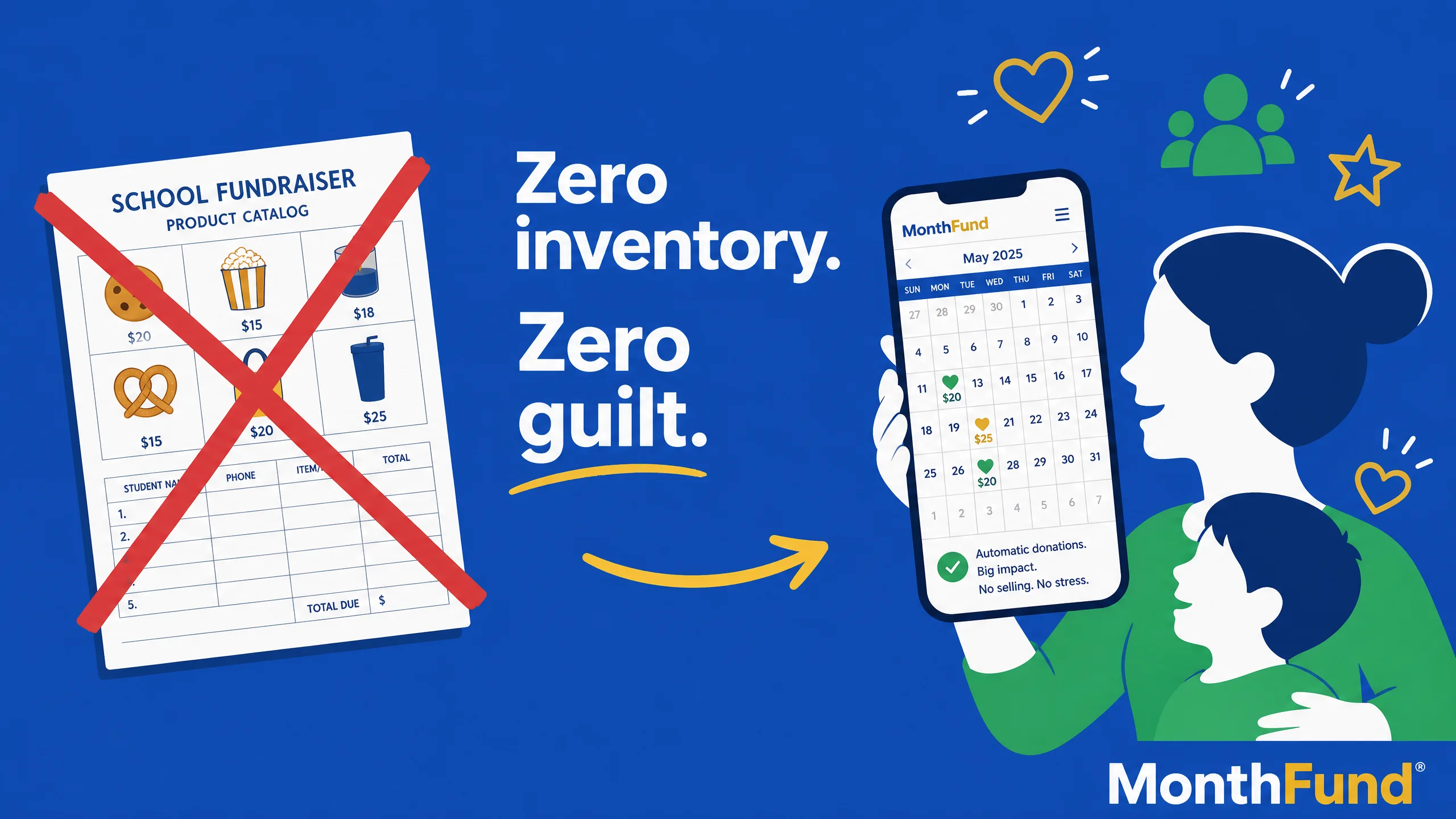
You are sitting at the kitchen table on a Tuesday night when your child pulls a glossy catalog out of their backpack. You know what comes next, and so does every parent in your group chat. There is a way to run a school fundraiser without selling products that respects parents' time and still hits goal.
“Skip the catalogs for one month a year. Use a calendar fundraiser as the no-product layer of your PTA plan: 25 parents, 31 named days, a $12,400 floor, and zero inventory in the gym. Parents share a link instead of a pitch, and 100% of the focus stays on the school.”
You are sitting at the kitchen table on a Tuesday night. Your child just pulled a crumpled, glossy catalog out of their backpack. It is filled with $25 wrapping paper and $18 tubs of cookie dough. You know exactly what this means. You are about to spend the next three weeks guilt-texting your coworkers, cornering your relatives, and eventually buying $100 worth of stuff you do not need just to hit the quota the school never quite said out loud.
For decades, this has been the default shape of school fundraising. It works, in the narrow sense that money does change hands. It also places an immense, repeated burden on the same group of parents year after year. The result is volunteer fatigue, soft fill rates, and a school that quietly raises less every season than the spreadsheet pretends.
There is a better way. We will walk you through how to run a school fundraiser without selling products, using the calendar fundraiser model that respects parents' time and actually hits the school's financial goal.
The Tuesday night catalog moment
Catalog drives have a familiar arc. The flyer comes home in the Monday folder. A reminder lands on Wednesday. Thursday is the kickoff assembly with a stuffed mascot from the fulfillment company. Then a parent volunteer becomes a part-time logistics manager for the next twenty-one days. Order forms get scanned at the kitchen table. A check made out to the wrong entity has to be voided. Three boxes of cookie dough thaw on a porch on a Tuesday afternoon.
None of this is a moral failing of catalogs. The format predates the internet for a reason: it gives a child something concrete to carry door to door and a donor something tangible to receive in return. The model is durable. It is also expensive, in ways most schools have stopped counting.
The true cost of product sales
When a school leans on product sales as its primary engine, two costs compound quietly. The first is the margin. Most catalog companies keep 50% to 60% of the revenue, plus shipping and handling fees that show up at reconciliation. If a parent sells $200 worth of popcorn, the school often sees about $80 of that after the vendor takes its share.
The second cost is logistical, and it is paid in volunteer hours. Someone has to collect the order forms. Someone has to tally cash and checks across thirty families. Someone has to be there when the delivery truck pulls up at 11:00 AM on a workday. Someone has to handle the inevitable missing items, the wrong addresses, and the parent who needs to return three tubs of frozen pretzel dough because their freezer broke.
Audit your last product fundraiser.
What you preserve when you stop selling products.
The calendar fundraiser model
If you want to raise real money without selling products, you need a model built on direct giving and shared accountability. That is what a calendar fundraiser provides. Organizers launch a month, fundraisers each share a calendar, donors claim days, and progress stays visible until the month fills.
The mechanics are simple. Organizers recruit fundraisers (parents, teachers, sometimes older students with a parent co-signer). Each fundraiser carries their own 31-day calendar. Their job is to invite people in their network to claim a day and donate that day's number in dollars.
Day 7 equals $7. Day 22 equals $22. The arithmetic is so simple that no one has to remember anything.
1 + 2 + 3 + ... + 31 = $496 per full calendar
When a 31-day month fills, that single calendar raises exactly $496. Every fundraiser multiplies that potential. If twenty-five parents at your school each carry a calendar and fill it, your floor is $12,400 for the month. Plan against a realistic 80% fill rate and you are still pacing toward $9,920, with zero inventory in the gym and zero envelopes for the treasurer to chase.
The ask is not "support our school." It is: I claimed Day 14 for the spring playground fund. Can you give $14?
Three reasons the structure works
1. Clear structure
Unlike an open-ended donation drive where supporters have to invent their own number, the calendar provides a specific, bite-sized ask. "Sponsor the 14th for $14" is much easier to send to an aunt than a generic appeal letter. The dollar amount is decided in advance, the structure is visible, and the donor does not have to do any social math.
2. Shared accountability
Because each fundraiser carries their own calendar, the responsibility is distributed. The pressure does not fall on three hyper-engaged PTA board members; it is spread across the community. This is the part that quietly fixes volunteer fatigue. Twenty-five parents asking ten people each is structurally different from three parents asking everyone.
3. Visible progress
Supporters want to see the impact of their gift. As days are claimed, the grid fills up. That visible momentum encourages others to jump in and claim the remaining days, the same way an event RSVP page accelerates as it fills. Why visibility moves the campaign explains the mechanism in more detail.
How to launch your no-sell fundraiser
Transitioning the school away from a catalog month requires a clear plan. Here is the four-step launch we walk every new PTA through.
1. Set the month and the goal
Choose a specific month for the campaign. A bounded window creates natural urgency, the same way a registration deadline does. Define exactly what the funds are for, whether that is new playground equipment, the arts program, or covering the spring field trip for every student. A goal of "general PTA funds" raises less than a goal of "new math manipulatives for every K-2 classroom" every time.
2. Recruit your fundraisers
Do not just send a flyer home. Host a brief kickoff meeting, or send a tightly-written email, that explains the new model. Lead with the core benefit: "We are not asking you to sell anything this year. We are asking you to share a link." The participant recruitment guide walks the three-filter screen we use to build a list that holds up across a full month.
3. Share the calendars
Each fundraiser gets a personal calendar page to share with their network via text, email, or social media. No printing, no envelopes, no order forms. The link is the asset, and it works the same way at 6:00 PM as it does at 6:00 AM.
4. Let donors claim days
Donors pick any open day on the calendar and donate that amount. The best part: 100% of the focus is on the school's mission, not on delivering frozen pizzas. Every dollar goes to the school minus standard Stripe processing, which is transparently disclosed at checkout.
Seed the first day yourself.
How the math compares
Put the two formats next to each other and the difference is hard to argue with.
| Metric | Catalog drive | Calendar fundraiser |
|---|---|---|
| Gross collected | $20,000 | $10,540 |
| Vendor share (50%) | -$10,000 | $0 |
| Payment processing (est.) | -$200 | -$320 |
| Net to school | $9,800 | $10,220 |
| Volunteer hours | 40-60 hours | 5-10 hours |
| Inventory in the building | Heavy | None |
The catalog scenario assumes a typical 50% vendor split. The calendar scenario assumes twenty-five parents at an 85% fill rate. Both are realistic numbers for a mid-sized elementary school. The school nets roughly the same dollars either way, but the calendar version frees forty hours of volunteer labor and removes the entire delivery-day choreography.
If you want to model these numbers against your own community, the outcome calculator lets you adjust participant count and fill rate in about a minute.
Where this fits alongside what you already run
We do not believe a calendar fundraiser should sweep the rest of your annual plan off the table. Most schools run a healthy mix of formats across a year: a catalog drive in the fall when families are settling in, an auction in the winter when corporate sponsors are looking for a tax-deductible home, a fun run in the spring, a spirit night every quarter. Those formats each do something a calendar month cannot.
The right way to think about MonthFund is as the no-product layer of your plan. It is the month where the ask is a numbered day, the dollars are transparent, and many parents share the load. For a fuller view of how the formats fit together, the format comparison is the right read. For school-specific use cases, including grade-level competitions and teacher participation patterns, why MonthFund works for schools and PTAs covers the playbook in depth.
You do not have to choose between a catalog and a clear month. Most schools run both, in different windows, for different audiences.
Your first month is the proof
The fastest way to know whether this fits your school is to run one month and see what changes. The setup is fifteen minutes. The launch checklist is one printable page. The grid is up the same day you decide to start. By the end of the month you will know two things you did not know before: how many parents in your community will actually share a link when you ask them to, and how much your school can raise without putting a single box of overpriced wrapping paper in the gym.
When you are ready, the launch checklist walks the full sequence from setup through close, and the schools page has the segment-specific examples. A month from now you can have an answer instead of an estimate.
If you are comparing formats before committing, the pick a date fundraiser guide explains the model in full, and pick a date fundraiser vs. fun run walks through the tradeoffs side by side.
How much can your community raise?
Use our interactive calculator to model your potential outcomes based on participant count and fill rate.
Tired of inventory?
Join hundreds of organizers who have switched to a logistics-free calendar model.
Common Questions
Is this meant to replace our annual catalog or auction?
No, and we discourage thinking about it that way. A calendar fundraiser is one strong option alongside catalogs, auctions, fun runs, and spirit nights. Many PTAs run their catalog drive in the fall and add a no-product calendar month in the spring to cover what the catalog cannot.
Will parents really raise money without an incentive product?
Yes. A specific ask of 'claim Day 14 for $14' is consistently easier for parents to make than a generic donation pitch. Modern donors prefer to see 100% of their gift go to the school rather than 40% to a wholesale catalog vendor.
What about donors who can only afford small days?
Days 1 through 9 are deliberately small. They exist so no one feels priced out. Aunts and grandparents who want to claim a birthday for $11 often become the most enthusiastic participants once the structure is explained.
How long does it take to set up the campaign?
Most PTAs go live in under 15 minutes for the campaign itself. The work that decides the outcome is recruiting your 25 fundraisers in the two weeks before launch.
Is there a cost to the school?
MonthFund is free to launch and run. The only deduction is standard Stripe payment processing on each donation, transparently disclosed to donors at checkout.
Calendar fundraisers for your group type
Keep Exploring
View all posts →The buy-a-block fundraiser: funding physical projects square by square
Mechanically identical to a calendar fundraiser, the buy-a-block model frames the grid around physical spaces. It is the perfect structure for funding community gardens, playgrounds, and neighborhood murals.
Calendar Fundraiser vs. GoFundMe: Why the Goal Meter Causes Donor Fatigue
GoFundMe is built for emergencies. A calendar fundraiser is built for structured, recurring organizational fundraising. Here is why the open-ended goal meter stalls, and why the 31-day grid works better for schools and teams.
How calendar fundraisers fit with galas, catalogs, and other fundraising (toolkit, not replacement)
MonthFund is one powerful layer in a larger toolkit. See how a calendar month complements product sales, ticketed events, and open donate pages, with patterns you can use around a 5K or gala.