
The 'No-Product' Fundraiser: Why skipping the popcorn and cookies raises more for your community
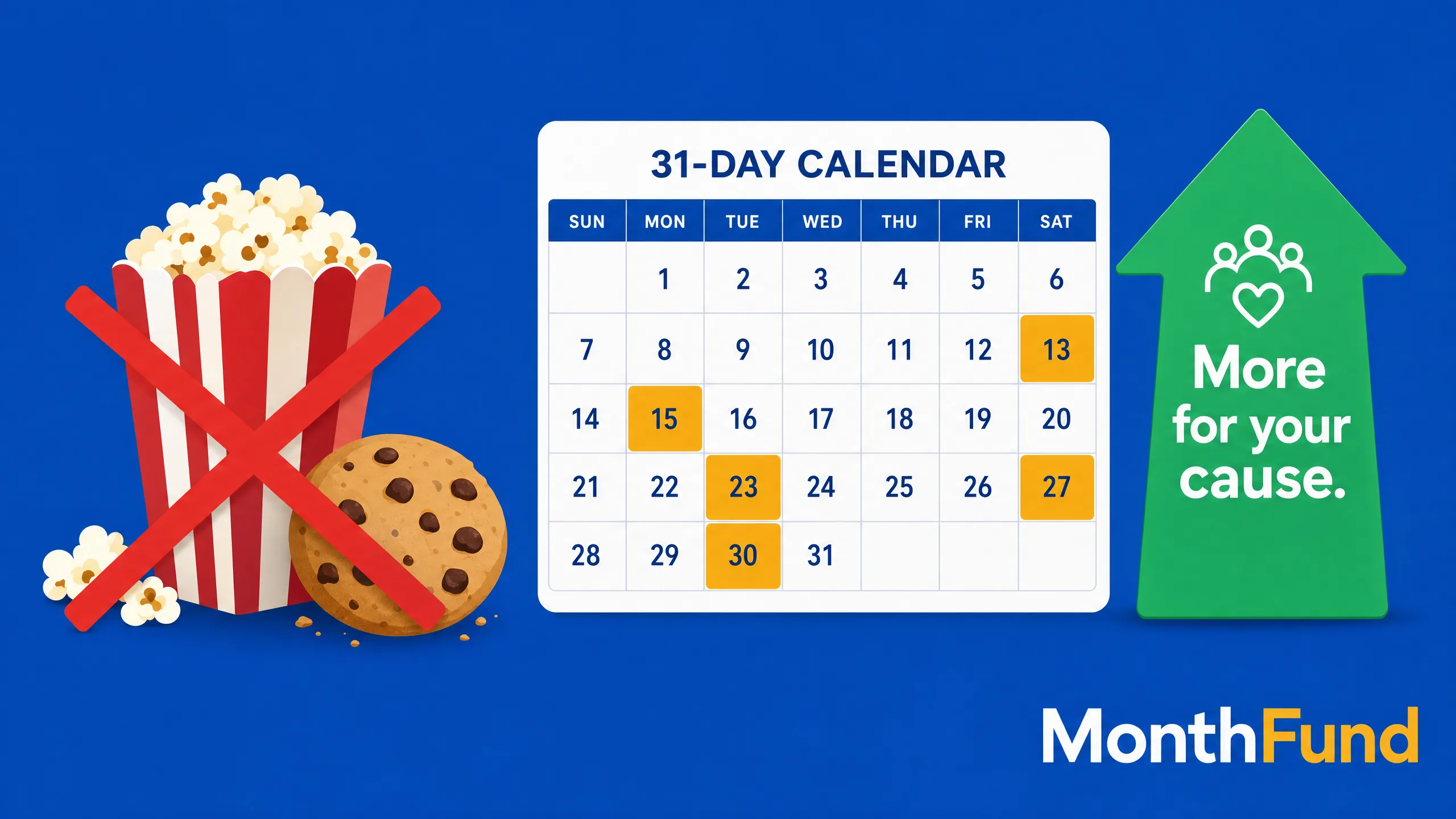
Traditional product fundraising has its place, but it often carries a heavy logistics load. Here is how adding a 'no-product' calendar layer can help you raise more between your major events while giving your volunteers a much-needed break.
“You don't have to choose between products and profit. A calendar fundraiser acts as a logistics-free layer that complements your existing campaigns, allowing you to capture direct donor intent without the overhead of inventory or order forms.”
If you have ever been an organizer for a PTA, a sports booster, or a local nonprofit, you know the "Product Push." It starts with a thick catalog of cookies, popcorn, or wrapping paper and ends three weeks later with a living room full of boxes and a spreadsheet that never quite balances.
These campaigns are a staple for a reason—they offer a familiar way for communities to contribute. However, as volunteer time becomes scarcer and donor preferences shift toward direct impact, many organizations are looking for ways to complement these traditional drives. A calendar fundraiser offers a powerful, logistics-free layer that treats the donor's intent with respect and the volunteer's time as a precious resource.
The Hidden Logistics Tax
Traditional product drives often carry a hidden "logistics tax" paid by your volunteers. When you sell a $20 bag of popcorn, your organization usually keeps about 50%, while the rest goes to the vendor and overhead. But the real cost is the hours spent on:
- Storage: Managing inventory in garages or school lobbies.
- Distribution: Coordinating pickups and multi-trip deliveries.
- Reconciliation: Tracking physical orders and balancing the books.
By adding a zero-inventory calendar month to your annual plan, you can capture revenue that goes 100% to your cause without adding a single box to your storage room.
Why Donors Prefer Direct Support
There is a growing "product fatigue" among donors. Your supporters already have enough cookies in the pantry and wrapping paper in the closet. When they give to your cause, they want to help the cause, not buy another item they don't need.
Direct giving is cleaner. It's more transparent. When a donor claims Day 22 for $22, they know exactly where that money is going. They aren't wondering how much of their gift is being eaten by a third-party vendor. This transparency builds deeper trust and often leads to larger, more frequent gifts over time.
The Calendar as the Product
In a calendar fundraiser, the calendar itself provides the structure and social proof that a catalog used to provide. Organizers launch a month, fundraisers each share a calendar, donors claim days, and progress stays visible until the month fills.
The calendar provides social proof: seeing other days filled encourages new donors to join in. It provides urgency: open days are visible gaps that need to be closed. And it provides gratitude: every donor gets their own "day" on the grid, making their contribution feel personal and celebrated.
Comparing the Math: Popcorn vs. Calendar
| Metric | Popcorn Drive | Calendar Month |
|---|---|---|
| Total Sales / Donations | $10,000 | $10,000 |
| Vendor Share (50%) | -$5,000 | $0 |
| Processing Fees (est.) | -$300 | -$300 |
| Net to Organization | $4,700 | $9,700 |
| Volunteer Hours | 40+ hours | 5-10 hours |
| Inventory Logistics | Heavy | None |
The math is stark. To put $10,000 in your bank account via a product drive, you have to sell $20,000 worth of stuff. To do the same with a calendar month, you just need to fill the grid.
You shouldn't have to be a part-time logistics manager to support your community. The 'No-Product' model returns the focus to what matters: the mission.
If you're ready to trade the catalogs for a clearer, more profitable month, start with our launch checklist or see how to model your first $10k month. For a full explanation of the pick a date model, the pick a date fundraiser guide covers the mechanics end to end.
How much can your community raise?
Use our interactive calculator to model your potential outcomes based on participant count and fill rate.
Tired of inventory?
Join hundreds of organizers who have switched to a logistics-free calendar model.
Common Questions
Do donors really prefer not getting a product?
Many do. While a catalog sale can be a fun tradition, modern donors often prefer the transparency of a direct gift. Offering a calendar month alongside or between your product drives gives them the choice to support you directly.
Is it harder to ask for money without a product?
Actually, it's often more personal. A clear, bounded request like 'I'm filling Day 15, can you give $15?' feels like a collaborative effort to fill a gap, which many supporters find more meaningful than a transaction.
How much more can we raise compared to popcorn?
Because you keep nearly 100% of the donation (minus standard processing fees), a calendar layer often nets 2x or 3x more per donor than a traditional product drive, making it a high-impact companion to your existing toolkit.
How do I convince my board to switch?
Don't think of it as a switch, but as an addition. Show them how a calendar month can bridge the gap between major events with zero extra logistics or inventory risk.
What's the first step to launch?
Check out our launch checklist to see how simple it is to layer a calendar fundraiser into your current annual plan.
Keep Exploring
View all posts →The buy-a-block fundraiser: funding physical projects square by square
Mechanically identical to a calendar fundraiser, the buy-a-block model frames the grid around physical spaces. It is the perfect structure for funding community gardens, playgrounds, and neighborhood murals.
Calendar Fundraiser vs. GoFundMe: Why the Goal Meter Causes Donor Fatigue
GoFundMe is built for emergencies. A calendar fundraiser is built for structured, recurring organizational fundraising. Here is why the open-ended goal meter stalls, and why the 31-day grid works better for schools and teams.
How calendar fundraisers fit with galas, catalogs, and other fundraising (toolkit, not replacement)
MonthFund is one powerful layer in a larger toolkit. See how a calendar month complements product sales, ticketed events, and open donate pages, with patterns you can use around a 5K or gala.