
Faith community calendar fundraiser: stewardship season on one month grid
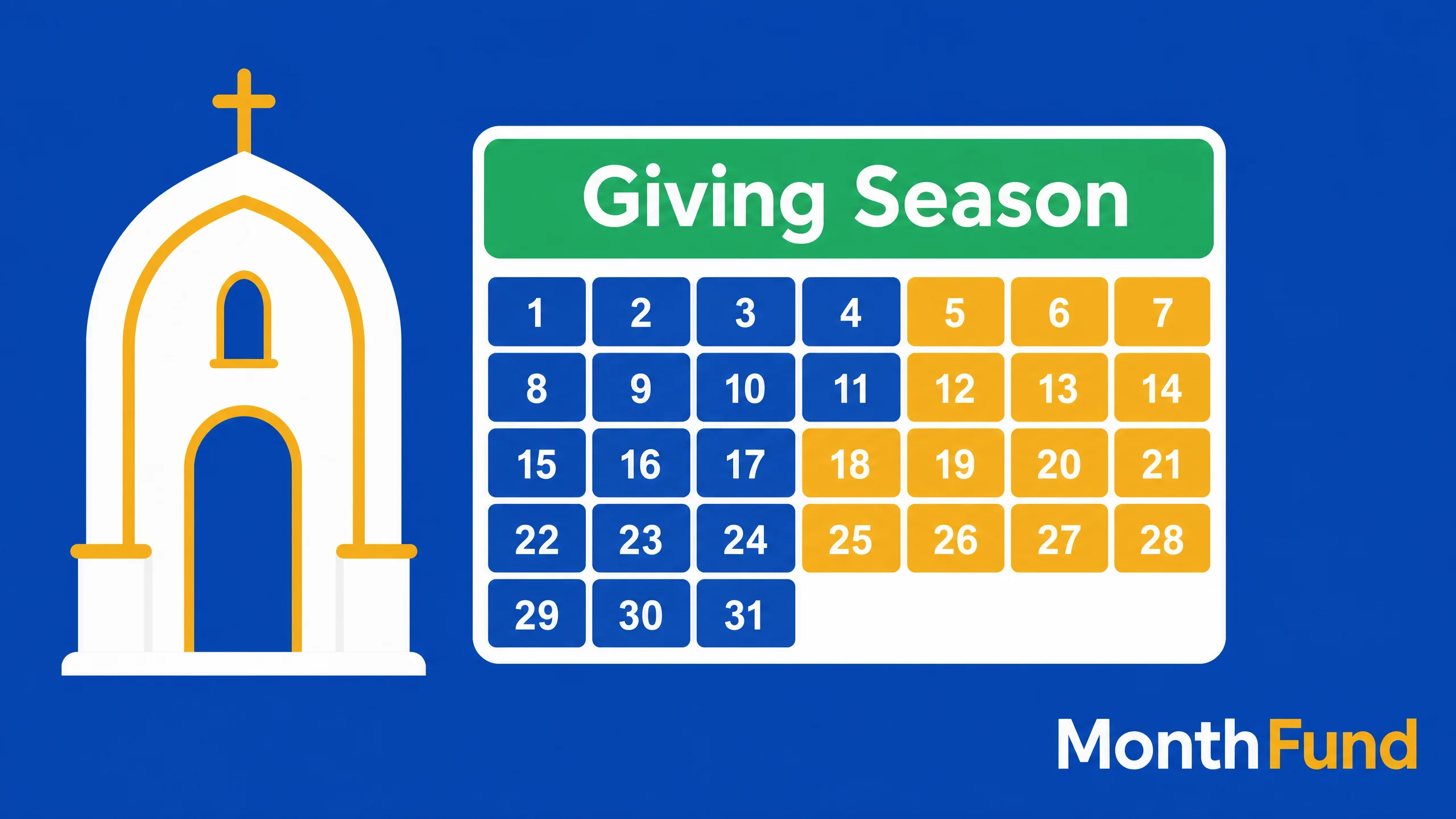
Giving seasons work when the community sees a clear role for more than a handful of households. A calendar fundraiser gives stewardship a month-shaped structure: named days, active participants, and a public grid that belongs to the whole congregation.
“Stewardship is about communal participation. Use a calendar month to let every household own a specific day, moving beyond reliance on major donors to create a shared narrative of giving that fits naturally into liturgical rhythms.”
Most congregations already run pledges, special offerings, dinners, capital phases, and targeted appeals. None of that has to disappear. A calendar fundraiser is another lane in the same spirit as communal giving itself: many people carrying something visible together. MonthFund is software for that month; it does not replace theology, polity, or your treasurer's good judgment. Nothing here is tax, canonical, or legal advice for your tradition or jurisdiction.
If the format is new to your team, anchor first in how calendar fundraisers fit with galas, catalog programs, and other fundraising, then return here for stewardship-specific execution.
Organizers launch a month, fundraisers each share a calendar, donors claim days, and progress stays visible until the month fills.
Stewardship rhythm and one bounded month
Stewardship is a relationship pattern: gratitude, intention, proportion, hope. Fundraising that reflects that pattern needs clarity, not endless "please share" banners. A calendar month gives you a bounded chapter: a start date, an end date, and a picture of progress that fits Sunday rhetoric ("we are filling March together") better than a thermometer alone.
The bounded window matters psychologically. Open-ended asks drift lazily into next quarter. A month closes. People can say yes to a season of effort without pretending their whole budget conversation is finished forever.
Congregational participation, not only major donors
Every community has households who can lead with large gifts. A healthy congregation also wants breadth: people who would never headline a banquet but will honor a specific ask they can explain to their cousin. Claiming Day 12 means "I am carrying $12 of communal work this month," with a face and a story someone outside your pew can understand.
For why public grids and named days change follow-through compared to a single aggregate goal, read why the calendar grid matters for accountability.
How it sits in your toolkit
Use the month alongside pledges, dinners, mission trips, and capital pushes. Example pairings: a stewardship letter names the annual theme; the calendar month lets committees and families embody the theme in daily asks. A youth trip still sells tickets; the month gives host families a peer path that is not another SKU of chocolate.
If leadership worries about competing with the general fund, name the campaign context clearly (building, outreach, scholarship, relief) and let the calendar's transparency show how this slice connects to mission. Segment FAQ angles match how many churches already think about special initiatives.
Who runs it and what to line up
Effective launches usually pair spiritual leadership (why we are doing this now) with operational leadership (who owns invites, reminders, and treasury questions). A stewardship committee or finance team often schedules the month; clergy name it from the pulpit; office staff get clean links for the newsletter and website.
Before you announce publicly, walk the launch checklist so invitations, banking, and the public page match what you promise verbally.
Timing examples without prescribing one tradition
Communities concentrate giving around different calendars: fiscal year, programmatic seasons, holidays, and local moments of need. You do not need this article to pick your correct window. You do need agreement internally: why this month, what counts as success, and how people ask outsiders to join.
Name examples in copy only as illustrations, not prescriptions. A spring push after Easter, a fall stewardship window, a discrete ministry month for relief, a youth summer goal: the model stays the same even when the story changes.
One campus or many tables
A single congregation can run one public month for everyone, or give ministries their own calendars when competition is friendly and accounting is clear. Smaller sites often win first with one month, one story. Multi-site communities may serialize months or tag teams by geography so leaders are not duplicating the same ask without coordination.
Messaging you can paste
Bulletin / newsletter: "We are filling [Month] together. Claim a day, invite your network to give that amount, and watch the calendar reflect our common work. Questions? [Link to your public page and organizer contact]."
From the pew (spoken): "This is not about guilt. It is about a month where everyone can carry one day. If you have never led a fundraiser before, this is the gentle shape for you."
Email to participants: "Your job is simple: own your day, message five people you already trust, thank them whether they give or not, and mark your day fulfilled when gifts land. The calendar stays public so we celebrate honestly."
Trust, transparency, and fees
Tell people where money flows (which fund, which initiative) and that card processing carries normal fees your treasurer can document. If someone asks how totals compare to "if every box fills," share planning math from the $496 number and modeling fill rates as a structure, not a pledge of outcomes.
When a calendar month should not lead
Skip leading with this format if your community is grieving or divided in a way that makes fundraising tone-deaf, if you are mid-capital feasibility with conflicting messages, or if you cannot roster a credible first wave of participants. Better to wait one season than to launch a hollow grid.
Recruitment still drives success. If you need a cohort playbook, use how to recruit 25 participants for your first calendar fundraiser and adapt invites to church relationships (small groups, boards, families).
Next steps for leaders
Read how MonthFund frames faith communities on MonthFund for faith communities, then open a free account when you are ready to set the month: sign up free. Product mechanics and donor experience are summarized on How it works. Unusual governance questions belong with your counsel and our team together only for product fit, not for interpreting church law or tax rules.
For the full model overview, the pick a date fundraiser guide explains the mechanics and math in plain terms.
How much can your community raise?
Use our interactive calculator to model your potential outcomes based on participant count and fill rate.
Built for your community
Whether it's mutual aid, school support, or local relief, we have the tools to help you scale.
Common Questions
Does this compete with our general fund?
Not usually. By framing it for a specific ministry or relief effort, it often activates 'extra' giving from households who want to see a concrete impact.
Is the public grid appropriate for church?
Yes, many congregations find that the 'common work' of a visible grid reinforces their values of transparency and shared responsibility.
How do we introduce this to the congregation?
We recommend a brief announcement during service and a follow-up in the weekly bulletin with a link to our 'how it works' guide.
Can it be used for youth mission trips?
Absolutely. Mission trips are a perfect use case for the rhythmic, peer-to-peer nature of a calendar month.
What are the platform fees?
Our pricing is transparent and designed to be affordable for communities of all sizes. View the details here.
Calendar fundraisers for your group type
Keep Exploring
View all posts →December Giving Calendar for Churches: Advent Plan
A December fundraising plan for churches that invites steady participation while keeping the mission, not pressure, at the center.
Youth sports travel fundraising: a season budget and calendar plan
Start with the trip budget, subtract committed funds, then set a fundraising target for the gap. Use conservative fill-rate scenarios to decide whether one calendar month is enough.
How calendar fundraisers fit with galas, catalogs, and other fundraising (toolkit, not replacement)
MonthFund is one powerful layer in a larger toolkit. See how a calendar month complements product sales, ticketed events, and open donate pages, with patterns you can use around a 5K or gala.