
Grassroots calendar fundraiser: fast coordination for local campaigns
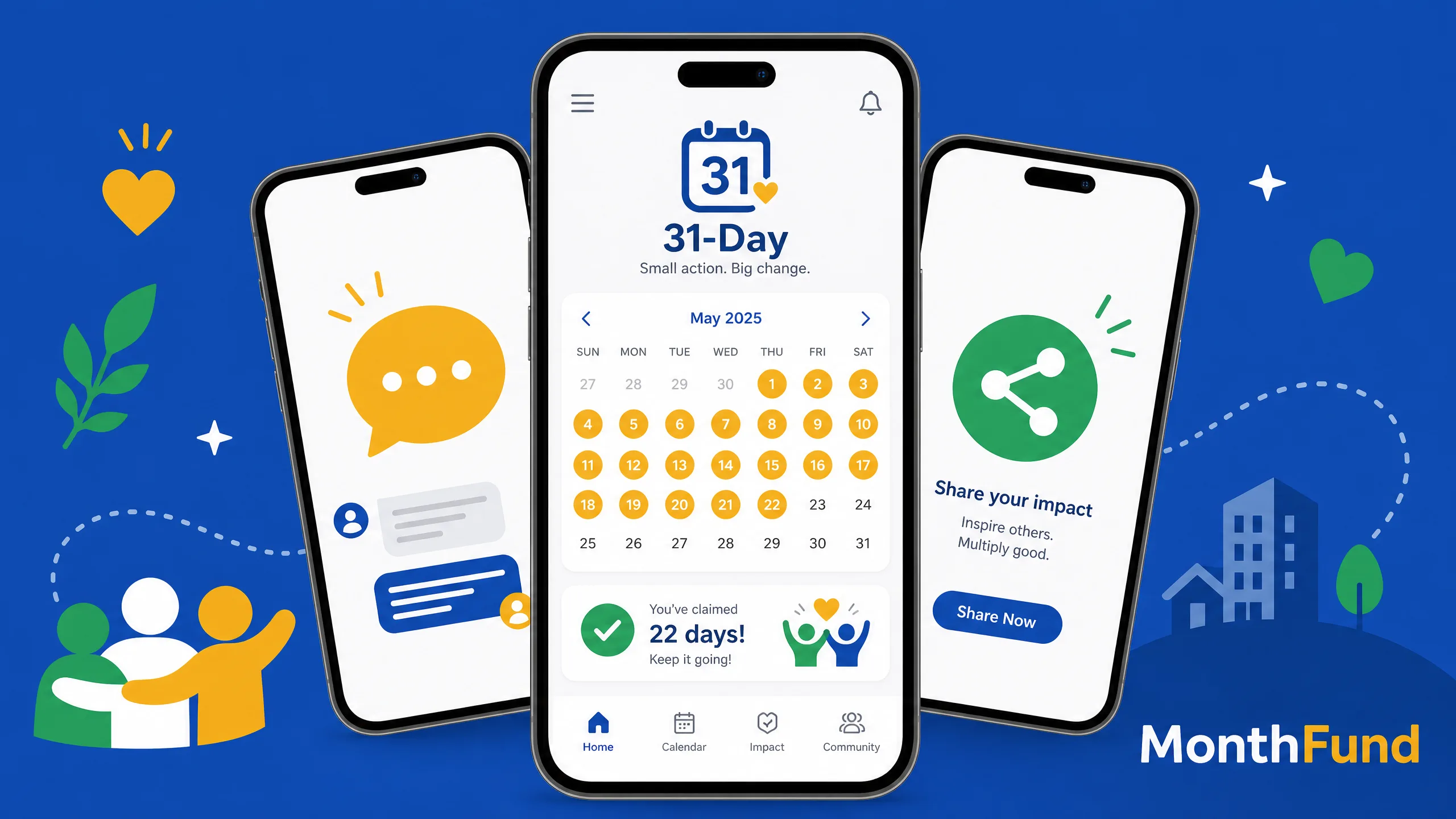
Grassroots teams, local orgs, and issue campaigns often have wide sympathy and shallow coordination. A calendar fundraiser gives you a bounded month, many peer fundraisers, and a public grid you can launch while momentum is still real.
“Speed is critical for grassroots momentum. Launch a calendar fundraiser in minutes to turn supporters into active peer fundraisers, using a visible grid to drive accountability and results without top-down nagging.”
Your people want to help. The hard part is turning that goodwill into activated networks before the moment passes. Week One everyone shares the same donate link; by Week Three the same five organizers are carrying every follow-up. A calendar fundraiser does not fix politics or community fatigue, but it does give every recruited participant a defined job: own a day, ask their own people, show progress on a grid everyone can see. MonthFund is coordination software, not a replacement for legal advice or campaign finance compliance. Read that twice if you touch electoral work.
For how this format sits in a broader toolkit (not zero-sum with events, merch, or other tools), start with how calendar fundraisers fit with galas, catalog programs, and open donate pages. This article is about tempo: fast launch, distributed outreach, and the month as a shared scaffold.
The coordination problem
Grassroots groups share a pattern: lots of people agree with you, fewer people know what to do this week. A generic link to a donation page produces one-off gifts and leaves the emotional labor concentrated in a tiny core. Issue spikes and election windows compress that further: you either convert attention into structure quickly, or you burn out the people who were already doing too much.
Peer fundraising is the fix in principle: supporters pull their own networks. In practice, peer fundraising without shape becomes hand-wavy ("share this") and hard to track. A month calendar makes the shape visible: numbered days, owners, open boxes, filled boxes. Supporters step into roles instead of hovering through another awareness-only cycle.
The goal is not a hotter banner graphic. It is more people owning a concrete slice of the work while the window is open.
What we mean by a calendar fundraiser here
In MonthFund terms, a calendar fundraiser is the month-scale version of the same motion we describe everywhere: Organizers launch a month, fundraisers each share a calendar, donors claim days, and progress stays visible until the month fills. Day amounts map to calendar dates (for example, Day 15 is a $15 ask). Organizers recruit fundraisers; each fundraiser has their own grid; donors claim days and give at least that amount. Progress stays public so the group can steer without constant top-down nagging.
Product detail and visuals live on How it works. Here we stay at the level of why grassroots campaigns adopt it.
Why it fits fast cycles and momentum
A ballot push, a district field program, a neighborhood defense fund, a chapter working a defined deadline: these moments need speed without chaos. You are not wrong to prioritize a rally, a canvass launch, or a press beat. You can still add a month layer that turns passive signal into named commitments while the feed is hot.
MonthFund is built so a campaign can go live on short notice. The strategic question is not perfection on day one; it is whether you give new participants a task they can finish in an evening: claim a day, message five people, know what "done" looks like for that day. That is the same clarity that turns issue energy into dollars without waiting for a merchandise vendor or a gala committee.
How it sits in your toolkit
Treat the calendar month as one lane next to everything else you already run: small-dollar email, events, SMS programs, donor meetings, membership dues, grants. It does not have to "replace" those things. It gives participants a bounded way to plug in when asking them to "donate" alone feels too vague and asking them to "volunteer ten hours" is not realistic.
If you are comparing structures rather than channels, revisit the pillar explainer: calendar fundraisers in the larger fundraising toolkit. The short version is alongside, not instead of.
For organizers who feel the difference between a one-off burst and longer community care, note that ongoing mutual aid groups often emphasize rhythm and sustainability over a sprint. MonthFund supports both patterns, but the emotional center of those stories is different; see MonthFund for mutual aid when the long arc is the point. This post stays focused on campaign tempo.
The motion, step by step
- Set the month and the public campaign name. Choose a calendar window your core team can defend for the full month.
- Recruit fundraisers who will own days, not just cheer. Quality over vanity roster size beats forty names that never message anyone.
- Each fundraiser shares their personal calendar with their network (text, email, social). One shareable campaign link still anchors the whole effort.
- Donors claim days and give. Filled days become receipts you can celebrate in group channels. Open days stay visible, which matters more than hiding the scoreboard.
The same scaffolding shows up in civic contexts that are not electoral at all. Parent groups already run an almost identical pattern when they put the month to work for a program budget; the same muscle applies to local orgs with a shared checking account and a treasurer who needs cover. If that parallel helps your committee picture the model, compare notes with MonthFund for schools and PTAs, then translate the roles back to your campaign.
Accountability without nagging
A single thermometer hides who is stuck. A month grid shows which days still need an owner or a gift. That public legibility is a feature for grassroots teams that do not have a development department: participants hold each other accountable because the structure is obvious, not because the lead organizer sends another guilt email.
For the argument that structure itself drives follow-through (not only cheerleading), read why the calendar grid matters for accountability.
Recruitment when time is short
Ideal world: you roster twenty-five strong participants before launch. Real world: you sometimes launch with twelve people who can move tonight. Be honest about the tradeoff: fewer nodes means fewer networks reached. The fix is tighter coaching and faster personal asks, not pretending twelve is twenty-five.
The full playbook for building a cohort is in how to recruit 25 participants for your first calendar fundraiser. Steal the pieces that fit a compressed timeline: name your first ten by hand, confirm verbally, then widen. Under pressure, prioritize people who already message their own circles without you chasing them.
Structural floor, not a promise
A complete 31-day path at face values sums to $496; that arithmetic is a planning floor, not a forecast of your community. Real campaigns often beat the floor because donors give above the day amount; some months fall short when fill rates lag. The important organizer habit is to model scenarios before you promise budgets downstream.
Walk the numbers with examples in the $496 number and how to model your month so your steering committee shares the same expectation about what "full" means.
Repeat months and organizing infrastructure
One successful month teaches your base what a filled grid feels like. Repeating the format on future cycles deepens the habit: more people know the script, fewer need hand-holding, and your list of proven peer fundraisers grows. You are building infrastructure, not just a one-off spike, even when each campaign stays time-bounded.
Keep this section light if your group is still on month one. The strategic point is simple: repeatability is a feature, not an obligation to run twelve months a year.
Data, trust, and your list
Participant and donor relationships belong to your organization inside your MonthFund account. We do not sell that data; your list is yours to steward. For money movement, be upfront about card processing: standard payment rails have visible fees; your treasurer should treat them like any other online fundraising line item. If your community asks where dollars land, answer at the level of program or committee, in the same plain language you would use at a public meeting.
Compliance and jurisdiction
MonthFund provides software to coordinate giving. It does not tell you whether a specific committee, candidate, or ballot effort may raise or spend in a particular way. Political campaigns and other regulated entities must confirm campaign finance rules in their jurisdiction before running any fundraiser here. We do not prepare filings, advise on limits, or interpret local election law. This paragraph is not legal advice; if you are uncertain, talk to counsel familiar with your geography and committee type.
If your situation is unusual and you need a human before you commit, use contact us so we can point you to product detail without pretending to be your compliance shop.
When a calendar month is not the right lead
Be candid with yourself. A calendar sprint is a weak lead if your community is exhausted, if leadership is mid-crisis, if legal constraints on who can solicit have not been answered, or if you still need major donors to carry fixed costs before small-dollar makes sense. It is also the wrong moment if nobody will recruit fundraisers, even with a perfect toolkit. Honest constraints protect trust.
Next steps
If the shape fits, route your team through three doors: the segment story for your people, MonthFund for grassroots campaigns; the operational list before you go live, the launch checklist; and a free account when you are ready to open the month, sign up free.
Common questions
Can we launch during an active issue moment? Yes. Speed is part of the design. You still need a shortlist of fundraisers and a clear month, but you do not need a week of ceremony to publish a usable grid.
Is MonthFund only for elections? No. Local nonprofits, mutual aid pods (for one month), neighborhood funds, and advocacy chapters use the same coordination pattern. Electoral examples show up because deadlines are sharp, not because the software is limited to them.
Is MonthFund suitable for political campaigns? It can be used as fundraising coordination software. Campaigns must verify that their planned use complies with applicable regulation; MonthFund does not manage compliance filings.
What happens to participant contacts we build? They stay in your organization's account. You control exports and follow-up; we do not monetize your list.
For the full model overview, the pick a date fundraiser guide explains the mechanics and math end to end.
How much can your community raise?
Use our interactive calculator to model your potential outcomes based on participant count and fill rate.
Built for your community
Whether it's mutual aid, school support, or local relief, we have the tools to help you scale.
Common Questions
Can we launch this in 48 hours?
Yes. As long as you have a core list of 10-15 people ready to claim days, you can go from zero to live almost immediately.
How do we handle campaign finance rules?
MonthFund provides the software, but you must ensure your campaign complies with local regulations. Always verify your specific setup with your compliance lead.
How do I activate supporters quickly?
Fast activation comes from direct asks. Use our participant recruitment playbook to move your supporters to action.
What's the difference between this and GoFundMe?
GoFundMe is a bucket. A calendar is a map. The grid structure drives higher accountability and more predictable results.
How do we report totals?
Your admin dashboard provides real-time reporting on all contributions, which you can export for your compliance needs.
Calendar fundraisers for your group type
Keep Exploring
View all posts →December Giving Calendar for Churches: Advent Plan
A December fundraising plan for churches that invites steady participation while keeping the mission, not pressure, at the center.
Youth sports travel fundraising: a season budget and calendar plan
Start with the trip budget, subtract committed funds, then set a fundraising target for the gap. Use conservative fill-rate scenarios to decide whether one calendar month is enough.
How calendar fundraisers fit with galas, catalogs, and other fundraising (toolkit, not replacement)
MonthFund is one powerful layer in a larger toolkit. See how a calendar month complements product sales, ticketed events, and open donate pages, with patterns you can use around a 5K or gala.