
Why MonthFund works for schools and PTAs: the calendar fundraiser structure parents can trust
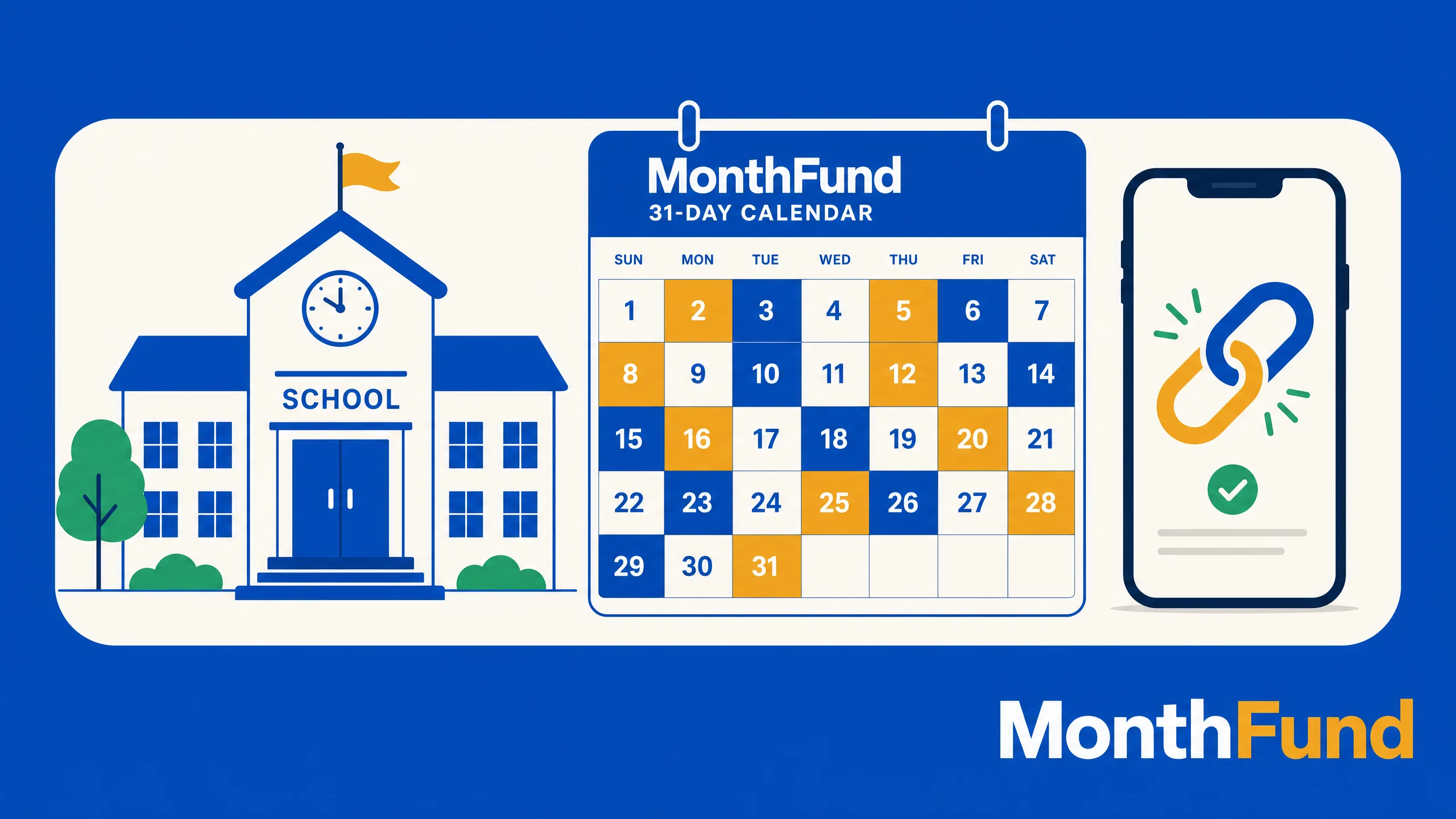
No products to sell for this campaign. No separate app for parents to learn. Here is why a calendar fundraiser fits PTA life, including alongside auctions, fun runs, or catalog seasons you already rely on.
“Skip the order forms and inventory. A calendar fundraiser gives parents a simple, bounded task: 'I own Day 14, can you give $14?' It's high-trust, low-friction, and ensures 100% of the focus stays on the school's needs.”
Most schools run a mix of fundraisers over a year: a catalog season, an auction, a fun run, a spirit night. Those formats work for different goals and audiences. A calendar fundraiser does not have to displace them. It gives you a month where the ask is a numbered day, the dollars are transparent, and many parents can share the load.
Yes, catalog drives still show up in many districts, and they can be effective when the timing and incentives fit. They can also leave the same parents juggling order forms and the treasurer reconciling splits. MonthFund is another tool when you want structure without inventory for that window.
What makes school fundraising uniquely difficult
Schools operate under constraints that most organizations do not face. Parents are time-poor. The ask has to be clear and low-friction or it gets ignored. Students cannot be primary fundraisers in the traditional sense, they are children, and their networks are their parents' networks. The organizer (usually the PTA president or a room parent) is a volunteer with limited bandwidth.
Vendors, platforms, and incentive programs can help with catalog programs and they add steps: coordination, fulfillment, and a share of the gross. That tradeoff can still be worth it for your community. MonthFund lives on a different path: no product intermediary for the calendar month itself, just payment processing and a clear day grid.
MonthFund responds to school constraints by giving parents a defined job: claim a day, name the dollar amount, ask your network for that amount.
How the model fits the school context
The PTA runs a MonthFund campaign for, say, February. Twenty-five parents are invited to participate. Each claims a day of the month. Day 7 means they ask their network, family, friends, colleagues, for a $7 donation. Day 22 means they ask for $22.
The ask is not "support our school." The ask is: I claimed Day 14. I'm raising money for my child's school. Can you donate $14?
This specificity changes the dynamic. It is not a guilt trip or a sales pitch. It is a clear, bounded request with a specific amount that the donor can immediately say yes or no to. Many parents describe less discomfort with this shape of ask than with open-ended "support our school" language layered on top of merchandise.
The ask is not "support our school." It is: I claimed Day 14. Can you donate $14?
No products, no split, no awkwardness
The most common feedback from PTAs using the MonthFund model is relief. No products. No vendor. No percentage going somewhere other than the school. Every dollar donated goes directly to the organization, minus standard payment processing fees, which are transparently disclosed.
For a school with 25 participating parents running at 80% fill rate in a 28-day February, the expected outcome is approximately $8,120. Run it again in March. Run it in April. The model compounds.
| Campaign | Month | Expected outcome (25 parents, 80%) |
|---|---|---|
| Campaign 1 | February | $8,120 |
| Campaign 2 | March | $9,920 |
| Campaign 3 | April | $9,300 |
| Total (3 months) | , | $27,340 |
How to structure a school campaign
The PTA president or lead organizer acts as the campaign organizer. The participants are parents, ideally the most engaged parents in each classroom or grade level. The campaign runs for the full month. The public campaign page goes in the school newsletter and the PTA email list.
A few things that work particularly well in the school context:
- Grade-level campaigns: Each grade runs its own campaign with its own calendar. Grade parents recruit from their classroom community. The grade that fills the calendar first gets a small recognition, pizza party, extra recess. Friendly competition within a school drives fill rates up significantly.
- Teacher participation: When a teacher claims a day alongside parents, it signals that this is a whole-community effort, not just a parent obligation. Teachers with larger networks, or who teach multiple sections, often make strong Day 20–28 participants.
- End-of-month reveal: At the last assembly or meeting, show the filled calendar. Name the participants. Make the collective achievement visible. The visual impact of a complete calendar reinforces the community identity that makes future campaigns easier to run.
The comparison parents make immediately
Parents often stack this model mentally against whatever ran last fall or spring. They notice the specific dollar tied to a specific day, the visible grid, and the absence of a catalog for this particular campaign. That does not mean your last fundraiser was a mistake; it means this format answers a different set of burdens for a focused month.
For a fuller look at how the month grid fits with other fundraiser formats, read how calendar fundraisers fit with catalog sales, events, and open-ended pages.
Schools benefit when the toolbox includes something with structure, clarity, and respect for time. MonthFund is built to be that month-shaped layer when you choose it.
If you are still comparing formats, the pick a date fundraiser vs. fun run guide walks through the tradeoffs side by side for school audiences specifically. The pick a date fundraiser landing page covers the full model with the math.
How much can your community raise?
Use our interactive calculator to model your potential outcomes based on participant count and fill rate.
Built for your community
Whether it's mutual aid, school support, or local relief, we have the tools to help you scale.
Common Questions
How do parents handle the asks?
Most parents find it easier to ask for a specific calendar day amount than a generic donation. It feels like 'filling a gap' rather than 'selling a product'.
Can we run this alongside our annual auction?
Absolutely. Many PTAs use a calendar month as a 'logistics-free' push in the spring or fall to complement their main event.
Is this safe for schools?
Yes. We use industry-standard encryption and Stripe for payment processing. We never store donor credit card information on our servers.
How do we handle the money?
Funds are deposited directly into your organization's linked bank account via Stripe. You can track everything in real-time.
What is the launch timeline?
Most schools can launch in 2-3 weeks. We provide a comprehensive launch checklist to keep you on track.
Calendar fundraisers for your group type
Keep Exploring
View all posts →December Giving Calendar for Churches: Advent Plan
A December fundraising plan for churches that invites steady participation while keeping the mission, not pressure, at the center.
Youth sports travel fundraising: a season budget and calendar plan
Start with the trip budget, subtract committed funds, then set a fundraising target for the gap. Use conservative fill-rate scenarios to decide whether one calendar month is enough.
How calendar fundraisers fit with galas, catalogs, and other fundraising (toolkit, not replacement)
MonthFund is one powerful layer in a larger toolkit. See how a calendar month complements product sales, ticketed events, and open donate pages, with patterns you can use around a 5K or gala.