
Digital vs. paper calendar fundraiser: why the grid moved online
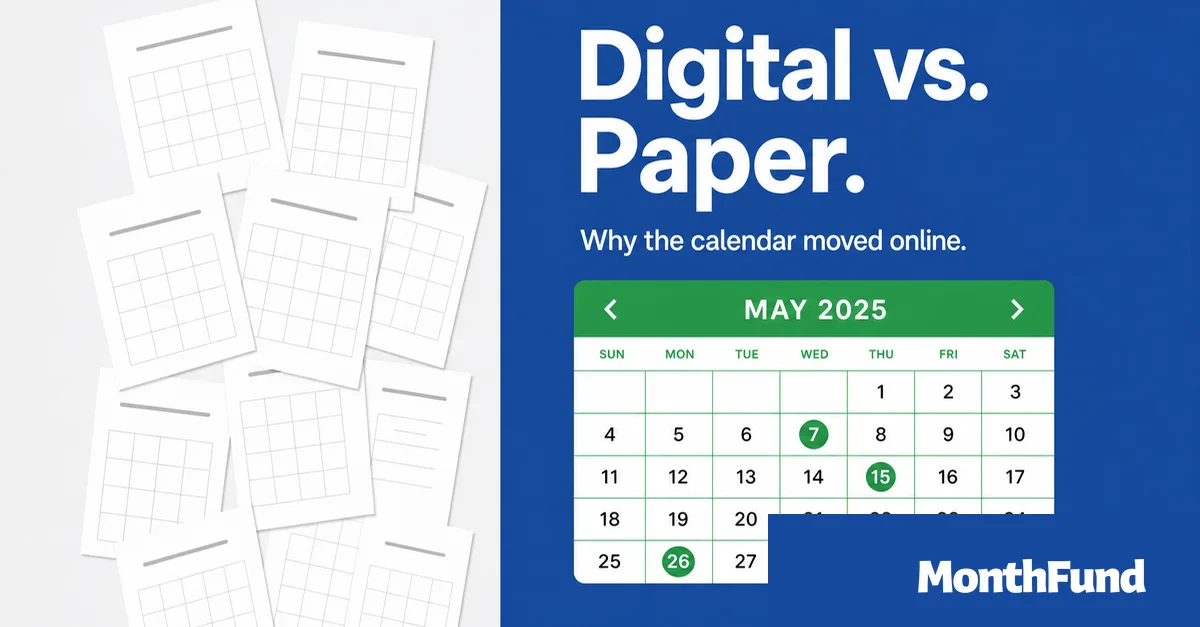
The calendar fundraiser started on paper. A printed month grid on the gym wall, names written in marker, cash in an envelope. The model worked then and it works now. What changed is everything around the grid: who tracks it, who can see it, and how much of the organizer's week it eats. Here is an honest look at both versions.
“Paper works for one small group in one room. It breaks the moment you have more than one person collecting, donors who are not physically present, or a treasurer who has to reconcile cash against names in marker. A digital grid keeps the same model, then adds live progress everyone can see, one page per participant, automatic receipts, and totals that reconcile themselves.”
Search for a calendar fundraiser template and you will find printable grids ready to tape to a wall. Nothing is wrong with them. The pick a date model is older than the software, and the math is identical on paper and on a screen: 31 days, each worth its day number, $496 when full.
So the question is not which version of the model is better. It is which version of the work you want: the organizer's work of tracking, collecting, and reporting.
What paper gets right
A physical calendar in a busy hallway has real advantages. It is impossible to ignore. It needs no login and no explanation. Watching names appear in marker day after day is exactly the visible momentum that makes this model work. For a single room of people who all walk past it, paper is genuinely good.
Where paper breaks
Paper breaks in predictable places, and every one of them lands on the organizer.
- Remote donors cannot claim a day. Grandparents, coworkers, and anyone not in the building are locked out, and those are often the most willing givers.
- One calendar means one collector. The model scales by giving each participant their own grid. On paper, ten participants means ten posters and ten envelopes of cash to chase.
- Reconciliation is manual. Someone matches names in marker against cash and checks, then produces a total the board will trust. That someone is usually a volunteer treasurer with a day job.
- Progress is invisible between visits. The grid only motivates people who see it. Everyone else hears about it once and forgets.
What the digital grid adds
Moving the grid online keeps the model and removes the clerical work. A digital calendar is a link anyone can open. Donors claim a day and pay in the same minute, from anywhere. The grid updates itself, so the visible-progress effect reaches every phone instead of one hallway. Each participant gets their own page, so 25 people can each run a calendar without 25 envelopes. And every gift is recorded and receipted automatically, so the month closes with an export instead of a counting session.
Side by side
| Paper grid | Digital grid | |
|---|---|---|
| Who can claim a day | People in the building | Anyone with the link |
| Progress visibility | One hallway | Every phone, live |
| Calendars per campaign | One per poster | One per participant |
| Collection | Cash and checks by hand | Card at the moment of claiming |
| Reconciliation | Manual, volunteer hours | Automatic records and exports |
| Receipts | Handwritten or skipped | Automatic |
When paper is still fine
If your whole donor base fits in one room, a printed grid and an envelope will do the job, and we mean that without irony. Some organizers even run both: a wall calendar for the room and a digital one for everyone else, then combine totals at the end. The model is the point, not the medium.
Next steps
If your campaign has outgrown the hallway, start a free digital calendar and share the link where your people already are. Then plan the month with the full playbook and keep it moving with week-by-week nudges.
How much can your community raise?
Use our interactive calculator to model your potential outcomes based on participant count and fill rate.
Ready to launch?
Set up your first fundraiser in under 10 minutes. No credit card required.
Common Questions
How does a paper calendar fundraiser work?
You print a month grid where each day shows a dollar amount (Day 12 equals $12), post it somewhere visible, and supporters write their name on a day and hand over that amount. A full 31-day calendar collects $496. The organizer tracks names, collects cash or checks, and updates the grid by hand.
Is there a free calendar fundraiser template?
Yes. Any month grid works: print a blank calendar, write the day numbers as dollar amounts, and add your cause at the top. The template is not the hard part. The hard part is tracking who claimed which day, collecting the money, and showing progress to people who never see the physical calendar.
Do paper calendar fundraisers still work?
For a single classroom, break room, or small congregation where everyone walks past the calendar, yes. Paper stops working when donors are remote, when multiple participants each need their own calendar, or when someone has to reconcile the cash. That is the point where most organizers move the grid online.
What does a digital calendar fundraiser add?
Four things: a shareable link so anyone can claim a day from their phone, live fill progress that is visible to every donor, per-participant pages so a whole team can run calendars at once, and automatic payment records and receipts so the treasurer reconciles nothing by hand.
Keep Exploring
View all posts →Calendar fundraiser template: the grid, the pricing, and the messaging, ready to copy
Everything you need to build a calendar fundraiser today: the 31-day grid layout, three pricing ladders with their totals, the header copy, and the tracking sheet. Recreate it in any doc or spreadsheet in twenty minutes, or run the same structure digitally.
People powered fundraising: many hands, one month, no hero required
People powered fundraising means many people each carry a small, visible piece of the goal, so no one person carries the whole month. Here is how boards, giving circles, congregations, and neighbors run it on one calendar grid, and why it belongs in the core toolkit of any group that raises money.
How calendar fundraisers fit with galas, catalogs, and other fundraising (toolkit, not replacement)
MonthFund is one powerful layer in a larger toolkit. See how a calendar month complements product sales, ticketed events, and open donate pages, with patterns you can use around a 5K or gala.