
How to run a successful calendar fundraiser (pick a date playbook)
A calendar fundraiser looks simple on paper: thirty-one days, thirty-one dollar amounts, everyone picks a day and gives. Search for a pick a date fundraiser and you will find the same model under a different name. In practice, most months stall because the organizer treated it like a link drop instead of a four-week motion. The good news is that the failures are predictable, and so are the fixes.
“Run the math before you recruit. Give every participant their own pick-a-date calendar page, not one org-wide donate button. Seed a few claimed days before launch so donors never see an empty grid. Then follow a weekly cadence: personal texts first, public milestones second, mid-month nudges third, and a final sprint on the high-dollar days.”
If you have never run a calendar fundraiser (also called a pick a date fundraiser), start with how the pick a date model works. This post is the operational playbook for both phrases — the sequence that separates a month that fills from a month that fizzles.
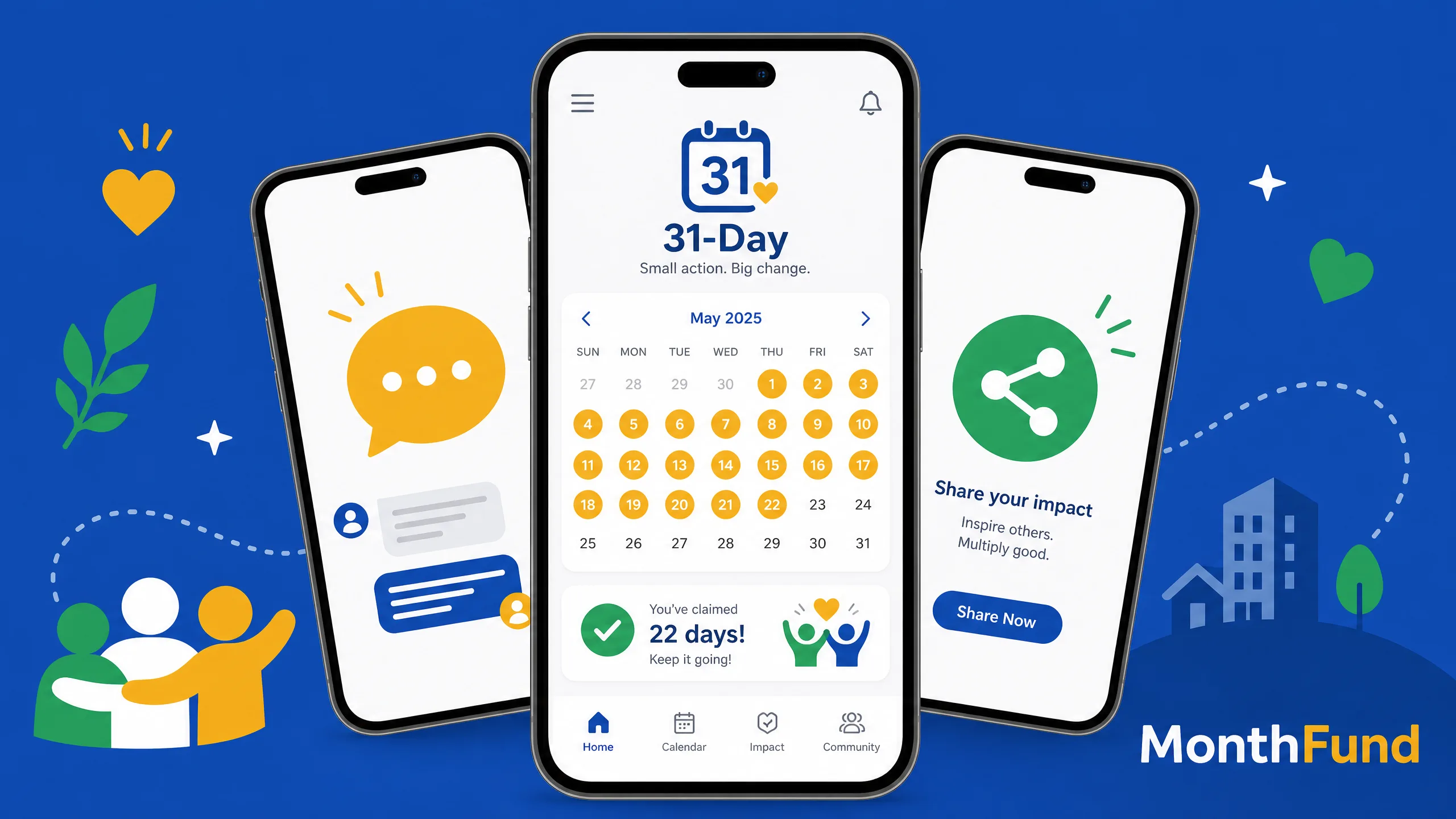
Organizers launch a month, fundraisers each share a calendar, donors claim days, and progress stays visible until the month fills.
Why most calendar months stall
After watching hundreds of campaigns, three patterns explain most soft results:
- No math up front. The board picked a goal because it sounded ambitious. Nobody calculated how many participants that goal requires.
- One link for everyone. The org posted a single donate URL and hoped twenty parents would share it. They did not, because there was nothing personal to share.
- An empty grid on Day 1. Donors opened the page, saw thirty-one blank squares, and bounced. Social proof matters. An empty calendar reads like an empty restaurant.
None of these are willpower problems. They are setup problems. Fix the setup and the same community that would have raised $2,000 can often raise $8,000 or more.
A calendar fundraiser is not a donation page. It is a month-long relay where every participant carries a leg of the pick a date grid.
Calendar fundraiser or pick a date fundraiser?
Same model, two common search phrases. Organizers often say “calendar fundraiser.” Parents and donors more often search “pick a date fundraiser” or “claim a day fundraiser.” A month calendar fundraiser is the same thirty-one-day grid either way.
That matters for how you write outreach. PTA emails can lead with “pick a date for March.” Board decks can say “calendar month.” Both should link to the same public grid. If you are building landing copy, our pick a date fundraiser overview and model explainer cover terminology without duplicating this playbook.
Long-tail searches worth answering on your campaign page (not just in blog posts): “pick a date fundraiser for [school name],” “how to claim a day fundraiser,” and “31 day pick a date calendar.” Put the org name, month, and cause in your title line. Donors who find you through any of those phrases should land on a grid that already shows claimed days.
Step 1: Run the math first
Before you send a single invite, lock three numbers: your goal, your expected average day claim, and a realistic fill rate. A fully claimed single calendar totals $496. That is the floor, not the ceiling — but you cannot plan a $15,000 month with four participants unless you stack multiple calendars per person.
Our guide on hitting your goal in 31 days walks through the recruit formula. The short version: divide your goal by what one active participant typically raises, and that is your headcount target. Write that number on paper before anyone asks “what do I have to do?”
Why this works
Step 2: Recruit people, not promises
Recruitment is the whole game. A calendar month with eight active participants will underperform a month with twenty-five average ones, even if the smaller group works harder. Your job in the two weeks before launch is to convert names on a spreadsheet into yeses on the record.
How to recruit your first cohort covers scripts and follow-up cadence. Two rules matter most:
- Ask individually. A group email gets polite silence. A thirty-second text — “Can I count you in for March?” — gets answers.
- Follow up within forty-eight hours. Email alone converts twenty to thirty percent of a list. Email plus a text follow-up converts closer to half.
Step 3: One pick a date page per participant
Here is the structural choice that separates strong pick a date campaigns from forgettable ones. Give every participant their own public calendar — their photo, their short story, their link — instead of routing all gifts through one org-wide button.
Why it works:
- Distribution scales. Twenty-five links in twenty-five group chats beat one link posted once by the treasurer.
- Ownership is visible. When Maria's calendar shows six green days and James's shows two, healthy peer momentum shows up without shaming anyone.
- Asks feel personal. “Claim a day on my pick a date calendar” is easier to send than “donate to our school.”
For larger targets, read about stacking multiple calendars. Ten participants on separate grids create a $4,960 baseline before any sponsor multiplier.
Step 4: Seed the grid before launch
The most underrated tactic in calendar fundraising is the soft launch. Three to five days before the public start, let your most loyal supporters claim a handful of days — especially the high-number ones ($25, $30, $31).
When a new donor lands on Day 1, they should see a grid that already has life in it. Names on squares signal that other people trusted this campaign. That single visual cue converts browsers into donors at a measurably higher rate than a blank page.
Real-life move
Step 5: Launch week — personal beats public
Launch week is not the time for a single Facebook post and silence. The sequence that works:
- Day 1–2: Each participant texts five people they know will say yes. Not a blast. Five names.
- Day 3–4: First public milestone post — screenshot a filling grid, tag a donor (with permission), name the next open day.
- Day 5–7: Gentle leaderboard energy. Celebrate whoever cleared their first ten days. Ask the bottom third for one more share, not one more dollar.
Encourage every participant to add a clear profile photo and two sentences about why the cause matters to them. Pages with a face and a story convert better than anonymous links every time — donors give to people, not interfaces.
Walk this math with us live every Friday.
We will set a goal, back into a fundraiser count, and work the 31-day cadence in real time. Bring your numbers. Every registrant gets The 31-Day Fundraiser Recruitment & Launch Playbook.
Step 6: The Day 7 dip and mid-month nudges
Momentum almost always stalls around Day 7. Initial enthusiasm fades. Life resumes. This is normal — and it is exactly when most campaigns die from neglect.
How to fill your calendar fundraiser maps nudges week by week. The mid-month essentials:
- Re-send the link to anyone who said “maybe later” in week one.
- Post a halfway update with a specific open day (“Day 19 is still open — $19 moves us to sixty-two percent”).
- Coach quiet participants directly. A personal note — “You are set up, you just have not shared yet” — outperforms a mass reminder every time.
Step 7: Sponsor matches and other accelerators
Once the basics are running, optional multipliers can push a good month into a great one. A local business 1:1 sponsor match doubles the value of every claimed day and gives you a co-marketing partner with their own email list.
Other accelerators worth planning before launch:
- Challenge match. Sponsor pays a lump sum only if the calendar hits one hundred percent by a deadline. Creates late-month urgency.
- Recurring day ownership. Ask donors to claim the same date every month. One calendar can become twelve months of revenue. See our guide on recurring calendar fundraisers.
- District or chapter roll-up. Large orgs run parallel calendars per classroom or team and combine totals for one headline number. The tiered mega-calendar model covers that structure.
What good enough looks like at close
Treasurers often treat anything below one hundred percent fill as failure. It is not. Most healthy campaigns land between seventy and ninety percent. The calendar still produces a number you can bank and repeat next season.
Read what good enough fill rate actually looks like before you report results to the board. Planning with realistic fill assumptions beats apologizing with surprise shortfalls.
Your first-week checklist
Print this pick a date / calendar fundraiser launch list and check boxes as you go:
- Goal, participant headcount, and launch date written down.
- Participant list with yes / soft / no status for every name.
- Each participant has a personal pick a date page with photo and two-sentence story.
- Campaign title uses org name + month + cause (works for both search phrases).
- Three to five days pre-seeded on the public grid before launch.
- Every participant sent five personal texts in the first forty-eight hours.
- One milestone screenshot posted publicly by Day 4.
- Mid-month nudge drafted and scheduled for Day 14.
- Donors can cover processing at checkout so your org keeps the full day value.
The pick a date fundraiser model works because the structure does the heavy lifting. Your job is to recruit the carriers, give them their own lane, and keep the grid visible until the month closes. Start your campaign or download the 30-day launch checklist to walk it step by step.
How much can your community raise?
Use our interactive calculator to model your potential outcomes based on participant count and fill rate.
Ready to launch?
Set up your first fundraiser in under 10 minutes. No credit card required.
Common Questions
What is a pick a date fundraiser?
A pick a date fundraiser is a calendar fundraiser under a different name. Donors claim a numbered day on a month grid and give that dollar amount (Day 12 equals $12). The public grid fills as gifts arrive. The model works for schools, PTAs, sports boosters, faith communities, and solo drives. See our explainer on how the pick a date calendar model works for the full mechanics.
How do you run a pick a date fundraiser for a school?
Start with the math: how many participant calendars you need for your dollar goal. Recruit parents or staff as individual fundraisers, each with their own pick a date page. Seed a few days before launch, then have every participant text five people in the first forty-eight hours. Mid-month, post which numbered days are still open. Most school pick a date campaigns land at seventy to eighty-five percent fill and still beat catalog sales on net effort.
How long does it take to run a calendar fundraiser?
Plan four weeks of prep and one calendar month of active promotion. Most organizers spend five to ten hours total on setup and recruitment, then thirty to sixty minutes per week during the month on nudges and updates. Whether you label it a calendar fundraiser or a pick a date fundraiser, the calendar itself does the daily accounting. Your job is keeping people sharing.
How many participants do I need for a pick a date fundraiser?
Work backward from your goal using an explicit fill-rate assumption. Twenty-five calendars total $12,400 only if every day is claimed at face value. At a 75% face-value fill assumption, one calendar models to $372 and a $12,400 target requires 34 calendars after rounding up. Our recruit guide walks through the headcount math.
What if we do not fill every day?
A partially filled calendar can still raise useful funds, but it does not guarantee a baseline. Model several fill-rate scenarios before launch, label each one as an assumption, and compare the actual result with the scenario afterward.
Should we use one donation page or one per participant?
One pick a date page per participant almost always wins. Each person reaches a different network. A single org-wide page puts the sharing burden on one treasurer and caps how many times your link can appear in different group chats without feeling spammy.
When should we start promoting a calendar fundraiser?
Recruit participants three to four weeks before the month starts. Soft-launch to five to ten loyal supporters a few days early so the public pick a date grid shows progress on Day 1. Then run launch-week personal outreach before you post anything broadly on social.
Keep Exploring
View all posts →Printable Calendar Fundraiser With a QR Code
Use a printable calendar and QR code to move supporters from a hallway bulletin board to a live, shareable online giving path.
Digital Calendar Fundraiser Setup: Personal Links
Set up a digital calendar fundraiser with personal supporter links, open-day claims, shared progress, and clear organizer roles.
How calendar fundraisers fit with galas, catalogs, and other fundraising (toolkit, not replacement)
MonthFund is one powerful layer in a larger toolkit. See how a calendar month complements product sales, ticketed events, and open donate pages, with patterns you can use around a 5K or gala.