
Arts and cultural nonprofits: a calendar fundraiser for the community giving tier
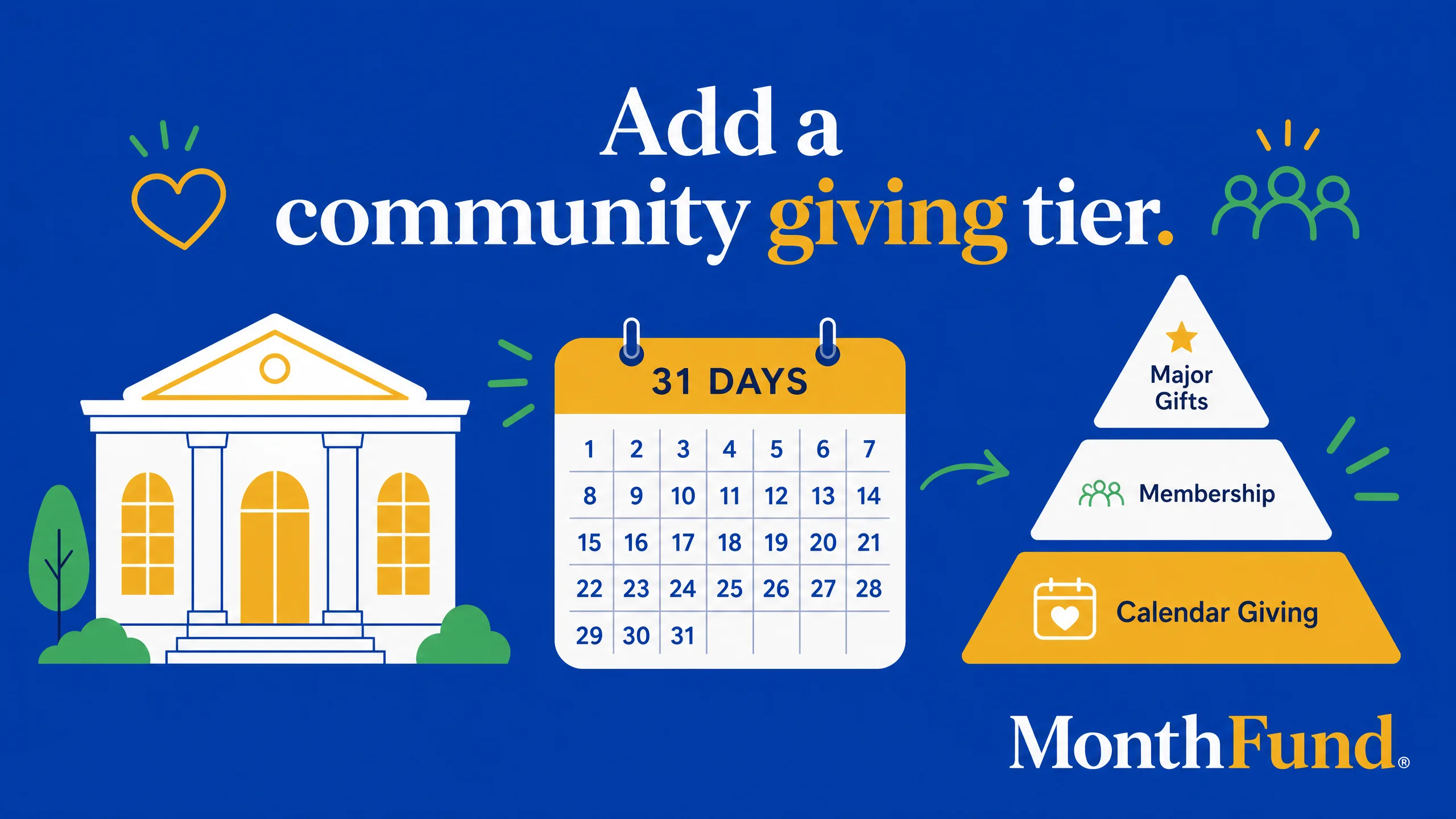
A calendar fundraiser for cultural institutions is a bounded 31-day peer campaign where patrons become day-owners and recruit their networks: a structured community giving tier alongside membership and major gifts. Most museums, theaters, and arts nonprofits already run galas, membership drives, and major gift programs. A pick a date fundraiser adds breadth without competing with the relationships your development team already stewards.
“Cultural institutions have audiences who attend but rarely give at scale. A calendar month turns patrons into community funders: each carries a named day, recruits their network, and fills a public grid. It complements membership and major gifts; it does not replace them.”
Most cultural institutions already run membership, annual fund appeals, galas, capital phases, and targeted program gifts. None of that has to disappear. A calendar fundraiser is another lane for the audience that fills your seats but rarely converts to structured giving: many patrons carrying named days on a public grid together. MonthFund is software for that month; it does not replace curatorial judgment, board governance, or your development director's portfolio strategy.
If the format is new to your team, anchor first in how calendar fundraisers fit with galas, membership programs, and other fundraising, then return here for arts-specific execution.
Organizers launch a month, fundraisers each share a calendar, donors claim days, and progress stays visible until the month fills.
The passive audience problem
Cultural institutions have audiences. Audiences attend openings, buy tickets, follow the work, and share posts. When they give, a relatively small pool of major donors and trustees often carries disproportionate institutional weight. The broader audience remains financially passive not because they do not care, but because the ask ladder jumps from "buy a ticket" to "join at the patron level" without a structured step in between.
That gap is expensive. Every season you leave it unstructured, you depend on the same development relationships to close the same gaps. A bounded calendar month gives patrons who will never headline a gala a concrete role they can explain to a friend.
Community funders: a tier most institutions leave unstructured
Community funders are supporters who care about your institution, contribute at modest day-level amounts, and actively recruit their own networks on your behalf. Claiming Day 14 means carrying $14 of visible work for the fall season fund, with a name on the grid someone outside your donor file can understand.
This is arts nonprofit peer fundraising in practice: not one central thermometer, but dozens of participant-led calendars. For why public grids and named days change follow-through compared to a single aggregate goal, read why the calendar grid matters for accountability.
| Giving tier | Typical ask | Who carries it | Best for |
|---|---|---|---|
| Membership / annual fund | $50–$500/year | Development staff + mail | Renewals, baseline support |
| Major gifts | $5,000+ | Director + board | Capital, endowment, leadership |
| Calendar month (community tier) | $1–$31/day claims | Patrons as peer fundraisers | Breadth, new donors, gala overflow |
How a calendar month fits your development program
Use the month alongside membership, galas, and major gift work. Galas concentrate storytelling and leadership gifts on one night; membership builds recurring baseline support; the calendar month captures donors who could not buy a ticket or who want a peer path that is not another formal pledge conversation.
Example pairings: run the calendar in the month before your annual gala so board members and patrons each carry a day while table sales build; or run it immediately after the gala to catch overflow interest while the season story is still fresh. Your ballroom program stays for leadership; the grid widens participation.
Tying campaigns to a program, season, or exhibition
General operating appeals fatigue faster than program-specific ones. Name the campaign for what patrons can picture: the fall exhibition fund, the youth ensemble tour, the residency that needs underwriting, the capital match window. Targeted campaigns with a clear reason to give consistently outperform undifferentiated asks because participants can repeat a sentence their network understands.
The calendar is the structure; the meaning is yours. Campaign pages reflect your campaign name and context; the public grid shows progress toward that specific story, not an abstract institution-wide total alone.
Who runs it on your team
Effective launches usually pair development leadership (why we are doing this now, which fund it serves) with program leadership (which season or exhibition the month supports). Development sets the goal, recruits the first cohort of participant-fundraisers from board, volunteers, and active members, and owns reminders. Program or marketing supplies the story assets for email and social.
Before you announce publicly, walk the launch checklist so invitations, banking, and the public page match what you promise in patron communications.
Timing on the institutional calendar
Institutions concentrate giving around fiscal year-end, programmatic seasons, capital phases, and local moments of need. You do not need this article to pick your correct window. You do need internal agreement: why this month, what counts as success, and how participants ask outsiders to join.
Illustrations only, not prescriptions: a June push to fund fall programming, a month tied to opening week, a discrete campaign for an emergency repair, a spring window when board recruitment for participants is easiest. The model stays the same even when the story changes.
Messaging you can paste
Board / development committee memo: "We are adding a calendar month to activate patrons who attend but are not yet in the major gift or membership pipeline. Each participant carries one day on a public grid; donors claim days at matching amounts. This complements our gala and membership work; it does not replace portfolio conversations."
Email to patrons / members: "We are filling [Month] for [Season/Program Name]. Claim a day, invite your network to give that amount, and watch the calendar show our community progress. Questions? [Link to your public page and organizer contact]."
Email to participant-fundraisers: "Your job is simple: own your day, message five people you already trust, thank them whether they give or not, and mark your day fulfilled when gifts land. The calendar stays public so we celebrate honestly."
Measuring success beyond dollars
Fill rate, participant count, and new-donor acquisition are visible through your campaign dashboard. MonthFund shows what was raised and who showed up to activate their network. If leadership asks how totals compare to a fully filled calendar, share planning math from the $496 number and modeling fill rates as a structure, not a pledge of outcomes. Use the outcome calculator to model participant count and fill rate before you recruit.
When a calendar month should not lead
Skip leading with this format if you are in a major gift quiet phase that requires singular messaging, if gala week itself needs every channel pointed at table sales, or if you cannot roster a credible first wave of participants. Better to wait one season than to launch a hollow grid.
Recruitment still drives success. If you need a cohort playbook, use how to recruit 25 participants for your first calendar fundraiser and adapt invites to patron and volunteer relationships.
Next steps for development teams
Read how MonthFund frames cultural institutions on MonthFund for cultural institutions, then open a free account when you are ready to set the month: sign up free. Product mechanics and donor experience are summarized on How it works. Custom domains, org units, and multi-campaign questions belong with our team.
How much can your community raise?
Use our interactive calculator to model your potential outcomes based on participant count and fill rate.
Built for your community
Whether it's mutual aid, school support, or local relief, we have the tools to help you scale.
Common Questions
How does MonthFund fit with our existing development program?
MonthFund is additive. It targets community-level giving and peer activation, distinct from major gift, grant, and membership programs. It fills a giving tier most institutions leave unstructured.
How does MonthFund work alongside our membership or annual fund program?
MonthFund mobilizes community funders who attend your events and follow your work but are not yet giving at a formal membership level. It adds capacity without competing with existing major donor or membership relationships.
Can we tie a campaign to a specific exhibition, production, or season?
Yes. Set the campaign name and context to your fall season, a capital initiative, a residency fund, or a specific exhibition. Targeted campaigns with a clear reason to give consistently outperform general operating fund appeals.
What reporting does MonthFund provide for our board or development committee?
Campaign dashboards show fill rate, total raised, per-participant performance, and donor breakdown in real time. At campaign close, CSV and PDF exports are available for board reporting, audit trails, and CRM import.
When should a calendar month not lead our development calendar?
Skip leading with a calendar month during major gift quiet phases, gala week itself, or grant deadline crunches when messaging must stay singular. Use it when you want distributed participation before or after those beats.
Calendar fundraisers for your group type
Keep Exploring
View all posts →December Giving Calendar for Churches: Advent Plan
A December fundraising plan for churches that invites steady participation while keeping the mission, not pressure, at the center.
Youth sports travel fundraising: a season budget and calendar plan
Start with the trip budget, subtract committed funds, then set a fundraising target for the gap. Use conservative fill-rate scenarios to decide whether one calendar month is enough.
How calendar fundraisers fit with galas, catalogs, and other fundraising (toolkit, not replacement)
MonthFund is one powerful layer in a larger toolkit. See how a calendar month complements product sales, ticketed events, and open donate pages, with patterns you can use around a 5K or gala.