
Personal calendar fundraiser: run a solo pick a date month without starting an organization
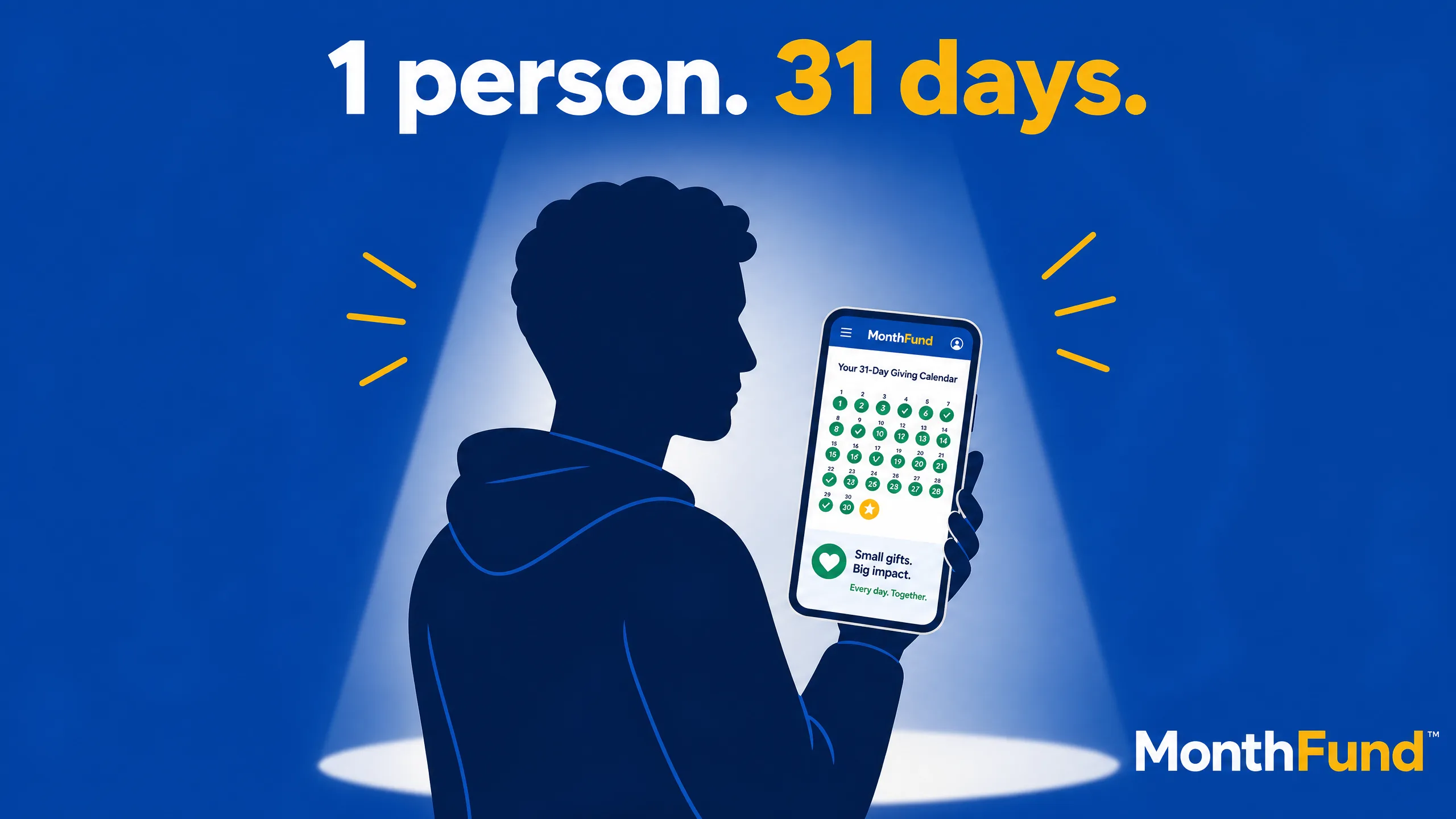
Most calendar fundraising software assumes you are a PTA, a congregation, or a nonprofit with a volunteer roster. If you are one person with a real goal, you should not have to invent an organization name to get a credible page. A personal calendar fundraiser is the same bounded month grid teams use, scaled to a solo account: donors claim numbered days, progress stays public, and payouts route to your Stripe account.
“Solo fundraisers get one shareable calendar page, not a committee dashboard. Donors claim days at matching amounts ($7 on Day 7, and so on). You keep the structure of a pick a date month without recruiting twenty-five co-fundraisers or filing paperwork you do not have yet.”
Organizations run calendar months by recruiting many participant-fundraisers, each with their own grid tied to one campaign. You are not doing that alone. A personal calendar fundraiser (also called a solo pick a date fundraiser) gives you one public month: friends and family claim days on your calendar, give the matching amount or more, and watch the grid fill. MonthFund is software for that month. It does not replace legal advice about taxes, beneficiaries, or whether your drive should be charitable in a formal sense.
If the format is new, anchor first in how calendar fundraisers fit with galas, catalogs, and other fundraising, then return here for solo execution.
Organizers launch a month, fundraisers each share a calendar, donors claim days, and progress stays visible until the month fills.
When one person needs structure without a roster
Generic payment links work for a one-off gift. They get thin when you need a month-long narrative: a teacher supply drive, a memorial fund, a mission trip you are funding yourself, a medical cost share among family (when speed is not the only constraint), or a creative project with a public goal. People hesitate because the ask feels vague. Numbered days fix that. Day 19 is $19. The donor knows what they bought into.
For why visible days beat a single aggregate thermometer on follow-through, read why the calendar grid matters for accountability.
What your personal calendar page looks like
You pick the month, set context in your campaign name, and share a personal URL (for example app.monthfund.com/u/yourname). Donors land on a live grid, claim an open day, and pay online. You see fill rate and totals without building a spreadsheet on the side. There is no paper sign-up sheet to reconcile and no inventory to store.
The mechanics match the org model at the donor layer; the difference is one fundraiser calendar instead of twenty-five. Outreach is your network, not a roster you manage.
Solo month vs. organization campaigns
| Personal account | Organization account | |
|---|---|---|
| Who participates | You (one calendar) | Many invited fundraisers |
| Admin surface | Your dashboard only | Campaign admin, invites, seats |
| Typical fees | 5% platform per gift | Community plan from 3% infrastructure fee |
| Best when | Solo goal, no committee yet | PTA, nonprofit, team with roster |
If you already have a board and twenty-five volunteers ready to carry days, start on MonthFund for organizations instead. Personal accounts are for the gap before that structure exists, or for goals that will never need a committee.
GoFundMe vs. a bounded calendar month
Emergency crowdfunding centers one story and one goal meter. That is the right tool when time is measured in hours and the audience is broad but shallow. A bounded calendar month centers repeatable day-level asks over thirty-one days. Donors who gave on Day 4 understand Day 18 when you post an update. The public grid shows honest progress without you narrating every dollar manually.
For a full comparison aimed at teams, see calendar fundraiser vs. GoFundMe. Solo readers should take the same split: urgent one-time crisis often fits GoFundMe; a month you can plan and share twice a week often fits the calendar.
Fees, payouts, and what donors see
Personal accounts are free to run. MonthFund collects a 5% platform fee on each donation as an application fee. Stripe processes cards on your connected account (typically about 2.9% + $0.30 per transaction). Checkout can show fees clearly; donors may cover them in one click. Payout timing follows Stripe Connect Express rules for your account.
Compare plans on pricing if you expect to outgrow solo mode and want lower per-gift fees with team features.
Who personal calendars work best for
- Educators and coaches funding classroom supplies, travel, or equipment without a district foundation in the loop yet.
- Memorial and celebration drives where family wants a dignified, structured month instead of an endless link.
- Individual mission or trip goals when you are the fundraiser, not the sending organization.
- Creators and side projects with a named month and a clear finish line donors can see.
Model outcomes before you announce. A full month at face values is $496; walk the arithmetic in the $496 number and use the outcome calculator with a participant count of one and a realistic fill assumption.
Share rhythm that fits one person
Growing into an organization later
If your drive graduates into a formal group, you can convert to an organization account and keep history instead of rebuilding from scratch. That path matters for teachers who start solo and later spin up a booster-style org, or for mutual aid pods that incorporate after a successful first month.
The end-to-end model overview lives in the pick a date fundraiser guide and in how the calendar model works.
Next steps
Read how MonthFund frames personal accounts on MonthFund for individuals, then open a personal signup when you are ready: start your personal page. Product mechanics are summarized on How it works. Questions about enterprise or multi-campaign needs belong with our team.
How much can your community raise?
Use our interactive calculator to model your potential outcomes based on participant count and fill rate.
Built for your community
Whether it's mutual aid, school support, or local relief, we have the tools to help you scale.
Common Questions
Do I need 501(c)(3) status or an organization name?
No. Personal MonthFund accounts are for individuals. You sign up as yourself, connect Stripe Connect Express, and share your calendar link. You can convert to a full organization later without losing campaign history.
How is a personal calendar different from a GoFundMe page?
GoFundMe is optimized for urgent, one-time crowdfunding with a single goal meter. A personal calendar month gives donors a specific day to claim and a visible grid that fills over time. For sudden emergencies, GoFundMe may fit better; for a bounded month with repeatable asks, the calendar structure usually performs better.
What fees do personal accounts pay?
MonthFund charges a 5% platform fee on each donation (no monthly subscription). Stripe card processing is separate, typically about 2.9% + $0.30 per transaction. Donors can optionally cover fees at checkout.
Can I still run this if I also volunteer for a school or nonprofit?
Yes. Many people keep a personal page for their own goal while helping a separate organization account. Each login context stays independent.
What is the realistic ceiling for one person filling a month?
A fully claimed 31-day calendar at face values sums to $496; that is a structural planning floor, not a forecast. Solo campaigns often beat it when donors give above the day amount, or fall short when outreach pauses mid-month. Model your network before you promise downstream budgets.
Calendar fundraisers for your group type
Keep Exploring
View all posts →December Giving Calendar for Churches: Advent Plan
A December fundraising plan for churches that invites steady participation while keeping the mission, not pressure, at the center.
Youth sports travel fundraising: a season budget and calendar plan
Start with the trip budget, subtract committed funds, then set a fundraising target for the gap. Use conservative fill-rate scenarios to decide whether one calendar month is enough.
How calendar fundraisers fit with galas, catalogs, and other fundraising (toolkit, not replacement)
MonthFund is one powerful layer in a larger toolkit. See how a calendar month complements product sales, ticketed events, and open donate pages, with patterns you can use around a 5K or gala.