
Calendar Fundraiser vs. GoFundMe: Why the Goal Meter Causes Donor Fatigue
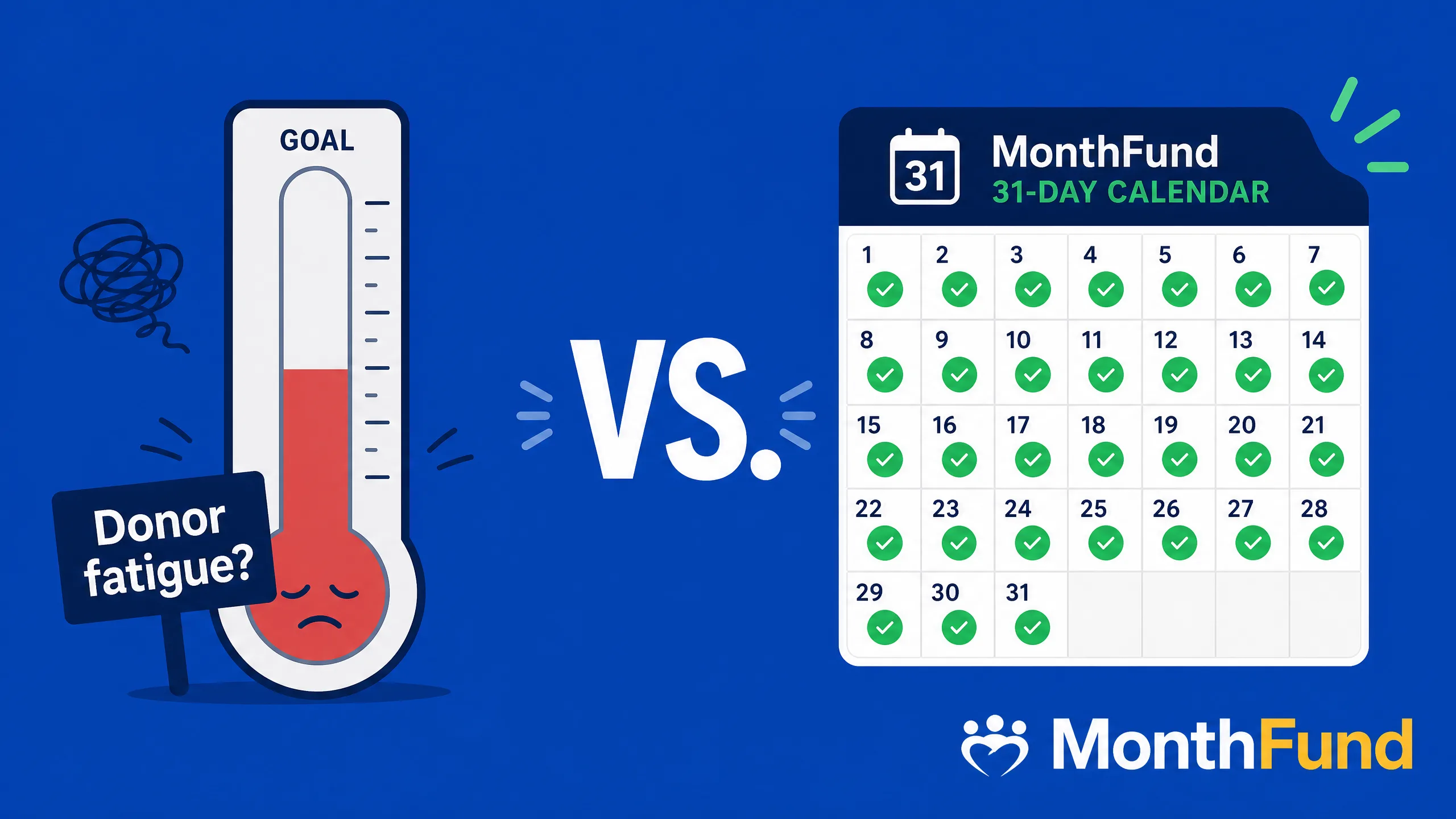
GoFundMe is the undisputed king of emergency crowdfunding. But when a school, booster club, or nonprofit needs to run a structured, recurring campaign, an open-ended GoFundMe page often leads to donor fatigue and stalled momentum. Here is why a calendar fundraiser is the better tool for organizational fundraising.
“GoFundMe is built for one-time, urgent needs with a single central page. A calendar fundraiser is built for structured, peer-to-peer organizational fundraising where dozens of participants each own a specific day. If you need to raise money for a sudden medical bill, use GoFundMe. If you need to fund a season of youth sports or a school year, use a calendar fundraiser.”
When an organization needs to raise money online, the default reflex is often, "Let's just start a GoFundMe."
It makes sense. GoFundMe is a household name. It is trusted, easy to set up, and excellent at what it was built to do: emergency crowdfunding. If a family experiences a sudden tragedy, or a community needs immediate disaster relief, GoFundMe is the right tool.
But when a school PTA, a youth sports booster club, or a local nonprofit tries to use that same tool to fund their annual operating budget, the campaign almost always stalls after the first week.
The problem isn't the platform. The problem is using an emergency tool for a structural need. Here is why a calendar fundraiser (also known as a pick a date fundraiser) outperforms an open-ended crowdfunding page for organizational fundraising.
The difference between crowdfunding and peer-to-peer
To understand why campaigns stall, you have to understand the difference between crowdfunding and peer-to-peer fundraising.
Crowdfunding (GoFundMe) is centralized. You create one page, with one story, and one big goal meter. You share that single link with everyone. The burden of driving traffic to that one page rests entirely on the core organizers.
Peer-to-peer fundraising (MonthFund) is decentralized. Instead of one central page, you recruit 25 participants. Each participant gets their own calendar to fill. They aren't just sharing a link; they are taking ownership of a specific micro-goal and asking their own distinct network to help them achieve it.
The Network Multiplier
Why the open-ended goal meter causes donor fatigue
GoFundMe relies on the Goal Meter. The psychology of the goal meter works perfectly in an emergency: "We need $10,000 for surgery by Friday."
But for a high school band trip, the goal meter works against you. When a donor sees a goal of $15,000 and the meter is only at $800, their $20 donation feels insignificant. It feels like throwing a pebble into a canyon. Conversely, if the meter is at $14,500, they might think, "They're basically there, they don't need my $20."
A calendar fundraiser replaces the open-ended goal meter with a bounded grid.
When a donor arrives at a calendar fundraiser, they aren't asked to chip away at a massive, abstract number. They are asked to do one specific, tangible thing: Buy Day 14 for $14.
That $14 donation doesn't feel like a drop in the bucket. It feels like a completed task. They successfully filled a square on the board. This gamification is why calendar fundraisers see significantly higher conversion rates for small-dollar donations.
The accountability of the calendar grid
The biggest weakness of a general donation page is the lack of a deadline. If a donor can give today, tomorrow, or next month, they will usually choose next month—and then forget entirely.
A calendar fundraiser is, by definition, bounded by time. It lasts exactly 31 days.
More importantly, the grid is public. When a participant shares their calendar, their network can see exactly which days are filled and which are empty. If Aunt Sarah buys Day 12, her name goes on Day 12. This creates healthy, visible momentum.
| Feature | GoFundMe | Calendar Fundraiser (MonthFund) |
|---|---|---|
| Primary Use Case | Emergency / One-time crisis | Recurring / Organizational |
| Structure | Centralized (One page) | Peer-to-peer (Many pages) |
| Visual Mechanic | Open-ended Goal Meter | 31-Day Bounded Grid |
| Donor Psychology | Drop in a bucket | Completing a specific task |
| Accountability | Low (Easy to ignore) | High (Publicly claimed days) |
When to use GoFundMe vs. MonthFund
We are not anti-GoFundMe. It is a phenomenal platform that has done immense good in the world. But tools must match the task.
Use GoFundMe when:
- You are raising money for a sudden, unexpected personal crisis.
- You need to launch in 5 minutes with zero participant coordination.
- Your primary audience is the general public who may not know you personally.
Use a Calendar Fundraiser (MonthFund) when:
- You are a school, team, or nonprofit funding a planned program.
- You have a roster of participants (students, parents, board members) who can each take ownership of a calendar.
- You want to run the same fundraiser again next year without burning out your donors.
If you are ready to move away from the stalled goal meter and give your team a structured, predictable way to raise money, a calendar fundraiser is the right tool for the job.
For a deeper dive into how the math works, read our guide on the $496 number. If you are ready to set up your grid, you can start your campaign for free today.
For a full overview of the pick a date model, the pick a date fundraiser guide explains the mechanics and math end to end.
How much can your community raise?
Use our interactive calculator to model your potential outcomes based on participant count and fill rate.
Tired of inventory?
Join hundreds of organizers who have switched to a logistics-free calendar model.
Common Questions
Is GoFundMe free for nonprofits?
GoFundMe does not charge a platform fee to start a fundraiser, but they do deduct a standard payment processing fee (typically 2.9% + $0.30 per transaction). They also ask donors for optional tips to support the platform.
Why do GoFundMe campaigns stall?
GoFundMe campaigns often stall because they lack a built-in urgency mechanism once the initial launch excitement fades. A calendar fundraiser solves this by giving every day of the month a specific dollar value and a specific owner, creating 31 micro-deadlines.
Can multiple people fundraise on one GoFundMe?
GoFundMe supports team fundraising, but it still directs traffic to one central goal meter. A calendar fundraiser is true peer-to-peer: 25 participants each get their own calendar to fill, multiplying your reach.
Which platform is better for recurring annual fundraisers?
A calendar fundraiser is better for annual events (like a spring baseball trip or fall PTA drive) because it establishes a predictable rhythm. Donors learn to expect the 'buy a day' format, whereas launching a new GoFundMe every year can trigger donor fatigue.
Calendar fundraisers for your group type
Keep Exploring
View all posts →The buy-a-block fundraiser: funding physical projects square by square
Mechanically identical to a calendar fundraiser, the buy-a-block model frames the grid around physical spaces. It is the perfect structure for funding community gardens, playgrounds, and neighborhood murals.
Pick a Date Fundraiser vs. Fun Run: Which is Right for Your School?
Fun runs build community but require massive logistics. Pick a date fundraisers require almost zero logistics but lack the in-person event. Here is how to choose—or how to run both.
How to Run a School Fundraiser Without Selling Products (That Parents Actually Want to Do)
Tired of catalogs and cookie dough? Run a school fundraiser without selling products using the calendar model: 25 parents, 31 named days, a $12,400 floor, and zero inventory in the gym.