
Pick a Date Fundraiser vs. Fun Run: Which is Right for Your School?
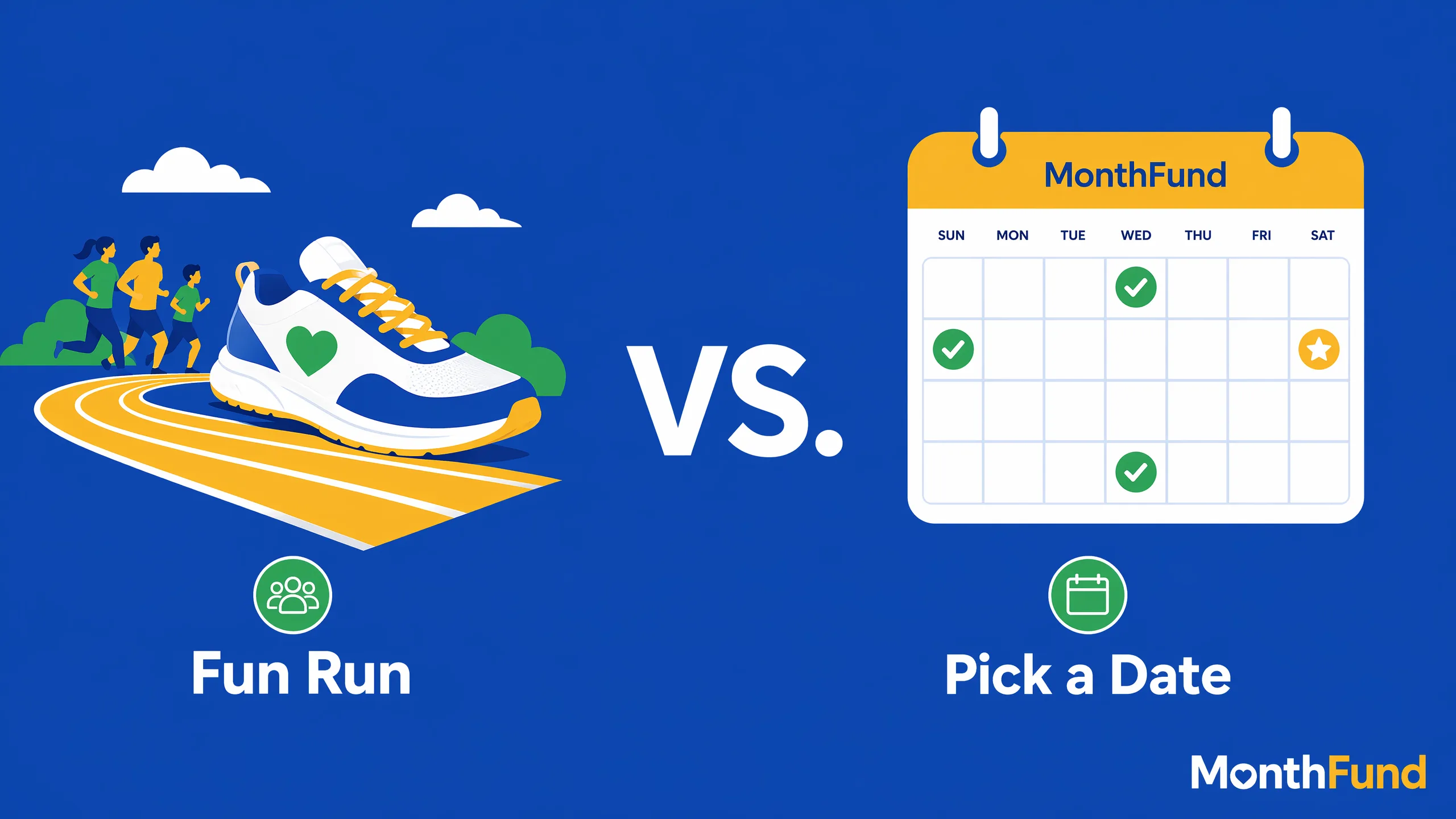
Fun runs are excellent for building community and getting kids moving. Pick a date fundraisers are excellent for raising money with almost zero logistics. You don't have to choose one over the other—they serve completely different purposes in your school's annual calendar.
“A fun run requires permits, t-shirts, water stations, volunteer coordination, and lap tracking. A pick a date fundraiser requires setting up a digital calendar and inviting parents to share it. Run the fun run in the spring for community engagement. Run the pick a date fundraiser in the fall for pure, low-overhead revenue.”
When a school or PTA needs to raise money without selling wrapping paper or cookie dough, the conversation usually comes down to two options: a fun run (or walkathon) or a pick a date fundraiser.
Both are massive improvements over product sales. Both rely on peer-to-peer sharing rather than door-to-door selling. But that is where the similarities end. One is a major physical event that requires months of planning; the other is a digital campaign that can be launched in an afternoon.
Here is how to compare the two formats, and why the best answer is often to run both at different times of the year.
The logistics load: event management vs. digital sharing
A fun run is an event management challenge. You need city permits (if off-campus), route planning, water stations, t-shirt ordering and distribution, first aid, and dozens of day-of volunteers to track laps and manage crowds. If you hire a full-service fun run company, they handle much of this, but you pay for it—often giving up 40% to 50% of your gross revenue.
A pick a date fundraiser is a digital coordination challenge. There is no physical event. The organizer sets up the campaign on a platform like MonthFund, invites 25 to 50 parents to participate, and each parent gets a digital 31-day calendar. The parents share their calendar link via email or social media. Donors click a date, pay online, and the calendar fills.
A fun run asks your volunteers to be event planners. A pick a date fundraiser asks them to be digital mobilizers.
The financial model: pledge-per-lap vs. the $496 calendar
The revenue model for a fun run is usually pledge-per-lap or a flat donation. The challenge is unpredictability. You don't know how many laps a student will run, and collecting pledges after the event requires a second wave of follow-up work.
The math of a pick a date fundraiser is entirely predictable. Every day of the month has a set dollar value (Day 1 = $1, Day 31 = $31). A fully claimed 31-day calendar raises exactly $496. If you recruit 20 parents and they each fill their calendar, you raise $9,920. The money is collected at the moment the donor claims the day, so there is zero post-campaign collection.
Weather, risk, and volunteer burnout
If it rains on the day of your fun run, you have a problem. You either move it to the gym (which changes the experience and lap math) or you use a rain date (which loses momentum and volunteer availability).
Because a pick a date fundraiser runs entirely online over a 30-day window, weather is irrelevant. More importantly, volunteer burnout is significantly lower. Parents don't need to take a day off work to hand out water cups; they just need to spend five minutes a week sharing their calendar link and thanking donors.
The verdict: how to run both
You don't have to choose. They serve different purposes.
Run the fun run in the spring. Use it as a community-building event. Accept the higher overhead and the logistics load because the goal isn't just revenue—it's getting kids outside, bringing parents together, and celebrating the end of the school year.
Run the pick a date fundraiser in the fall. Use it to fund the PTA budget early in the year. It requires almost zero logistics, has incredibly high margins, and doesn't exhaust your volunteer base before the holidays.
If you are ready to see how the digital calendar model works, read our full guide on how calendar fundraisers fit with other formats, or launch your first campaign on MonthFund today.
How much can your community raise?
Use our interactive calculator to model your potential outcomes based on participant count and fill rate.
Tired of inventory?
Join hundreds of organizers who have switched to a logistics-free calendar model.
Common Questions
Which raises more money: a fun run or a pick a date fundraiser?
Both can raise significant funds, but the net revenue differs. Fun runs often have 30-50% overhead if you use a full-service company (for prizes, event staff, and platform fees). A digital pick a date fundraiser on MonthFund has zero inventory or event overhead, meaning more of the money stays with the school.
Can we run both in the same school year?
Yes. The most successful PTAs run a high-engagement event (like a fun run or gala) in the spring, and a low-logistics, high-margin campaign (like a pick a date fundraiser) in the fall. They don't compete because the ask and the experience are completely different.
Do kids participate in a pick a date fundraiser?
While parents usually manage the digital sharing, kids can absolutely be involved. Many schools have classrooms compete to fill their collective calendar first, or have students record short video asks that parents post alongside their calendar link.
What happens if it rains on the day of our fundraiser?
For a fun run, rain is a logistical nightmare that requires backup dates or indoor gym routing. A digital pick a date fundraiser runs entirely online for 31 days, so weather is never a factor.
Keep Exploring
View all posts →The buy-a-block fundraiser: funding physical projects square by square
Mechanically identical to a calendar fundraiser, the buy-a-block model frames the grid around physical spaces. It is the perfect structure for funding community gardens, playgrounds, and neighborhood murals.
Calendar Fundraiser vs. GoFundMe: Why the Goal Meter Causes Donor Fatigue
GoFundMe is built for emergencies. A calendar fundraiser is built for structured, recurring organizational fundraising. Here is why the open-ended goal meter stalls, and why the 31-day grid works better for schools and teams.
How calendar fundraisers fit with galas, catalogs, and other fundraising (toolkit, not replacement)
MonthFund is one powerful layer in a larger toolkit. See how a calendar month complements product sales, ticketed events, and open donate pages, with patterns you can use around a 5K or gala.