
Community organization fundraising ideas: 12 ways to fund local projects without car washes
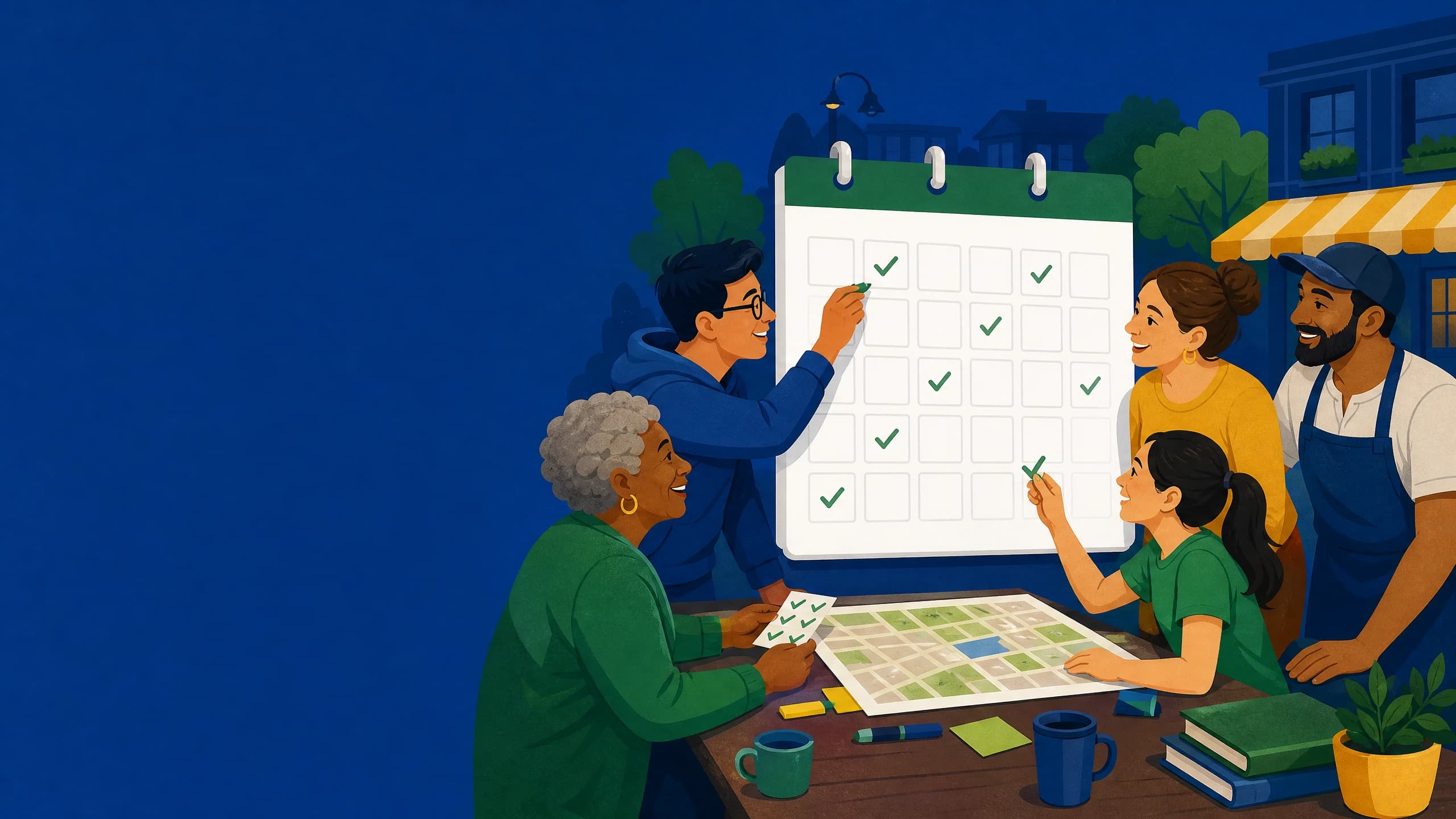
When the neighborhood association or the local scout troop needs to fund a project, the default answer is often a bake sale or a car wash. We gather the community, we ask for hours of labor, and we count the small change at the end of the day. There is a quieter, more structured way to gather resources that respects the time of the people doing the work.
“Community organizations often rely on high-effort, low-return fundraising events. By shifting to a calendar fundraiser or a buy-a-block model, local clubs, scout troops, and neighborhood associations can raise significant funds through structured, shared ownership without selling products or spending weekends washing cars.”
There is a familiar rhythm to community organizing. The neighborhood association decides to plant a new garden, or the local scout troop plans a trip, and immediately the question of resources arises. The answers we reach for are the ones we have always known. We organize a car wash. We ask parents to bake. We set up tables outside the grocery store.
These events bring people together, and there is a beauty in that shared labor. Yet, when the sun sets and the cash box is tallied, the financial return rarely matches the hours invested. We ask our community to trade their weekends for small change.
We need methods that respect the time of the people doing the work. We need structures that allow a community to gather its resources quietly and efficiently, leaving the weekends for the actual work of the association or the joy of the scout trip.
The hidden cost of the community car wash
Consider the logistics of a traditional community fundraiser. It requires securing a location, purchasing supplies, coordinating volunteers, and hoping for clear weather. It is an exercise in hope and exhaustion.
The alternative is not to stop raising funds, but to change the mechanism. A calendar fundraiser offers a different path. It removes the inventory, the permits, and the unpredictable weather. It replaces them with a clear, bounded structure where the community can participate without exhaustion.
The calendar model for local clubs
For a local club or scout troop, a pick a date fundraiser provides a visible planning structure rather than a result promise. Instead of asking members to sell products to their neighbors, you ask them to share a 31-day grid.
Each day holds a value. A supporter claims the 12th and gives $12. Another claims the 25th and gives $25. It is a quiet, dignified ask. It says to the supporter: we have a goal, here is a small piece of it, will you carry this piece for us?
This is people powered fundraising in its truest sense. No single family is asked to write a massive check, and no single volunteer is asked to manage a warehouse of cookie dough. The burden is distributed, and the progress is visible to everyone.
The buy-a-block approach for physical projects
When the neighborhood association is funding something tangible, like a playground renovation or a community mural, the calendar model can be adapted into a buy-a-block fundraiser.
The mechanics are identical. You present a grid with numbered squares. But instead of days on a calendar, the squares represent blocks of the project. A supporter sponsors block number 30 for $30. It grounds the abstract math in the physical reality of the neighborhood.
It allows the community to literally build the project piece by piece. When they walk past the finished mural, they know exactly which small square their contribution made possible.
Twelve fundraising ideas worth putting on one page
A strong community fundraising plan is not a drawer full of unrelated ideas. It is a small mix of methods with different jobs. One may bring neighbors together, another may fund a specific project, and another may give local businesses a clear way to participate. The best choice is the one your volunteers can actually run without losing the month to logistics.
- Calendar fundraiser. Give supporters a numbered day to claim, then let the public grid show the group's shared progress. This is the cleanest starting point when you need a direct-giving campaign with no product inventory. Our full launch playbook maps the setup and outreach sequence.
- Buy-a-block campaign. Translate the grid into a project map for a mural, garden, playground, or renovation. It works especially well when donors can picture the finished work. The buy-a-block guide shows how to make that connection clear.
- Local business sponsor match. Ask one business to match gifts made on a defined day or up to a defined amount. The offer is more concrete than a vague donation request, and it gives the business a reason to share the campaign too.
- Community dinner or game night. Sell a simple ticket, keep the program short, and use the gathering to introduce the larger project. This is useful when the community needs to reconnect before it is ready for a direct ask.
- Skill-share workshop. Invite a local cook, artist, gardener, or financial coach to lead a paid session. The ticket pays for a useful hour, which can feel more natural than a pure donation request.
- Restaurant percentage night. Partner with a local restaurant for one announced evening. Treat the night as a visibility and relationship-building moment, not the only line in the budget.
- Peer birthday or milestone asks. Give committed supporters a small script so they can mark a birthday, anniversary, graduation, or retirement by inviting their own network to fund the project.
- Community clean-up with pledges. Turn a planned clean-up, planting day, or repair day into a sponsored action. Use it when the event itself demonstrates the work your group is asking people to support.
- Pre-order merchandise. Use pre-orders rather than buying shirts or tote bags in advance. Keep the design simple, make the deadline clear, and use it for belonging more than margin.
- Raffle or donated-experience drawing. This can create energy if local rules permit it and the prize is genuinely desirable. Assign one owner to secure items and one owner to handle the rules before announcing anything publicly.
- Neighborhood yard sale. A shared sale works when a few households already have items to contribute and a visible location. It is better as a community event than as the primary path to a large goal.
- Recurring day ownership. Invite a supporter who claims a meaningful date to keep it each month. That turns a one-time campaign into a gentler, repeatable revenue rhythm. See how recurring calendar fundraising works before you make the invitation.
If the group is small, choose one direct-giving format and one light community event. If the group is larger, add a sponsor match rather than adding more volunteer-heavy activities. Fewer methods, run with care, beat a crowded calendar every time.
Engaging local businesses with purpose
Local businesses want to support the community, but they receive countless vague requests for donations. A structured grid changes the conversation.
Instead of asking a local bakery for a general donation, you ask them to sponsor Day 31 of your calendar or the cornerstone block of your project. It is a specific, defined partnership. In return, their name sits proudly on that square on your public grid. It is clean, it is visible, and it is easy for a small business owner to say yes to.
A thirty-day operating rhythm
The first month does not need a complicated project plan. It needs a short sequence that keeps the work visible and the asks human. In the week before launch, write the one-sentence goal, recruit a small group of people willing to share, and ask two trusted supporters to claim the first dates or blocks. The public campaign begins with something already in motion.
During the first week, every organizer sends a few personal messages before relying on broad social posts. In the middle of the month, share one useful update: a photo of the garden bed being planned, a sketch of the mural, or a note from the scout leader about the trip. In the final week, name the remaining blocks or open days with enough specificity that someone can act immediately.
Make the project answerable in one sentence
For a ready-to-use sponsor request, download the community project sponsor pitch. It includes a letter, a sponsor menu, and an outreach tracker that work whether you run the campaign on MonthFund or not.
Building a sustainable rhythm
Community organizations endure because they build sustainable rhythms. The way we gather resources must be as sustainable as the meetings we hold and the projects we complete.
By moving away from high-friction events and toward structured, shared ownership models, we free our members to do the actual work of the community. We replace the exhaustion of the car wash with the quiet satisfaction of a fully claimed grid.
This is how a community funds itself. Not with noise and stress, but with structure, clarity, and many hands carrying a small piece of the load.
How much can your community raise?
Use our interactive calculator to model your potential outcomes based on participant count and fill rate.
Ready to launch?
Set up your first fundraiser in under 10 minutes. No credit card required.
Common Questions
What are the most effective fundraising ideas for community organizations?
The most effective methods balance the effort required with the funds raised. While events like galas or fun runs build community, they require massive logistics. Structured peer-to-peer methods, such as a calendar fundraiser or a buy-a-block campaign, often yield higher returns with far less logistical burden, making them ideal for neighborhood associations and local clubs.
How can a scout troop raise money without selling popcorn or cookies?
A scout troop can run a pick a date fundraiser. Instead of tracking inventory and managing deliveries, scouts invite family and friends to sponsor a day on a 31-day calendar. This provides a clear, bounded ask that funds the troop directly.
What is a buy-a-block fundraiser?
A buy-a-block fundraiser is mechanically identical to a calendar fundraiser but framed for physical community projects. Instead of claiming a day, supporters sponsor a 'block' or 'square' of the project, such as a community garden or a playground renovation. The math and the shared accountability remain exactly the same.
How do we get local businesses to sponsor our community organization?
Local businesses respond best to specific, visible opportunities. Ask them to sponsor a high-value day on your calendar fundraiser or a premium block in your community project. Offer clear recognition on your public grid and social media in exchange for their support.
Calendar fundraisers for your group type
Keep Exploring
View all posts →10 Basketball Team Fundraising Ideas With Low Logistics
Ten basketball fundraising approaches that minimize inventory and make it easier for each family to help fund the season.
Nonprofit fundraising ideas for 2026: 20 that work, ranked by effort and payoff
Most nonprofit fundraising lists read like a brainstorm. This is a ranked survey of 20 ideas grouped by how much staff and volunteer time they take and what they actually return, so a small team can pick the right two or three for the year instead of trying everything.
Cheer fundraising ideas: 12 ways to fund competition season without selling
Competition fees, uniforms, choreography, and travel are all due before the first routine hits the mat. Twelve cheer fundraising ideas ranked by effort and payoff, most with no products and no door-to-door, so the squad funds the season instead of chasing money mid-schedule.