
Are "free" calendar fundraiser platforms really free? Donor tips vs. transparent fees
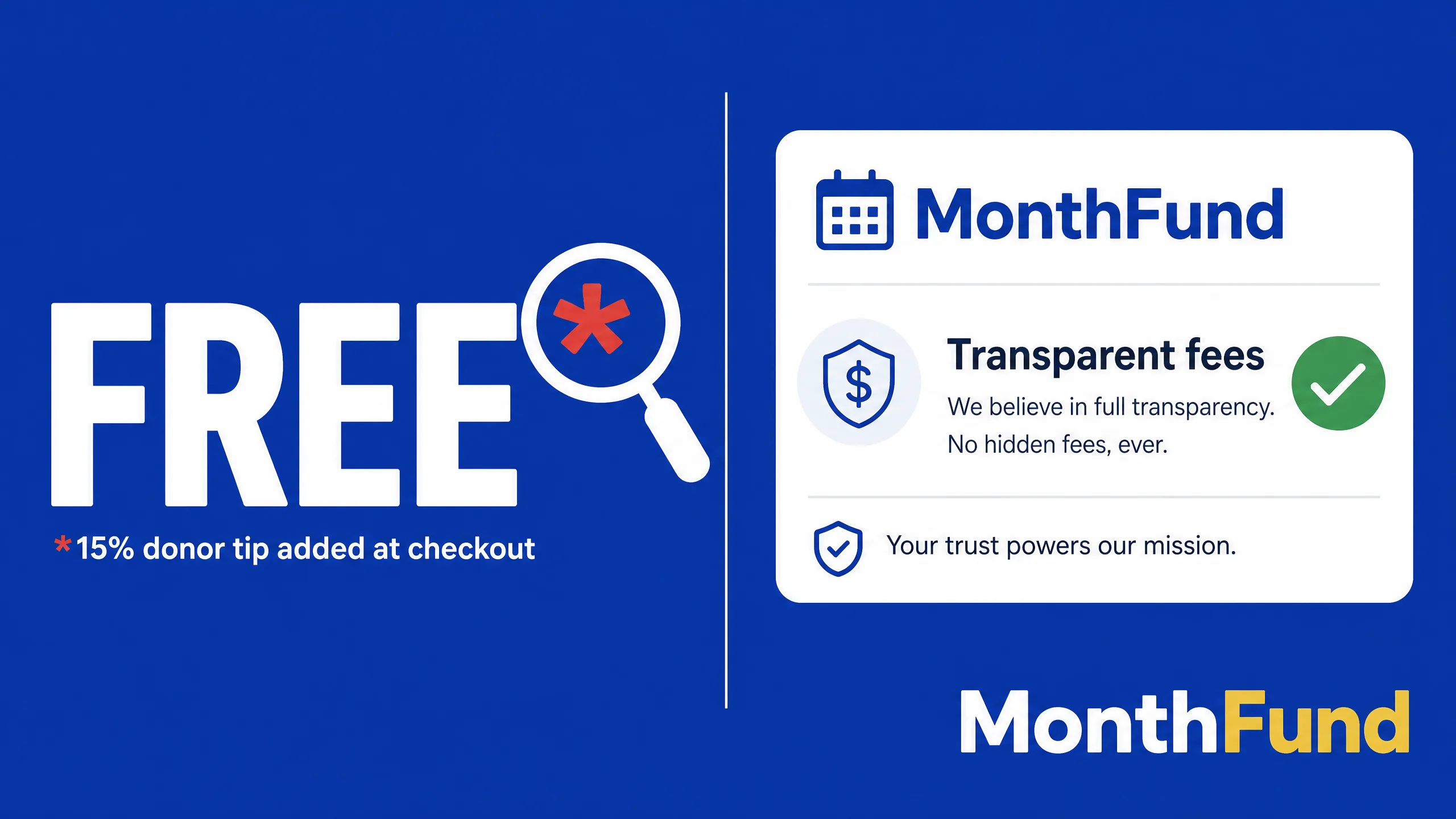
Almost every calendar fundraiser platform advertises 0% platform fees or 100% free. That is technically true for the organizer and quietly misleading about the whole picture. The money to run the software comes from somewhere, and on most free platforms it comes from your donors through a tip defaulted at checkout. Here is how the model works and what it actually costs your cause.
“Free calendar fundraiser platforms fund themselves with a donor tip defaulted at checkout or a processing markup. As of June 2026, Zeffy defaults the tip to 17 percent on donations up to $99.49 and 15 percent above that, and says about two of three donors leave it. On a $10,000 campaign, a 15 percent default tip can divert up to $1,500 of donor generosity to the software. A transparent fee, disclosed and coverable in one click, is predictable and usually cheaper for your cause.”
When you shop for a calendar fundraiser platform, the loudest promise is almost always the same: 0% platform fees, 100% free, keep every dollar. It is worth slowing down on that claim, because running software costs money, and on most free platforms that cost is shifted onto your donors rather than removed.
This is a companion to our broader roundup, the best calendar fundraiser platforms in 2026. Here we focus only on the money. Fee figures below are drawn from each provider's own pricing pages as of June 2026; verify current terms before you decide.
Are these platforms really free?
For the organizer, often yes. For the donor and the cause, usually no. Most platforms advertising 0% fees, including Teamfi, Zeffy, and 99Pledges, fund themselves through an optional donor tip presented at checkout. That tip goes to the software company, not your organization. On top of that, payment processing fees always apply, regardless of what the platform charges.
The clearest current example is Zeffy, a broad nonprofit platform sometimes used for calendar-style campaigns. As of June 2026, Zeffy's checkout defaults the donor tip to 17 percent on donations up to $99.49 and 15 percent on larger gifts, and the company states that roughly two of three donors leave a contribution. Teamfi, the most direct calendar competitor, also runs on optional donor tips but advertises a take-home of about 96.6 percent after Stripe's 2.9% + $0.30, with the tip left to the donor.
"Free" almost never means free. It usually means the cost moved from your invoice to your donor's checkout screen.
How the donor tip model works
The mechanics are simple. A donor claims Day 80 of a larger goal and goes to pay $80. The checkout adds a second line, a contribution to support the platform, pre-selected at the default percentage. On Zeffy that default is 17 percent on a gift this size ($13.60). If the donor does not notice or does not change it, they pay $93.60. The $80 reaches your cause; the $13.60 goes to the software company.
The tip is genuinely optional, and that is the platform's defense. The catch is that defaults are powerful and the opt-out can be buried. On Zeffy, declining the tip requires selecting "Other" and manually entering $0, a step many donors miss. So a default tip behaves like a fee your donors pay on the platform's behalf, often without realizing where it goes. Zeffy itself reports that about two of three donors leave a contribution.
What "free" actually costs your cause
Here is the same $10,000 campaign under four scenarios. The processing fee is held roughly constant; the variable is how the platform funds itself.
| Model | Goes to the platform | Where it comes from |
|---|---|---|
| Tip model, 15% default kept by most donors | up to ~$1,500 | Added to donor checkouts |
| Tip model, many donors opt out | $0 to a few hundred | Whatever donors choose to tip |
| Revenue-share platform (e.g. Snap Raise ~20%) | ~$2,000 | Taken off the top of your raise |
| Transparent fee, 3% (MonthFund free tier) | ~$300 | Disclosed, donors can cover it |
| Transparent fee, 0% (MonthFund Network) | $0 platform | Covered by a flat subscription |
The tip model's cost is unpredictable by design. It can be near zero if donors decline, or far higher than any reasonable platform fee if they accept a 15 to 17 percent default. For context, Teamfi's own comparison page notes that revenue-share fundraising platforms commonly take 5 to 25 percent off the top, which is $500 to $2,500 on a $10,000 raise. A transparent 3 percent fee is both predictable and, in most cases, the lowest real cost to your cause.
Payment processing is never free
No platform escapes card processing. Stripe and most processors charge about 2.9% + $0.30 per transaction; PayPal-based tools (such as CalendarFundraiser) run closer to 3.5% + $0.49, and a-thon tools like 99Pledges list 3.49% + $0.49. When a platform says "you keep 100%," it means 100% after processing. Teamfi states this plainly: a take-home of about 96.6 percent on a 0% platform fee, because Stripe still takes roughly 3.4 percent. That is honest, and it is also not free. It just is not the part anyone hides.
The transparent fee alternative
MonthFund takes the other approach: a disclosed platform fee instead of a donor tip. It is 3% on the free Community tier, 2% on Professional ($49/mo), and 0% on Network ($199/mo), with 5% for personal accounts. Donors see the fee and can cover it in one click, so your cause receives the full intended gift. Stripe processing is separate and stated plainly.
The point is not that a fee is morally superior to a tip. It is that a disclosed fee is predictable and honest, and a defaulted tip is neither. For organizations that run the model monthly, the subscription path to 2% or 0% can also beat a tip model outright.
Which model raises more?
It depends on donor behavior, which is exactly the problem with the tip model: you cannot plan around it. If your donors reliably decline tips, a tip platform can be cheap. If they accept defaults, you may quietly lose 10 to 15 percent of every gift. A transparent fee lets you model your expected raise and fill rate with a known cost, then promise your board a number you can actually hit.
Plan with a number you control
Questions to ask any "free" platform
- How do you make money? If the answer is donor tips, ask what the default percentage is.
- Does the tip go to my cause or to you? On tip-model platforms, it goes to the platform.
- What is my total cost on a $10,000 campaign if donors leave every default in place?
- Can donors see and choose to cover the cost, or is it presented as a tip to you?
Honest platforms answer all four without flinching. For the full landscape and where each tool fits, read the best calendar fundraiser platforms in 2026, and see the side-by-side fee breakdowns on the comparisons hub.
Next steps
Review MonthFund pricing to see the transparent tiers, model your campaign with the $496 number, and start free when you are ready. Donors should know where their generosity goes; a clear fee is one way to keep that promise.
How much can your community raise?
Use our interactive calculator to model your potential outcomes based on participant count and fill rate.
Ready to launch?
Set up your first fundraiser in under 10 minutes. No credit card required.
Common Questions
Are calendar fundraiser platforms really free?
They are usually free for the organizer, not for the donor. Platforms like Teamfi, Zeffy, and 99Pledges charge 0% to the organization but rely on an optional donor tip at checkout that goes to the software company. As of June 2026, Zeffy defaults that tip to 17 percent on gifts up to $99.49 and 15 percent above that. Payment processing fees (about 2.9% + $0.30) also always apply.
What is the donor tip model?
The donor tip model funds a 'free' platform by adding an optional contribution to the platform on the donation checkout, often pre-selected. Zeffy, for example, defaults to 17 percent (15 percent on larger gifts) and reports about two of three donors leave a tip; removing it requires choosing 'Other' and entering $0. The tip goes to the platform, not your cause.
Is a tip model cheaper than a platform fee?
Not necessarily. A 15 to 17 percent default tip is far higher than a 3 percent transparent fee. If most donors leave the default, your cause loses more than under a disclosed fee. The tip is optional, so the real cost depends on how many donors notice and opt out.
How much does MonthFund cost?
MonthFund charges a transparent platform fee: 3% on the free Community tier, 2% on Professional ($49/mo), and 0% on Network ($199/mo), plus 5% for personal accounts. Stripe processing (about 2.9% + $0.30) is separate. Donors can cover the platform fee in one click, and it is always disclosed.
What should I ask before trusting a free platform?
Ask three things: How does this platform make money? Is a tip defaulted onto my donors, and does it go to you or to my cause? What is the total cost on a $10,000 campaign if donors leave the defaults? Honest platforms answer all three plainly.
Keep Exploring
View all posts →Calendar fundraiser vs. spreadsheet and payment link
A spreadsheet and Venmo link can work for a tiny campaign. Compare the actual operating work: duplicate claims, receipts, participant links, and closeout, then choose the least complex system that can do the job.
A coordination system, not a donation page: what fundraising software should actually do
A donation page collects money. It does not recruit participants, track who is carrying the month, or produce a report your board can read. Here is the difference between collecting and coordinating, and how to tell which one your campaign needs.
How calendar fundraisers fit with galas, catalogs, and other fundraising (toolkit, not replacement)
MonthFund is one powerful layer in a larger toolkit. See how a calendar month complements product sales, ticketed events, and open donate pages, with patterns you can use around a 5K or gala.