
How Fundraising Platforms Make Money: The 3 Revenue Models Explained
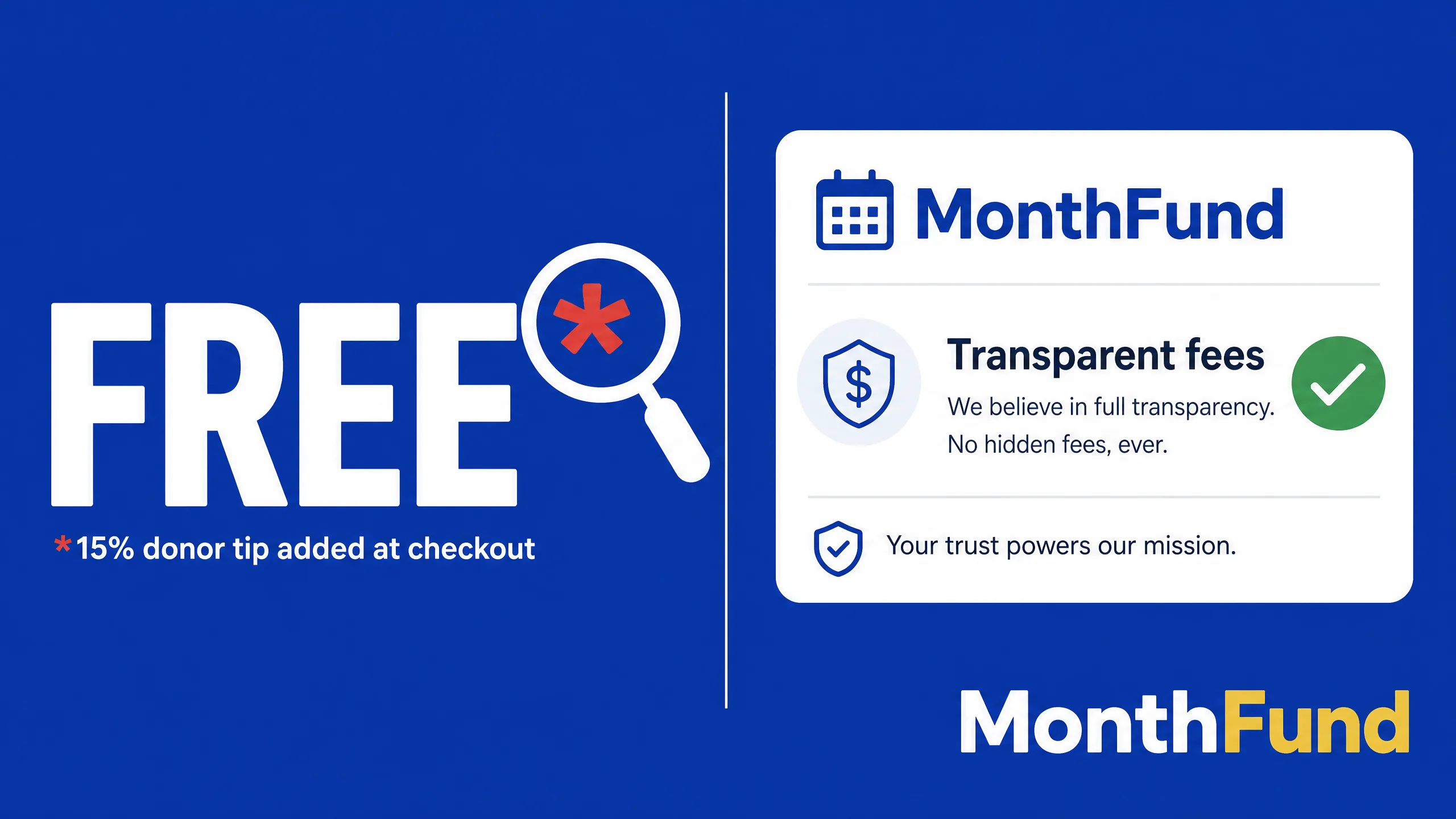
Every fundraising platform costs money to run. Servers, SMS reminders, customer support, and payment security are not free. Yet almost every popular fundraising tool advertises as "100% free," so where does the money actually come from?
“There are exactly three ways a fundraising platform makes money: donor tips added at checkout, hidden markups on payment processing, or a transparent infrastructure fee. The first two quietly shift cost onto your donors. MonthFund uses the third, a small disclosed fee donors can cover in one click, so your cause keeps 100% of the intended gift.”
So how do they make money?
In the fundraising software industry, there are exactly three ways a platform generates revenue: platform fees, donor tips, and processing markups. Understanding which model your platform uses matters, because what looks free to the organizer often shifts a significant cost onto the donor pool.
Here is a plain-math breakdown of the three models, how they work, and what they actually cost your cause.
Model 1: The donor tip model (the “0% fee” illusion)
This is the most common model used by platforms that advertise as “100% free” or “0% platform fees.”
How it works: The platform charges the organization nothing. Instead, when a donor reaches checkout, the platform automatically adds a “tip” or “voluntary contribution” to the platform itself. This tip is often defaulted to 15%, 17%, or even 20% of the donation amount.
The math: If a donor intends to give $100 and the platform defaults a 15% tip, the donor is charged $115. The organization gets $100 (minus card processing), and the platform keeps $15.
The impact: While the organization pays no fees, the donor pool is drained. A $10,000 campaign with a 15% default tip means donors paid $11,500 total. The platform extracted $1,500 from your community. Donors also often mistake this tip as going to the organization, leading to frustration when they realize they tipped a software company.
Model 2: The processing markup model
Credit card processing costs money. Stripe, PayPal, and standard merchant accounts typically charge around 2.9% + $0.30 per transaction. Some platforms hide their revenue inside this processing fee.
How it works: The platform advertises a “0% platform fee” but charges a blended rate of 4%, 5%, or even 6% for “payment processing.”
The math: The platform pays the actual card processor 2.9% and keeps the remaining 1.1% to 3.1% as its revenue.
The impact: This model is cleaner than the tip model because there are no surprise charges at checkout. But it lacks transparency. The organization pays the fee, yet it is bundled into a single line item that makes it hard to see what the software costs versus what the card company takes.
Model 3: The transparent infrastructure fee model
This model separates the cost of the software from the cost of card processing, and states the fee clearly upfront.
How it works: The platform charges a fixed percentage (for example, 1% to 5%) for using the software, plus the standard, un-marked-up card processing fee (for example, 2.9% + $0.30).
The math (and the donor-covered feature): On a $100 donation with a 3% infrastructure fee, the platform fee is $3.00. Many modern platforms using this model give donors the option to cover that fee at checkout. It is a small, transparent amount (3% instead of a 15% tip). If the donor covers it, they pay $103, the organization receives the $100 intended gift, and the platform keeps $3 to run the servers.
The impact: This is the most ethical and sustainable model. It is free for the organization to launch, it does not deceive donors with large default tips, and it clearly funds the infrastructure required to run the campaign.
Why MonthFund uses transparent infrastructure fees
At MonthFund, we believe your community's generosity should go to your cause, not to a software company's tip jar.
We publish our exact fee structure upfront: 3% on the free Community plan, 2% on Professional, and 0% on Network. Donors see this small infrastructure fee at checkout and can cover it in one click. Because it is honest and reasonable, most do. Your cause keeps 100% of the intended gift, and your donors never feel tricked.
When choosing a fundraising platform, always ask: if this is free for me, how much is it extracting from my donors?
How much can your community raise?
Use our interactive calculator to model your potential outcomes based on participant count and fill rate.
Ready to launch?
Set up your first fundraiser in under 10 minutes. No credit card required.
Common Questions
How do 'free' fundraising platforms actually make money?
Most charge the organizer nothing and instead add a default 'tip' to the donor at checkout, often 15% to 20%, or they bake their revenue into an inflated payment-processing rate. Either way the cost shifts to your donor pool rather than disappearing.
What is the donor tip model?
The platform defaults a voluntary contribution to itself at checkout. On a $100 gift with a 15% default tip, the donor pays $115, your organization receives $100, and the platform keeps $15. Donors often assume the tip went to the cause.
Is a platform fee or a donor tip cheaper for my community?
A transparent platform fee is usually far smaller. A 3% fee on $100 is $3, versus a 15% default tip of $15. Because the fee is small and clearly labeled, most donors cover it, so your cause still nets the full intended gift.
How does MonthFund make money?
MonthFund charges a transparent infrastructure fee: 3% on the free Community plan, 2% on Professional, and 0% on Network, plus standard un-marked-up card processing. Donors see the fee at checkout and can cover it in one click.
Keep Exploring
View all posts →Calendar fundraiser vs. spreadsheet and payment link
A spreadsheet and Venmo link can work for a tiny campaign. Compare the actual operating work: duplicate claims, receipts, participant links, and closeout, then choose the least complex system that can do the job.
A coordination system, not a donation page: what fundraising software should actually do
A donation page collects money. It does not recruit participants, track who is carrying the month, or produce a report your board can read. Here is the difference between collecting and coordinating, and how to tell which one your campaign needs.
How calendar fundraisers fit with galas, catalogs, and other fundraising (toolkit, not replacement)
MonthFund is one powerful layer in a larger toolkit. See how a calendar month complements product sales, ticketed events, and open donate pages, with patterns you can use around a 5K or gala.