
The 3-Day Rule: how to keep a fundraiser from stalling
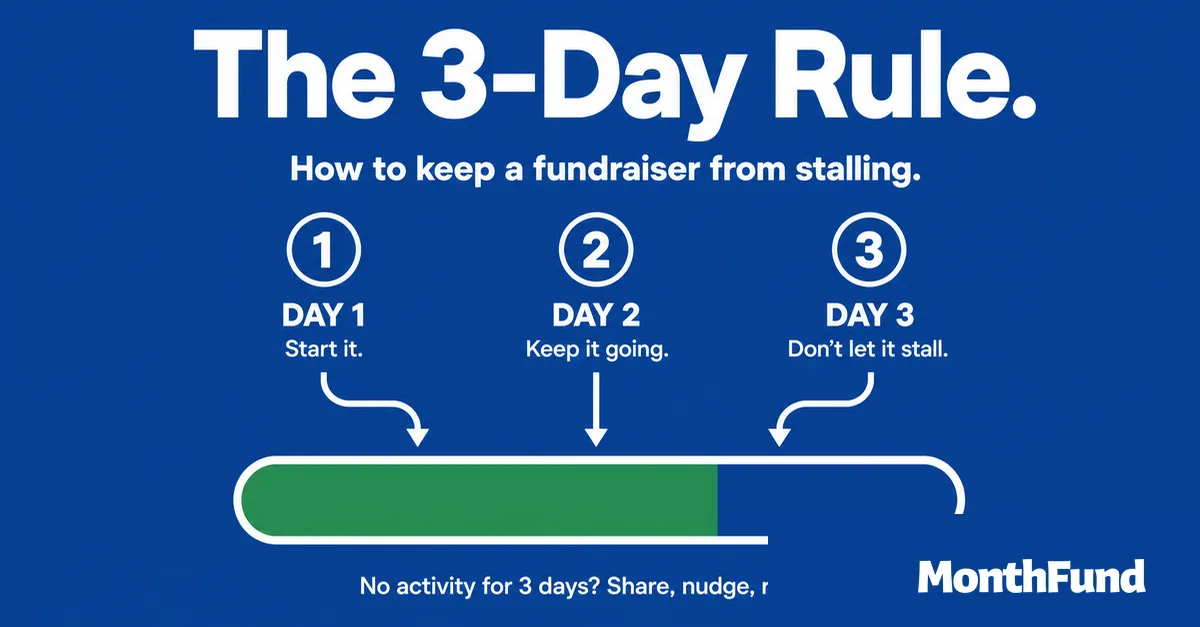
Most fundraisers do not fail. They stall. The launch goes fine, the first week fills a handful of days, and then the campaign goes quiet while everyone waits for it to finish itself. The 3-Day Rule is the simplest fix we know: if nothing has happened on your campaign for three days, you make one move that day.
“Watch one signal: days since the last donation or share. At three days of silence, act the same day with one of three moves: share the campaign somewhere new, nudge one participant personally, or spotlight a donor publicly. Small, same-day interventions keep a month alive far better than one big mid-campaign push.”
Every organizer knows the shape of a stalled campaign. Days one through five feel great. Then the graph flattens, the group chat moves on, and by day twelve the calendar looks exactly like it did on day seven. Nothing went wrong. Nothing happened at all, and that is the problem.
The good news: stalls are visible days before they matter, and the fix is almost never a dramatic relaunch. It is one small action, taken on time.
Why fundraisers stall
Launch week spends your easy attention. The people who were already primed to give do, and then the campaign is competing with everything else in everyone's feed. A calendar fundraiser has a built-in advantage here, because a public grid shows exactly what is done and what is not. But the grid only helps if people look at it, and after a few silent days, they stop looking.
The 3-Day Rule
The rule has one trigger and one obligation.
Trigger: three days with no donation, no new share, and no public update on your campaign.
Obligation: one move, made the same day you notice. Not a strategy meeting. Not a rewritten plan. One share, one nudge, or one spotlight, today.
Three days is the right window because it is long enough to skip weekends and normal lulls, and short enough that the campaign still feels alive when you act. A stall caught at day three needs one text. A stall discovered at day ten needs a rescue.
How to spot a stall early
You cannot apply the rule to a campaign you cannot see. On a dashboard with live fill rates, the check takes ten seconds a day: has anything changed since yesterday? If you are tracking by hand, put a two-minute daily reminder on your phone. What you are watching is not the total raised. It is the date of the last event.
One number to watch
Three moves that restart momentum
Share somewhere new. Not the same link in the same channel. A new place: the neighborhood group, the workplace Slack, the alumni list. Name specific open days when you do. "The 14th and the 21st are still open" outperforms "please support us" every time.
Nudge one participant. In a multi-participant campaign, momentum stalls person by person. Find the calendar that has gone quietest and send its owner a personal, friendly message with one concrete ask: "Could you text two people today about your open days?" One re-activated participant often restarts the whole board.
Spotlight a donor. Publicly thank the most recent giver by name, with the day they claimed. Gratitude is the only campaign content that never wears out, and every thank-you is also an advertisement that the campaign is alive and being seen.
If you need the exact words for any of these, the 21 message templates cover launch, nudge, and thank-you scripts you can copy directly.
A week-by-week rhythm
The 3-Day Rule is the floor, not the plan. A healthy month still follows the standard cadence: personal outreach in week one, a public milestone in week two, open-day callouts in week three, and a countdown finish in week four. The week-by-week playbook covers each checkpoint. The rule exists for the gaps between those beats, which is where campaigns actually die.
Next steps
Set the goal before the month starts with the 31-day goal method, then run the month where you can see it. A free MonthFund campaign gives you live fill tracking and per-participant activity, which turns the 3-Day Rule from a guess into a ten-second daily check.
How much can your community raise?
Use our interactive calculator to model your potential outcomes based on participant count and fill rate.
Ready to launch?
Set up your first fundraiser in under 10 minutes. No credit card required.
Common Questions
Why do fundraisers lose momentum?
Because attention decays faster than campaigns run. Launch week reaches everyone who was already primed to give. After that, the campaign only moves when someone actively puts it back in front of people. Silence reads as completion, so supporters assume the moment has passed.
What is the 3-Day Rule in fundraising?
A monitoring habit: if three days pass with no donation, no new share, and no public update, the organizer makes one move that same day. The move is small: share the link somewhere new, personally nudge one participant, or publicly thank a recent donor. The rule works because it catches stalls at day three instead of week three.
How do you restart a stalled fundraiser?
Give people a specific, time-boxed reason to look again. Name the open days rather than the total ("the 14th and 21st are still open"), set a mini-deadline ("we want the first row done by Friday"), or announce a match. A specific ask restarts action; a repeated general ask does not.
How often should you post about a fundraiser?
Two to three times a week on social, and every post should be different: a launch, a milestone, a thank-you with names, a call for specific open days, a final countdown. Direct personal messages do more work than any public post, so budget most of your energy there.
Keep Exploring
View all posts →Can Schools Use Stripe for Fundraising? Start With the District
MonthFund cannot currently mail fundraiser checks. Learn how a school or district may approve Stripe, who should own the account, what the business office needs, and which real schools already use Stripe for selected payments.
School fundraiser approval guide: budget, payments, and privacy
A principal or PTA board needs more than a catchy idea. This approval packet covers purpose, budget gap, payment flow, privacy, parent communications, and closeout before the campaign reaches families.
How calendar fundraisers fit with galas, catalogs, and other fundraising (toolkit, not replacement)
MonthFund is one powerful layer in a larger toolkit. See how a calendar month complements product sales, ticketed events, and open donate pages, with patterns you can use around a 5K or gala.