
Free Fundraising Platforms: Donor Tips & Real Costs

A fundraising platform can be genuinely free to a nonprofit while asking donors to contribute separately to the platform. The useful question is not only whether the software is free. It is who pays, how much they pay, and whether everyone can see where the money goes.
“Free to the organization can still mean an optional platform contribution, deducted processing cost, or an estimated fee-cover choice for the donor. The right model is the one your team can explain clearly, including the gift, any extra amount, the total charge, and what reporting actually shows.”
Fee policies and stated-fee examples reviewed October 22, 2026. Examples below are illustrations, not industry-average tip amounts or quotes for every account.
What does “free fundraising software” mean?
“Free” can mean no subscription, no platform fee, or no charge to the nonprofit while donors contribute separately to the provider. None eliminates actual costs; they shift who pays and how. Understanding your platform's model helps you explain it honestly to supporters. For a full picture of how calendar fundraising works, start with the basics before comparing fee structures.
A provider may charge no subscription but take a platform fee from donations. It may charge no platform fee while deducting payment-processing costs. Or it may charge the nonprofit neither of those fees and fund its service through optional contributions from donors.
Zeffy, for example, says voluntary donor contributions fund its platform and processing costs. Under its published model, the nonprofit receives the intended donation even when a donor contributes $0 to Zeffy. That can be a real benefit for a small organization. It is also a separate decision for the donor: their contribution to Zeffy supports Zeffy, not the campaign. [1]
A fair comparison should acknowledge both facts. Free to the nonprofit does not necessarily mean the donor pays nothing beyond their gift. But an optional contribution is not a mandatory fee.
A platform tip is not an extra donation to your cause
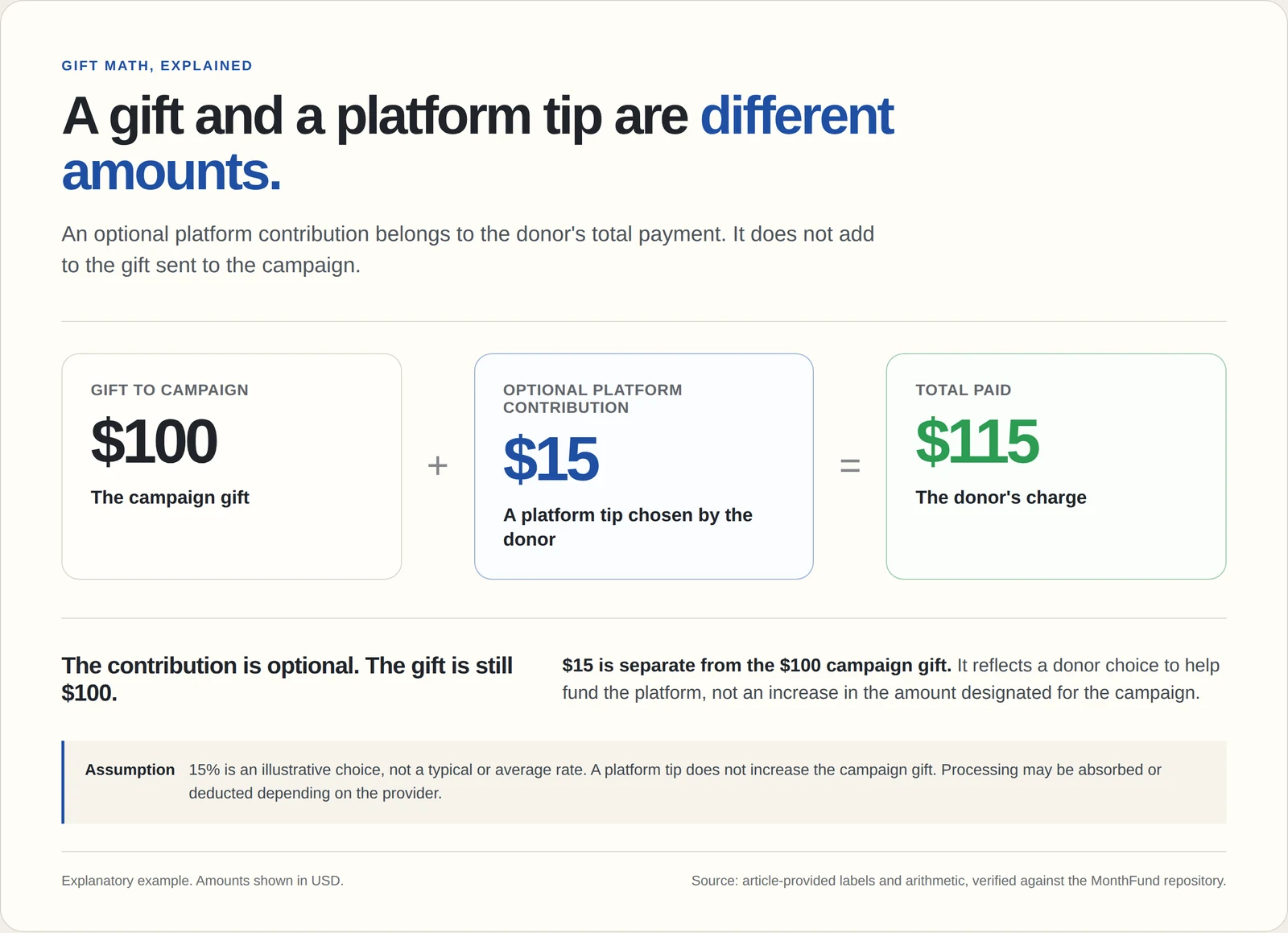
A voluntary tip to a fundraising platform supports the software provider, not your campaign. If a donor pays $115 and $15 goes to the platform, the campaign still receives $100. That distinction is easy to miss when amounts appear together at checkout. For more on how platforms monetize, see how fundraising platforms make money.
A supporter may understand that they are helping the software provider. They may also assume that an extra amount benefits the organization or simply covers its processing cost. Clear labels matter because those are different choices.
GoFundMe describes its tips as voluntary contributions to GoFundMe and says transaction fees are deducted from donations. Zeffy says its contributions fund the platform and the processing it covers. Givebutter Standard has another arrangement: on eligible tip-enabled online transactions, donors can choose a platform tip and processing coverage, while Givebutter absorbs uncovered fees. [1] [2] [3]
There is no single tipping model, and there is no single processing rate that applies to every provider, account, currency, or payment method.
Why can smaller donations show higher suggested contributions?
Some platforms suggest a higher percentage on smaller gifts because fixed processing costs represent a larger share of a small donation. But a suggested percentage is not an average paid. Donors can adjust or decline the contribution. Zeffy's help center says its suggested contribution percentage changes with the transaction amount: larger donations have a lower suggested percentage (Zeffy, accessed Oct 2026). It also says organizers cannot customize the contribution wording or suggested dropdown amounts, although they can explain the model elsewhere on their form. [1]
That means a supporter making a small gift may encounter a higher suggested percentage than someone making a large gift. It does not mean the smaller donor is required to pay it. Donors can change the contribution, including to $0. [1]
There is a practical reason to compare both dollars and percentages. A fixed processing charge makes up more of a small gift than a large one. But a provider contribution can support more than processing alone, including the software and costs of serving organizations whose donors do not contribute. It should not automatically be treated as the exact card fee on that particular gift.
Also separate three figures: the suggested contribution, the contribution a donor chooses, and the average contribution actually paid. A screenshot can establish the first. It cannot establish the third.
In a June 2023 article, Zeffy reported that contributors gave an average of 4%. That is an older provider-reported figure, not a verified current average. It is a useful reminder that a high suggestion does not prove donors pay that amount on average. [4]
Can organizers see what donors paid to the platform?
Not always. Some platforms do not show organizers whether donors added a tip. GoFundMe explicitly states organizers cannot see tip amounts (GoFundMe, accessed Oct 2026). This means the campaign total may not reflect the supporter's full outlay. Ask your provider what appears in exports and whether platform contributions are visible. [2]
Reporting differs by provider, so ask a specific question: “Does our export include the donor's gift, their separate platform contribution, their total charge, and the amount our organization receives?”
Refund handling is another useful test. Zeffy says refunding a donation does not automatically refund the donor's voluntary contribution to Zeffy. The nonprofit cannot refund that contribution independently; the donor requests it from Zeffy through their receipt. That does not make the contribution wrong. It shows that the campaign gift and provider contribution are separate payments with separate handling. [5]
An organizer should understand that distinction before a donor asks about a receipt or refund.
What should organizers check on recurring gifts?
Verify whether platform contributions repeat each month and what the total recurring charge is. A checkout label like “monthly” does not confirm whether extra amounts apply once or every payment. Before promoting monthly giving, check the donation amount, the total recurring charge, and whether any platform contribution applies only to the first payment or to later payments too. Confirm the answer in the recurring-payment terms and receipts.
For example, if a $25 monthly gift includes a $4.25 platform contribution every month, the supporter spends $29.25 per month. Over 12 payments, that is $300 to the campaign and $51 to the platform, for $351 total. This is illustrative arithmetic, not a claim that every Zeffy recurring gift has that contribution or schedule.
Zeffy's donor instructions include an “Adjust tip” control for the optional contribution added when the donor first gave. Its monthly-giving guide also explains recurring receipts and donation management. Organizers should show supporters how to find those controls and verify what applies to their own recurring arrangement. [6] [7]
The simple question is: “What amount will leave the donor's account each period, and what portion supports our campaign?”
What effect can platform contributions have on donors?
An unexpected extra amount can make donors pause or reduce their intended gift. If a donor has a fixed budget, money paid to a platform is unavailable for the cause. Misunderstanding can also create disappointment if supporters think extra amounts benefit the organization. But not every tip displaces a donation—research shows presentation matters as much as amounts.
Someone who planned to give a particular amount may pause when the total increases. If they have a fixed giving budget, money contributed to a platform is not available for the cause within that same budget.
A misunderstanding can also create disappointment. If a supporter thought an extra amount increased their campaign gift, learning that it went to the software provider may lead them to question the organizer, even though the organizer did not receive it.
Those are possible effects, not outcomes every donor experiences. We should not assume every tip displaces a donation, every donor feels pressured, or every platform tip reduces future giving.
Research from ideas42 and Every.org illustrates why presentation matters. Their case study described a 15% default platform-contribution slider. Clearer, positive messaging increased the share of donors leaving a contribution and was associated with more subsequent giving in that experiment. That is not evidence that all tip prompts are good or bad. It shows that how the choice is explained can affect behavior. [8]
GoFundMe also offers refunds for unintentional tips. That acknowledges accidental contributions can happen, but does not establish how common they are. [9]
The organizer's job is to protect an informed choice: explain the recipient of each amount, make optional amounts easy to change, and avoid treating a donor who declines an extra contribution as less generous.
How do established fundraising tools make fees visible?
Several major tools publish their fees and provide net-payment reports. Donorbox, Bloomerang Fundraising, and Blackbaud all document charges and offer exports showing donation amounts, fees, and net proceeds. Their products and costs are not identical to MonthFund, but their reporting practices show what transparency can look like. For platform comparisons, see are free calendar fundraiser platforms really free.
| Platform | Fee model | Donor fee cover | Net-amount reporting |
|---|---|---|---|
| Zeffy | Voluntary donor contribution | Contribution covers platform + processing | Org receives full gift even if $0 contribution |
| GoFundMe | Transaction fee + voluntary tip | Tip supports platform; fees deducted from gift | Organizers cannot see tip amounts |
| Givebutter | Standard: tip + processing option | Tip and processing coverage; uncovered absorbed | Varies by plan |
| Donorbox | Plan-dependent platform + processing | Estimated cover includes platform + processor | CSV shows donated, fees, net |
| Bloomerang | Subscription + processor-dependent | GiftAssist depends on processor config | Fee statements with net amounts |
| Blackbaud | Solution/currency-specific schedules | Donor cover + Complete Cover option | Reports show donor-paid, provider-paid, fee amount |
| MonthFund | Published rates (3%/2%/0%) + Stripe | Optional estimated cover, starts unchecked | Base, Extra, Fees, Total in reports |
Donorbox separates platform and processing costs
Donorbox publishes plan-dependent platform fees alongside payment-processing information. Its pricing page distinguishes fundraising features, payment methods, and account circumstances rather than offering one rate for every transaction. [10]
Its donor fee-cover calculation includes the applicable platform fee and an estimated processor rate. Donorbox cautions that the actual amount received can differ when the account's processing rate differs from the estimate. Its Donations CSV can show the donated amount, fees, and net amount after fees. [11] [12]
The useful lesson is that a published rate, an estimated donor add-on, and the final net amount are three related but different numbers.
Bloomerang Fundraising documents fee statements and net amounts
Bloomerang Fundraising, formerly Qgiv, combines subscription pricing with processor-dependent transaction arrangements. GiftAssist gives donors a way to add support toward costs; its behavior and rates depend on the configured processor and fundraising feature. [13] [14]
Its transaction and fee-statement documentation includes net amounts and fee fields, so an organizer can review charges rather than infer them from a campaign total. [14] [15]
The useful lesson is to ask for the fee statement as well as the fundraising report.
Blackbaud distinguishes donor-covered and provider-paid fees
Blackbaud Merchant Services publishes schedules that vary by currency, payment method, and Blackbaud solution. It also offers donor-selected fee coverage and, for eligible transactions, Complete Cover, where Blackbaud pays fees even when the donor does not contribute. [16] [17]
Its reporting documentation includes fields such as donor-covered fees, Blackbaud-paid fees, and fee amount. [18]
The useful lesson is that fee coverage can have different funding sources. A clear report should distinguish what the donor paid from what the provider paid and what was deducted from the gift.
How does MonthFund approach donation costs?
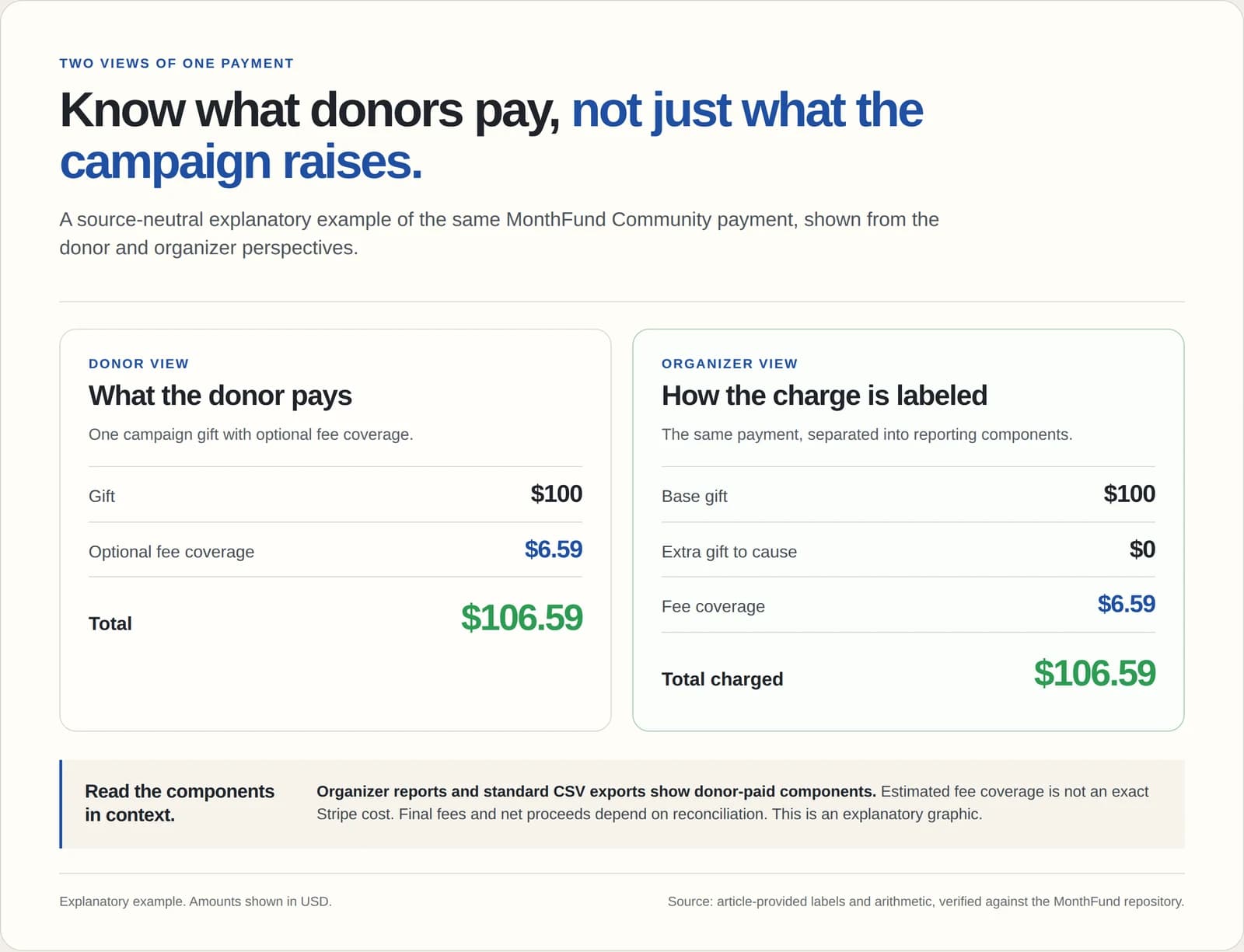
MonthFund publishes default rates (3% Community, 2% Professional, 0% Network) and offers optional estimated fee coverage that starts unchecked—not a separate platform tip. Donors see the base gift, any extra donation to cause, fee coverage, and total before payment. Campaign reports show those same components. See Fees and Transparency and Pricing for current public plan details.
Personal has a 5% platform fee with no monthly subscription. Stripe processing is separate on all plans, including Network.
Community is free to launch. Our aim is to give smaller organizations access to the tools for a strong fundraiser. Professional adds capacity and tools for organizations handling greater complexity, rather than making basic donor-payment visibility the reason to upgrade.
Donors can choose to add a calculated amount toward fees. It starts unchecked. The suggestion combines the applicable MonthFund rate with estimated card processing and accounts for fees on the additional amount itself. It is not a request for a separate 10%, 15%, or 20% platform tip. See how optional fee coverage works.
Before payment, the donation summary shows the base gift, any additional gift to the cause, optional fee coverage, and total charge. Organization campaign reports and standard donation exports show those donor-paid components too. That does not mean the estimated cover equals every final processing charge. Final fee and net-payment accounting depends on reconciliation and is not all shown in the ordinary campaign ledger.
One $100 gift, three different arrangements
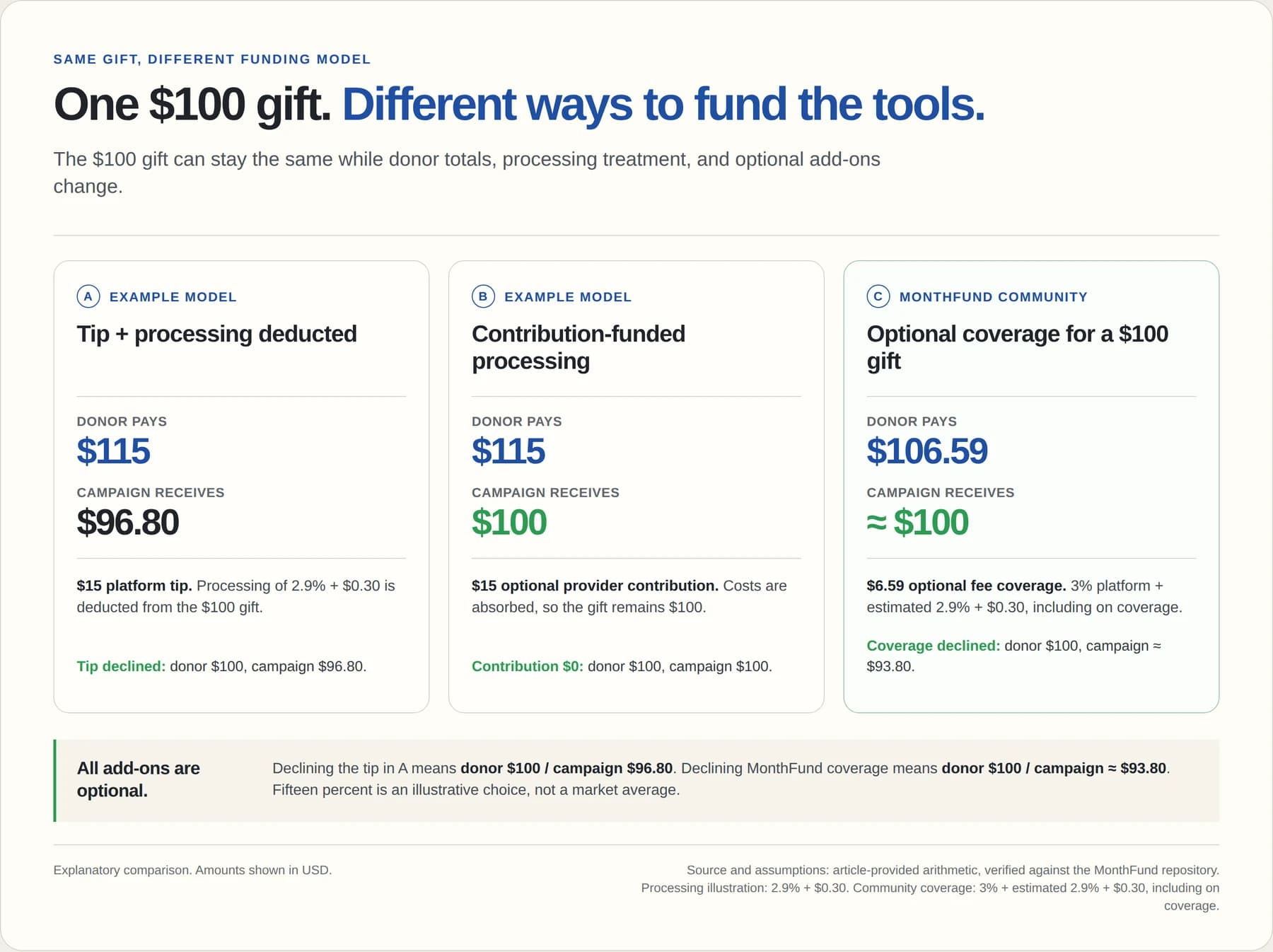
A platform tip with processing deducted: A $100 gift plus an illustrative $15 tip means the donor pays $115. At a processing charge of 2.9% plus $0.30 deducted from the gift, the campaign receives $96.80. The tip supports the provider, not the campaign.
A contribution-funded platform that absorbs processing: A $100 gift plus an illustrative $15 platform contribution also means the donor pays $115. The campaign receives $100. Under a model that absorbs costs even without a contribution, the campaign still receives $100 when the contribution is $0.
MonthFund Community with optional fee coverage: The current calculation suggests $6.59 for fees, for a total payment of $106.59. It is designed to leave approximately $100.00 for the campaign using a 3% MonthFund rate and estimated processing of 2.9% plus $0.30. Actual processing costs and rounding can differ. Read the $100.00 Community illustration.
All of these add-ons are optional in these examples. Without MonthFund fee coverage, the donor pays $100 and the campaign receives approximately $93.80 under those processing assumptions. Without the platform tip in the processing-only example, the donor pays $100 and the campaign receives $96.80.
MonthFund is not always the lowest-cost option. Its distinction is a stated rate, a calculation-based optional cover, and visibility into the donor-paid amounts. A larger checkout total does not necessarily produce a larger campaign gift.
What should organizers ask before choosing a platform?
Test the donor checkout yourself before committing. Walk through a small gift, a large gift, and a recurring setup. Note what extra amounts appear, whether they start selected, and whether you can explain them to your supporters. For a side-by-side comparison of calendar fundraiser platforms, see the best calendar fundraiser platforms in 2026.
Then ask these questions:
- Who receives each additional amount, and can the donor set it to $0?
- Can we change the wording or suggestion, or explain it on the form?
- What happens to processing costs when a donor declines the extra amount?
- What repeats on a recurring gift, and how can the donor change it?
- Can we see the full donor payment, fee components, and final net proceeds in reports?
- If the donation is refunded, is the provider contribution refunded too?
You do not need to reject a tip-supported model to ask those questions. You need enough information to explain it honestly to your community.
How should you choose a fundraising platform?
The best platform is one you can explain honestly to your supporters. Choose a tool where you understand who pays what, what the donor sees, and what your reports show. That matters more than a “free” headline. Your community already gives its time and care—respect that by making the money understandable too.
Your community already gives its time and care. Respect that by making the money understandable too.
See MonthFund's fees and transparency or compare plans.
References
- Zeffy contribution model, variable suggestions, and organization controls (accessed Oct 2026)
- GoFundMe transaction fees, platform tips, and organizer visibility (accessed Oct 2026)
- Givebutter Standard pricing and eligible fee coverage (accessed Oct 2026)
- Zeffy June 2023 contribution model and reported average (accessed Oct 2026)
- Zeffy voluntary contribution refunds (accessed Oct 2026)
- Zeffy donor recurring-payment and tip controls (accessed Oct 2026)
- Zeffy monthly donation scheduling and receipts (accessed Oct 2026)
- Every.org and ideas42 behavioral tipping study (accessed Oct 2026)
- GoFundMe voluntary tips and unintentional-tip refunds (accessed Oct 2026)
- Donorbox published pricing (accessed Oct 2026)
- Donorbox estimated fee-cover calculation (accessed Oct 2026)
- Donorbox donation fees and net-amount CSV (accessed Oct 2026)
- Bloomerang Fundraising pricing (accessed Oct 2026)
- Bloomerang GiftAssist and transaction reporting (accessed Oct 2026)
- Bloomerang Fundraising fee statements (accessed Oct 2026)
- Blackbaud currency and payment-specific fees (accessed Oct 2026)
- Blackbaud donor and provider fee coverage (accessed Oct 2026)
- Blackbaud fee reporting fields (accessed Oct 2026)
How much can your community raise?
Use our interactive calculator to model your potential outcomes based on participant count and fill rate.
Ready to launch?
Set up your first fundraiser in under 10 minutes. No credit card required.
Common Questions
Is Zeffy really free for nonprofits?
Under Zeffy's published model, it charges no platform or processing fees to the nonprofit and the organization receives the intended donation even when a donor contributes $0 to Zeffy. Separate voluntary contributions fund the provider's software and processing costs.
Does a platform tip go to the nonprofit?
A tip or voluntary contribution to a platform supports the provider, not the campaign. An extra amount designated as a donation to the cause is different. Check the provider's labels and receipt.
Does tipping replace payment-processing fees?
Not on every platform. Some deduct processing costs from the gift while inviting a separate tip. Others absorb processing through voluntary contributions or eligible fee-cover programs.
Is 10% to 20% the average platform tip?
The sources in this guide do not establish an industry-wide average. Published suggestions and observed defaults are not the same as average contributions actually paid. The 15% examples in this guide are illustrations.
Can organizers see donor platform tips?
It depends on the provider. GoFundMe says organizers cannot see whether donors leave tips. Ask what appears in your platform's donation ledger, export, and payment reports.
Does MonthFund use platform tips?
MonthFund's donation checkout uses a stated platform rate and optional estimated fee coverage, not a separate platform tip. Donor and organizer views distinguish the gift, any extra support for the cause, fee coverage, and total.
Keep Exploring
View all posts →Are Calendar Fundraiser Donations Tax Deductible? A Donor Guide
Learn how organizers should disclose 501(c)(3), fiscal sponsor, informal, or personal status so donors can check recipients, benefits, and gift records.
How to Close Out a Digital Calendar Fundraiser
Use a practical closeout sequence for receipts, gratitude, lessons learned, and a thoughtful next campaign after the final day is claimed.
How calendar fundraisers fit with galas, catalogs, and other fundraising (toolkit, not replacement)
MonthFund is one powerful layer in a larger toolkit. See how a calendar month complements product sales, ticketed events, and open donate pages, with patterns you can use around a 5K or gala.